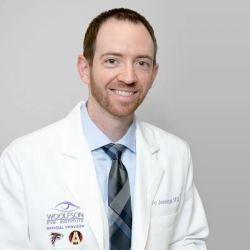
 Dr. Eric Jennings is the Medical Director of Ophthalmology at ModMed, a healthcare technology company that builds specialty‑focused electronic health records and AI solutions to streamline clinical workflows. In this role, Dr. Jennings shapes ophthalmology content, informs product design, builds front‑end features, and helps steer ModMed’s AI efforts to better support clinicians and patients. He is also a board‑certified ophthalmologist specializing in cataract surgery, refractive surgery (LASIK), and corneal and external disease at the Woolfson Eye Institute.



Here’s a glimpse of what you’ll learn:
- [03:05] Dr. Eric Jennings explains why doctors need a bigger voice in EHR innovation
- [09:59] Can AI make healthcare more personal by improving clinician-patient interaction?
- [11:54] AI’s future in diagnostics and personalized medicine
- [15:02] The impact of AI on imaging in ophthalmology and how radiology is leading the way
- [17:57] Practical steps for clinicians to start adopting AI today
- [26:31] How AI will educate, communicate, and empower patients through personalized education and communication tools
In this episode…
In the evolving world of healthcare, innovation is key. But how does the future of eye care look when technology like AI becomes more integrated into daily practices? As the demand for efficiency grows, will AI become a reliable partner or a replacement for the human touch?
According to Dr. Eric Jennings, a leading ophthalmologist and advocate for AI-driven solutions, the future of healthcare is a delicate balance of technology and human interaction. He believes that AI, especially in the form of AI-powered scribe technology, can help doctors be more present with patients by handling mundane administrative tasks. This not only reduces burnout but also allows for more personalized care, making time for what truly matters — patient interaction.
In this episode of the Cleinman Connect Podcast, Dr. Trevor Miranda is joined by Dr. Eric Jennings, Medical Director of Ophthalmology at ModMed, to discuss the evolving role of AI in the eye care industry. They dive into how AI is changing workflows, improving accuracy in diagnostics, and the long-term implications of its integration into practices. Dr. Jennings also shares insights into the AI-powered tools shaping the future of healthcare, from AI scribes to personalized patient care.
Resources mentioned in this episode:
- Kevin Wilhelm on LinkedIn
- Marketing4ECPs
- Cleinman Performance Partners
- Dr. Trevor Miranda on LinkedIn
- Dr. Eric Jennings on LinkedIn
- ModMed
- Scribe
Quotable Moments:
- “We’re very comfortable with things, but this time seemed different. ModMed took a forward-thinking approach.”
- “We as doctors have a lot going on, and so we don’t want to have to just copy and paste text or do all those other tasks.”
- “The less I need to focus on documentation and ancillary tasks, the more personal I can be.”
- “AI is poised to help with things like clinical decision support based on image analysis.”
- “AI does and will help with everything. It’s going to have its fingers in everything: documentation, billing and coding, analytics, patient communication.”
Action Steps:
- Integrate AI-driven tools into your workflow: Leveraging AI tools, like scribes, enhances efficiency and reduces administrative burdens, allowing for more focus on patient care.
- Foster continuous AI learning: Regularly update your AI systems to adapt to evolving clinical practices, ensuring better decision support and accurate diagnostics.
- Encourage physician involvement in tech development: Involving doctors in the creation of AI tools ensures that the technology aligns with real-world medical needs and challenges.
- Promote interdisciplinary collaboration: Working across departments in health tech development fosters innovation and improves the integration of AI into clinical settings.
- Prioritize patient-centered AI applications: AI should enhance the patient experience by improving communication, education, and accessibility, resulting in better engagement and outcomes.
Sponsor for this episode…
This episode is brought to you by Marketing4ECPs!
Working with them is like hiring a full-time marketing professional who knows the industry and understands your goals. Except, instead of one experienced marketer, you get a whole team in your corner.
Whether you’re an optometrist, ophthalmologist, or optician, they can help you grow your business with a plan that’s completely customized for you. Learn more here.
Powered by Rise25 Podcast Production Company
Episode Transcript
Intro: 00:00
Welcome to Optometrist Unleashed, a Cleinman Connect Podcast with Dr. Trevor Miranda, a monthly doctor led discussion about everything surrounding the business of optometry.
Dr. Trevor Miranda: 00:15
Hello, I’m Dr. Trevor Miranda, and I’m your host on this episode of Optometrist Unleashed for the Cleinman Connect Podcast. This episode is brought to you by Marketing4ECPs. Working with them is like hiring a full time marketing professional who knows the industry and understands your business goals. Except instead of one experienced marketer, you get a whole team in your corner. Whether you’re an optometrist or ophthalmologist or optician, they can help you grow your business with a plan that’s completely customized for you. Learn more at marketing4ecps.com. That’s marketing4ecps.com,
I’m joined today by Dr. Eric Jennings, an experienced ophthalmologist working in a high volume, cutting edge surgical practice skilled in medical and surgical care, including cornea, external disease, refractive surgery, laser assisted cataract surgery, advanced technology, iols, and AI based solutions. He is the Medical Director of Ophthalmology at a Multispecialty full service EHR solution and works across departments engaging with the product management, sales, marketing and development teams. Welcome to Cleinman Connect, Dr. Eric Jennings.
Dr. Eric Jennings: 01:31
Thank you, Dr. Miranda, thanks so much for having me. What an introduction. I appreciate it. So nice to be here.
Dr. Trevor Miranda: 01:36
Well, we’re really great to have you. And we want you to share your journey from ophthalmology into health tech world. And how did that lead to your current work at ModMed?
Dr. Eric Jennings: 01:49
Sure. You sort of got through a lot of it. I’m a cataract, cornea and refractive surgeon. I practice in Atlanta, Georgia. I’ve been out of my fellowship training for about ten years.
You know, I already always had an inclination towards technology, especially in the world of eye care, where we love our toys and technology is already a part of how we practice. So I guess my journey started maybe mid-career. I was invited to be a consultant with some of the large leading ophthalmic device companies, and through that I really enjoyed the collaboration. I enjoyed trying new things, things that perhaps aren’t fully built yet, and I enjoyed providing feedback and frankly, being part of the innovation. So I said, you know, this is really cool stuff.
It’s nice to be part of this. So that kind of steered me in the sort of the world of health tech, not just as a user, but potentially being even more than that.
Dr. Trevor Miranda: 02:45
Yeah, it’s great to have, you know, physicians in the trenches be able to direct the medtech to do what we really need to help us. And what would you say inspired the AI integration part of healthcare? I know AI is super hot right now. How did you start thinking about AI as part of your journey?
Dr. Eric Jennings: 03:05
I think I started back in 2020. There was a little thing that happened called the pandemic, and it kind of dovetailed into what I do now. But I realize as much as I love patient care, as you alluded to, I felt like doctors need to have a bigger role in the decisions that shape our work, specifically in the EHR and technology spaces. So rather than just dealing with what we’re given, I kind of wanted to say so in building it and working upstream. So I started getting more involved.
And if you fast forward to, I guess, 2023, the medical director opportunity at ModMed was available and I took advantage. And so you kind of alluded to a lot of my roles, including I actually do some of the coding into the software. I do the XML and JavaScript right into it. So I’m a, I guess, a pretend developer for all the real developers listening. I really respect what you do.
But a couple years ago, everything kind of shifted towards AI. There was this feeling, you know, ChatGPT came out. There’s a lot of AI stuff, if you will, and we all saw it coming. But medicine and healthcare have always been behind in adopting anything new, right? Doctors have a if it ain’t broke, don’t fix it type approach.
We’re very comfortable with things. But this time seemed different. ModMed, who I work for, took a forward thinking approach and jumped on it. Right. We’re full speed, so we’re kind of leading the charge with all these AI innovations.
I had this interest because I see it as sort of the future as to what we’re doing. And back to the original thought. I would rather have a say in how it’s used and how it will influence my my job, my career, how I take care of patients. And so that was the next logical step. And frankly, it’s been very exciting.
Dr. Trevor Miranda: 04:53
That’s super exciting. I have a real live Chairside scribe, which I not all of my colleagues do, but I can’t. I feel like if that scribe sick or I don’t have it, I feel like a little bit lost. For my day. So I can see how helpful you know, an actual scribe is.
Can you tell me a little bit about the A scribe technology that you’re working on?
Dr. Eric Jennings: 05:17
So our AI scribe technology is slightly different. Basically what you may be familiar with or that your listeners, an AI scribe is just speech to text. If you have an iPhone, if you have an Alexa, a lot of things do speech to text pretty well. And then in the medical field, what it does is it’ll take all of your text that you just spoke about, and it can classify it for you. It can put it into paragraphs.
Right. Chief complaint. Why the patient’s here. Your your exam your impressions or assessment and plan. Right.
A lot of people are familiar with the Soap note so it can categorize that. But that’s sort of where the AI part ends. What I in a biased fashion love about ModMed in our EMR is called Emma is. We rely on structured data. So the stuff that you input into the EMR has downstream functions prescriptions, orders.
Testing interpretations, visit billing and coding. It all does things for you downstream. So that’s what we’ve leveraged with our own AI. Our AI is built internally. It’s native, so we’re building it ourselves.
It’s not a bolt on, which I think makes it very powerful. But not only does only the AI take your speech to text, but it goes a step further and it’ll have that prescription ready for you. It’ll interpret the Oct for you. It builds and codes for you. We as doctors have a lot going on, and so we don’t want to have to just copy and paste text or do all those other tasks.
We want the AI to do it for us. That’s the whole idea. So that’s what I’m super proud of with our tool, that maybe a little bit different than what some of the AI scribes are available right now.
Dr. Trevor Miranda: 06:57
And Dr. Jennings. Is it learning your tendencies and how you say things, and is it sort of adapting to your style as time goes on? Do you have to say the prescription out loud? For instance, you have to read the numbers that you get.
Dr. Eric Jennings: 07:11
So we have our solution is ambient listening. So what’s really powerful about this is it doesn’t even need to learn your tendencies. It listens to a doctor patient interaction. And what we’ve done and trained it on is natural conversation. So you just talk to your patient.
You talk about the dry eye. Yeah. You know it looks like it’s it’s it’s gotten a little worse. We got a test today that showed some irregular astigmatism. We’ll go ahead and increase your restasis.
You don’t have to do more than that. The system is smart enough to know what that means. And that was one of the benefits of having on staff practicing physicians at ModMed, as we can actually teach it the nuance of clinical practice. So you don’t even need to do that. It already does it for you knowing what you’re saying, but it is a listening tool.
so it unfortunately can’t read your mind. You do have to say what you want it to do, but as you mentioned, you have a scribe, so it can’t really watch what you’re doing. But as long as you’ve discussed it with your patient, which I think we all strive for better patient education, the AI component will do its job.
Dr. Trevor Miranda: 08:15
Right. And I guess you’ve got other technologies to draw from. For instance, a phoropter. If you have an actual spectacle or ax, it can it can take it in, create an order, create the restasis in your example prescription for the patient, maybe send it to the pharmacy, that type of thing.
Dr. Eric Jennings: 08:30
Yeah. Which you mentioned first the the pretesting. So we in our system we call it pretesting. So visual acuities refraction manifest refractions. We are building that functionality out.
But again it’s going to have to be spoken because it’s a listening tool, which you’re alluding to is a sort of a side project that goes beyond AI as interoperability. We at ModMed, as a side comment, want to be able to plug and play with any device, and you really don’t need AI for that. That’s just the two devices or the device in either speaking the same language. And we sort of pioneered those interoperability discussions with some large vendors to where it doesn’t matter what device it is or frankly, what EMR is. We all want to plug and play because as a doctor, I don’t want to have to be typing things in.
But perhaps you don’t even want to have to call out the prescription. So with our AI solution, you will be able to. But yes, it would be wonderful if no matter what device you use, I can extract or import those discrete data which in our platform we have a box and everything so that you can use that later on.
Dr. Trevor Miranda: 09:35
Yeah. That’s awesome. I know some of you know, our colleagues might wonder, are we depersonalizing healthcare or I care when we start using technology like AI? You know, I’m of the opposite opinion. I think it allows a better touch point instead of me turning to type or have, you know, turning my face from the patient, I get this connect time this human touch.
What are your thoughts?
Dr. Eric Jennings: 09:59
I totally agree with you, but I also see the concern, right? That the more technology we implement that, the less personal the exam and the interaction is going to be. But I’m in the mindset of that. This should re analyze the interaction with an AI listening tool that it doesn’t matter if I talk about the weather, the football game, it doesn’t matter what’s going on. I can actually have another conversation with my patient.
That’s why I went into medicine to talk to them, listen to their concerns and not worry if I miss an exam finding, not worry if I’m getting the right visit code because we look at the eye. But then if we have to turn a document sometimes I found myself saying, hang on a second, let me type all this down so I don’t forget. Well, now you don’t have to worry about that. Now. What we do have to look out for is, as AI does make us more efficient, does that mean that you can now add ten more patients to your schedule?
Maybe. But as a direct impact, the less I need to focus on documentation and ancillary tasks, the more personal I can be, and the less I have to worry about all the other stuff that doesn’t involve direct patient care.
Dr. Trevor Miranda: 11:08
Absolutely. That’s really insightful. I want to go a little bit beyond scribes. We’ve actually in our practice, we’ve taken an enterprise version of ChatGPT. We’ve called it Rover and sort of quote unquote trained it.
This is the anagram of Trevor. So Trevor backwards is Rover. And Rover. It’s actually quite remarkable. It’s listen to my podcast and my articles and our standard operating procedures and you know, culture book and everything.
And we’ve divided it into little subsets. Dry eye Rover, for instance. It can be even patient facing where you ask it, you know, what are these treatments lipiflow and restasis and such. But I wondered what your thoughts are on what the future of AI in terms of diagnostics and personalized care. What’s what’s coming down the pike?
Dr. Eric Jennings: 11:54
I think a lots a lots coming down the pipe, so I kind of break it down maybe in my head as there’s clinical and there’s operational. First of all, that’s a phenomenal name for a tool. I love that in a clinical sense. You know, if we’re talking a little bit differently than scribes, there’s things like image analysis. There’s things called clinical decision support.
And I will speak a little tactfully here. AI is poised to help with things like clinical decision support based on image analysis based with coupled with other data, right IOP, macular thickness, CCTV, and the most recent studies. Glaucoma is a perfect example, right? It’s teed up for clinical decision support, which means something that helps the clinician figure out what to do next, whether it’s medication, surgery, procedures, whatever it is. I’ll say that big companies are hesitant to pull the trigger because there’s a little bit of an unknown landscape of regulation compliance.
And to be blunt, the medical legal ramifications of using these tools. But it’s naive to think that it’s not coming right. And this would then lead to things like personalized treatment. AI can digest a ton of information about an individual. That’s what it’s good at.
It can compare things to millions and billions of data points to support a decision. So you’re absolutely right. There’s those types of things in ophthalmology that will help clinically. Now operationally, you know I’m fortunate ModMed, we’ve already dug into a lot of this stuff. But the idea of this AI powered practice, right.
This ecosystem isn’t a fantasy anymore. Right. For these administrators listening, it’s here AI does and will help with everything. It’s going to have its fingers and everything documentation, billing and coding, analytics, patient communication, not just talking to them in the room, but the scheduling, asking questions, appointment management. You know, we still need people.
We’re still going to need people. But I’m excited about AI kind of taking over some of these things that frankly, it doesn’t we don’t need to be doing that on that kind of level. So I’m excited for it to affect everything that we don’t want to do so we can take care of the patients.
Dr. Trevor Miranda: 14:07
Yeah, 100%. We’re using AI to review our recorded calls to our front desk, and it gives us a call sentiment analysis, for instance. So it’s really quite intriguing from that point of view. Also as a as a side note, you know, we’re treating age related macular degeneration, dry age related macular degeneration with some of these novel treatments like Photobiomodulation and Transpalpebral microcurrent, and trying to get AI to look at all the scans in the volume of like the the Dicom data from our OCTs to analyse serial analysis over time. Is there actually structural improvement that’s coupled with visual acuity improvement.
So fascinating things coming down the pipe to to be assistive. As I agree with you. Assistive to the physician, the optometrist, or ophthalmologist in terms of caring for that patient and reformulating the treatment plans.
Dr. Eric Jennings: 15:02
Absolutely. And you hit on a I’m sorry, but a big example of that is the OCTs. We were big into imaging in eye care, and it’s interesting to see the specialty that’s been in this longest is radiology. They are based in imaging only, and there is a concern that AI would take over the jobs of these radiologists, but they’ve embraced it. The American College of Radiology has an AI division.
And you can actually look at the models they’ve trained to help them do their job better. So we are ripe for that. Next computer vision and AI recognition. I mean, diabetic retinopathy screening is already available. So yeah, any kind of image.
But further these companies that produce the images, the Zeiss and top of the world, they already have lots of data within their scans that we’re hoping to also leverage and input through these AI models, as you mentioned.
Dr. Trevor Miranda: 15:57
Yeah. And Eric, do you feel like it’ll become standard of care to have an AI coupled with your scanning technology. So you have this oversight, if you will, this extra layer of diagnostic interpretation to give the clinician some some real time feedback?
Dr. Eric Jennings: 16:17
Cautiously, I do think so. And I think this is going to be a little bit into the future. But in terms we think about standard of care, right. As published studies that directly impact and improve patient care. As these tools mature and studies come out showing the advantages to being able to process large amounts of data.
And let’s be honest, the cost goes down because right now these things are optional, right? You don’t have to do these things. It’s still new. It’s still scary. I get it.
A lot of us are excited. Some are cautious. Some are saying, no way, don’t don’t, don’t want to do it. but I think down the road, as we’ve done with testing, right back in the quote unquote old days, everything was physical exam. Then Oct came out.
I don’t need that. I can look in the eye and see CSM. Well, now if you’re not getting an Oct it’s not standard of care for certain conditions. So I think AI is going to fall in that same category. Down the road.
Absolutely.
Dr. Trevor Miranda: 17:16
Yeah. I’m old enough to remember, you know, when smartphones came out and the internet came out and even like an email. Do we need an email? Of course we do. Do we need a website?
Of course we do. So the same thing is going to happen with AI. We’re going to adopt it. What would you say to practitioners that are maybe a little bit on the fence? Like how can they how can they wrap their their minds around AI?
Is there is there some easy tools that you’d suggest or that you investigated in your early days? I mean, you’re you’re way ahead of the curve and you’ve gone even to the, the realm of of teaching yourself programming and coding. So that’s excellent. But what would you suggest? You know, the, the average optometrist or ophthalmologist would were to to investigate this this area.
Dr. Eric Jennings: 17:57
I think the first one is a scribe because it’s what directly affects our workflows. That said, a quick anecdote and this is what we’ve something we’ve gotten from some of the big practices and let me say successful practice. They don’t have to be big practices. Doctors that have stepped back to look at their workflows periodically. It’s one thing to kind of get buried in your day to day.
You know, the money’s coming in, the patients are done. I’m going to go home. But those who step back and say, let me evaluate my entire workflow, the patient journey through my clinic from making the appointment or finding my practice all the way through the end of the visit. Hopefully you’ve nailed down a couple of those points where there’s some improvement needed. I’d be willing to bet you that there’s an AI tool out there that helps with that problem.
So before you go revamping everything, perhaps look into some AI tools that are available. Scribe is the the lowest hanging fruit because it’s one of the most mature. But even at ModMed, we’re working on things like front office assistant for for appointments, for patient communication, billing and coding. I know a lot of docs, especially on their own, struggle with claims. They struggle with denials.
There’s AI tools for that. So if that’s one of your big pain points, certainly look into that and then clinical documentation for sure. So if you’re hesitant, if you’re nervous don’t just start adding garbage technology. Really take a step back and look at where some improvements needed. Maybe try out an AI tool.
I think that’s a good place to start.
Dr. Trevor Miranda: 19:29
Yeah, thanks for that. I looking forward to what we can do to be more efficient and just actually enhance our patient care, our touch points. It’s the more AI we use, the more human we can be. I think is is really what the take home message of that is. What what personally is exciting to you in ophthalmology?
What what do you think is the most exciting area, whether it’s it’s AR or not or in this new technology world, what’s exciting to you?
Dr. Eric Jennings: 19:59
What’s most exciting? I think it’s kind of we discussed it a little bit, but just the ability to for AI to kind of take over every aspect, right? As a clinician, I didn’t go into this to worry about billing and coding and make sure the prior authorizations are taken care of. And and I know the patients are are worried about their appointments. So I’m just excited for a tool and we’ll call it AI because it is.
But think of a tool to come take the mundane, repetitive tasks off of my plate so we can refocus on the task at hand, which is caring for your patient, right? And I could also add, I think the clinical staff are feeling this too. Right? So I’m most excited for them because there’s been a little bit of friction amongst staff who, if you’re pushing 80 plus patients through a clinic, right. The staff are like, I’m having a hard time doing this.
You got to answer the phones. You gotta if you have technicians, work up the patient. If you have a scribe, you got to do that. Ophthalmologists get ready for the procedures. They’re getting burnt out too, right?
They need some help. Your your revenue cycle, your billers. They’re just pulling their hair out because there’s so much to do. So between taking things off of their plate, kind of getting us back to what we’re doing, and also we discussed a little bit about interoperability, AI helping with making everything work as a cataract surgeon. When I plan my surgeries, I use different planning tools, but there’s still a lot of redundant typing and data entry, and that’s not efficient.
And that leads to mistakes, right? Transcription errors. Transcription mistakes. No surgeon. No doctor wants to see an oopsie.
Because as we know in the world of eye care, Millimeters matter. So the less we can worry about that and the more precision we have, that’s good for everybody.
Dr. Trevor Miranda: 22:00
Yeah, 100% I do. I’m excited to actually it will increase the satisfaction, decrease the burnout rate. I think of practitioners when we implement technologies that are going to take some of that redundancy that that the work that’s repetitive out of our out of our hands and into technology for sure. Are you for ModMed, just so I understand, is that for optometry and ophthalmology or are you specifically ophthalmology focused?
Dr. Eric Jennings: 22:27
Yeah. So we have we’re multi-specialty for medical. So we have, you know, dermatology, ophthalmology, orthopedics, pain podiatry, ob gyn, urology. We have lots of plastics. Our ophthalmology vertical or specialty coincides also with optometry.
So it was through the affinity platform previously I think they just changed their name. But we do support the optometry workflows. That’s actually part of my job as well. So we have another team that does some optometry specific workflows. And in our system they’re called plans.
So things like specialty contact lens fittings and some nuances for optometry. Our optometry team handles, but I work with those folks directly to make sure everything kind of flows back and forth really well. So the answer is yes, we do support optometry. And I will say further, we’ve made it a point where when our AI scribe is mature, that it also supports the optometric workflow because we’re a team, right? So you can’t silo eyecare right now.
So it supports the nuances of both.
Dr. Trevor Miranda: 23:35
Yeah. That’s it. That’s awesome. And sort of to wind it up, what other cool projects are you working on? Is there anything you’re doing personally or professionally that would be exciting.
Dr. Eric Jennings: 23:46
So the first one we kind of talked about a little bit, but there’s a project that I’ll just mention called Eyes on Fire for you nerds listening. Look it up. It’s super cool. Fire is a coding language that helps two processes connect or talk. It’s a language.
So for example, IOP is written in code in a certain way. So if I want to send IOP from my EHR to something else, it has to speak the same language. Well, not shockingly, every device company, every EMR kind of built it with their own language because it was the best way to do it. We have partnered with industry partners, with big societies to say, you know what? Enough’s enough.
We all have to agree on the same language because we’re competitors, but we’re also friends. We need each other’s data to continue to innovate. So I’m part of a big project where we’re defining what are called endpoints. So the definitions of each of these points. So what does visual acuity look like in code.
What does IOP look like in code refraction et cetera, et cetera. So that if you’re an eye doctor, no matter what EMR you use, no matter what device you pull in, you said it best. If I want to pull in that refraction or pull in those data, it won’t be a problem. And that should be a challenge for any vendor, right?
We’re not siloing data anymore. Sharing is best because nowadays data is gold. And then we’re at ModMed man knee deep in AI. I’m so excited for all the other stuff we have coming out. Just front office assistants, revenue cycle, pretty much anything.
You name it. We’re even building out like a clinical summary because it’s one thing to take notes for you. But if I’m going to a room, you know, I know my patient fairly well, but we’re going to be able to provide a summary of the last 3 to 5 visits right there. And it’s AI generated. It’s not just a bunch of bullet points because that can get cumbersome, right?
So AI is going to provide me with the pertinent information that I need to know before I go into that patient’s room. All in the same vein of helping me see this person a little bit faster, but also be able to talk to them and not have to dig through my chart. So we have really exciting things coming down in the world of tech and AI for sure.
Dr. Trevor Miranda: 26:01
Yeah, it’s amazing. The latest release of Gemini, for instance, in my emails where it summarizes and just catches me up without having to scroll through all my emails, is kind of game changing. So I figure it’s got a similar thing for the practitioner. What about the patient? Eric?
You know, is the patient getting tied in with communication? Now we have much more sophisticated patients that want to be in charge of their health and want to be knowledgeable and be collaborative with their practitioners. What are your thoughts with tying in the patient into sort of this, this new AI technology?
Dr. Eric Jennings: 26:31
Absolutely. They have to be and there’s multiple facets to that. So I guess off the top of my head, there’s a couple things to consider. First is communication right. So patient communication is important.
They don’t care that you have to see lots of patients per day right. They have a question or they want to know about their medication refill. And you only have so many people able to return phone calls. That’s where AI comes in, because for little questions and quips. Can it tell you about an appointment?
Sure. Can it reschedule? You sure you need a refill? Can it look in the chart and find out? Absolutely.
There still should be an avenue to talk to a person, right? We’ve all had to call A18 hundred number, and I’m tired of hearing the bots walk me through this menu. So there’s always a way to get to a person, but I don’t always need to get to a person. I would rather have something help me quickly for a little task that I know can be done by a friendly AI model. And then the other component is education.
I’m very passionate about this because I think the better educated a patient is, the better they do. I feel that paternalistic days are over where, you know, take this drop and do what I say, right? Patients want to know why? Well, why am I doing this? Educate them.
Why are you taking this and what? What are the expectations? Right. So can AI helped them by, you know, getting some personalized education materials that perhaps match their level of understanding or clear expectations, explanation, visual aids to help them. Because, again, the more informed they are, the more compliant.
And that’s how your treatments or your recommendations are really going to attach as a surgeon, letting them know in advance about what a cataract consult is going to be like, what cataract surgery is going to be like. Tailoring that using AI tools is going to be super important for their time in my time.
Dr. Trevor Miranda: 28:26
Yeah. And Dr. Jennings, are you releasing these tools to to allow the patient to interact with them without supervision? Or are they able to do trust the AI tool not to hallucinate, so to speak?
Dr. Eric Jennings: 28:39
That’s a really good question. Yeah, I do trust it, but that’s a really good point. For those listening to, you know, AI can and does hallucinate. We train it with large amounts of data. We give it lots of if then statements.
But sometimes it’s trying to do the best by you and keep you happy. But it’ll just come up with something out of the blue and you go, what did what did you do there? That doesn’t make any sense. I would argue that people make mistakes too, right? If you have somebody that’s making an appointment or refilling a medication, they make mistakes.
To your point, if you’re evaluating AI products, it’s really important to know how it was built, right? Transparency in the data, how it was trained, how to how is it catching hallucinations? Like how is the company doing it? Does the doctor have control over AI mistakes? That’s going to be critically important to vetting and implementing any AI tool.
We kind of discussed a little bit, but yes, MIMEDX is invested in front office assistants, billing assistants and clinical workflow assistants. So it’s sort of imperative that we, you know, quality. Check these things as much as possible to make sure the hallucinations don’t happen. But more importantly and transparently, make sure that when something inevitably happens, that it’s caught in a timely manner and everyone’s made aware because those things happen. So that’s been a huge priority for sure.
Dr. Trevor Miranda: 30:09
Yeah, that’s you make a great point. Validation of the AI algorithms is super important. And I think sometimes the end user, you know, me for example, is just trying to get out. We don’t think about what goes on in the background to make sure that we got we have a valid output that we can trust and our and then we can trust it to be trustful for our patients, trustworthy for our patients. So wow.
Dr. Eric Jennings, thank you so much for your time today and your expertise and your insights. I feel like we could carry on this for for hours because it’s really a fascinating area. And I’m sure in a very short time you will have some major updates and some other cool things. So really appreciate you joining us on Cleinman Connect Podcast and look forward to having you back.
Dr. Eric Jennings: 30:56
Thanks so much. I really appreciate the time. Please. You know, look, I’m on LinkedIn for me, but go to my website if you’re interested. You know, they have the social media too, on LinkedIn, Instagram, Facebook, Twitter and all those things.
But it’s just for those who are curious about AI, we have some AI resources. It’s not the platform itself, but we’ve tried to at least educate people who are curious for those who have already are gung ho congratulations. But I know a lot of people are still a little weary, which you’re supposed to be if you’re in healthcare. So, you know, please ask those hard questions as you move forward in your careers.
Dr. Trevor Miranda: 31:32
Amazing.
Outro: 31:34
Thank you for listening. At Cleinman, we take pride in helping our optometrists unleash their full potential. Subscribe to get the newest episodes or visit us anytime at Cleinman.com.