
Here’s a glimpse of what you’ll learn:
- [04:41] Tyler Kemp explains why storytelling is the universal key in all marketing efforts
- [05:56] How awareness ads fill the top of your marketing funnel
- [12:20] Why awareness and conversion ads work best together
- [17:12] Tips for tailoring tactics to new or established practices
- [18:22] What inspired Tyler to launch his new marketing podcast
In this episode…
The practices that win tomorrow’s patients rarely start by asking for an immediate appointment. They start by becoming familiar, memorable, and trusted long before someone ever searches “eye exam near me.” So how do digital awareness ads quietly shape the buying decisions your future patients haven’t even realized they’re making yet?
Drawing from his experience as a marketing strategist in the eye care space, Tyler Kemp explains that awareness is the largest and most overlooked stage of the patient journey. He compares it to the digital version of a billboard: you can’t click it, you’re not meant to act immediately, but it plants a seed that grows into recognition and trust when the need arises. For Tyler, the real opportunity lies in consistently showing up where your audience already spends time online so that when they are ready to book, your name is the one they already know.
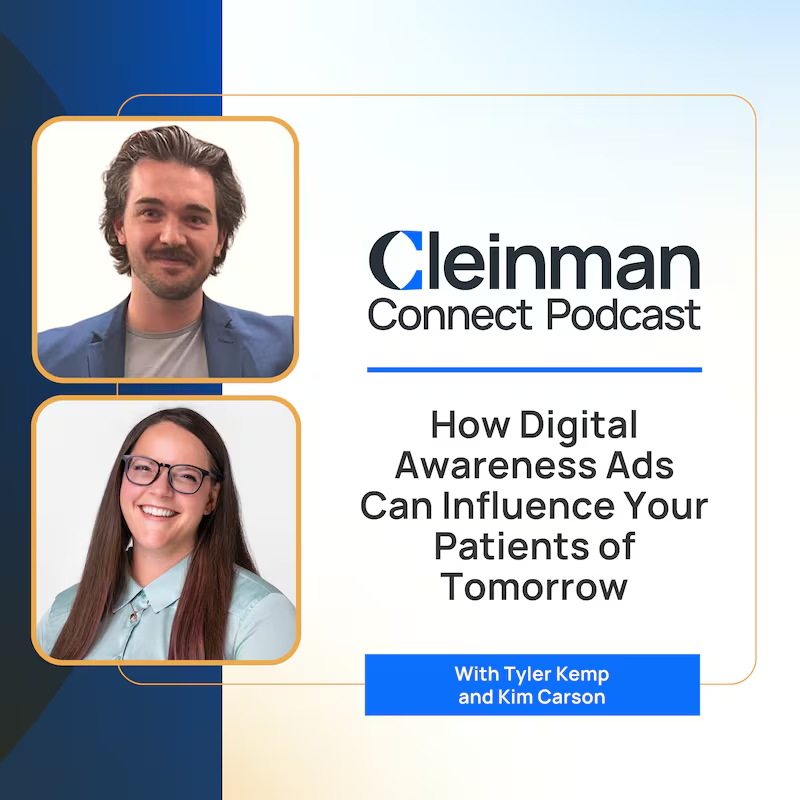
In this episode of the Cleinman Connect Podcast, Kim Carson is joined by Tyler Kemp, Account Manager at Marketing4ECPs, to discuss how digital awareness ads influence the patients of tomorrow. They break down the marketing funnel, explain the difference between awareness and conversion ads, and share real-world examples of how repetition builds trust. Tyler also shares advice on focusing your strategy around future patients, not just today’s bookings.
Resources mentioned in this episode:
- Kevin Wilhelm on LinkedIn
- Marketing4ECPs: Website | Instagram | YouTube
- Cleinman Performance Partners
- Tyler Kemp on LinkedIn
- “[HR Services] The Power of Engagement Surveys” with Jenny Rowell and Olivia Leduc on the Cleinman Connect Podcast
- “[Growth] Unleashing the Optometrist & the Pursuit of Process in Eye Care” with Dr. Trevor Miranda on the Cleinman Connect Podcast
- Vision Expo
Quotable Moments:
- “More than 60% of your potential patient base sits within the awareness stage.”
- “It’s the idea around give, give, give and then ask.”
- “It never hurts to continue that communication with your current or past, or even potentially future patients in that way.”
- “So focus on the patients of tomorrow and utilize that awareness and branding as strongly as you possibly can.”
- “You need one and the other to be able to be as effective as possible with these overall marketing strategies and campaigns.”
Action Steps:
- Invest consistently in digital awareness ads: Staying visible across social and display platforms builds familiarity and trust before patients are ready to book.
- Map your marketing to fill the full patient journey: Aligning awareness, interest, and conversion efforts ensures you are nurturing future demand, not just chasing immediate appointments.
- Prioritize brand storytelling over constant promotions: Clear, consistent messaging helps patients understand why they should choose you over competitors.
- Balance awareness and lead generation campaigns: Combining both strategies keeps your funnel full while still converting patients who are ready today.
- Focus on the patients of tomorrow: Building recognition now positions your practice as the natural choice when future eye care needs arise.
Sponsor for this episode…
This episode is brought to you by Marketing4ECPs!
Working with them is like hiring a full-time marketing professional who knows the industry and understands your goals. Except, instead of one experienced marketer, you get a whole team in your corner.
Whether you’re an optometrist, ophthalmologist, or optician, they can help you grow your business with a plan that’s completely customized for you. Learn more here.
Powered by Rise25 Podcast Production Company
Episode Transcript
Intro: 00:07
Welcome to the Cleinman Connect Podcast, where we discuss marketing, ownership, growth strategies, and everything else surrounding the business of optometry. Cleinman is Optometry’s trusted business partner for over 35 years. Hello, I’m Kim Carson, hosting Tyler Kemp, Account Manager at Marketing4ECPs. On this episode of the Cleinman Connect Podcast, past guests of the show include Olivia Leduc and Jenny Rowell from Cleinman Strategic HR services. And every month we have Dr. Trevor Miranda hosting Optometrist Unleashed, where you get the POV from an OD.
Those episodes are available at Cleinman.com or wherever you like to listen. Thank you so much for smiling at my jokes already. Tyler, this should be a good episode. This episode is brought to us by Marketing4ECPs.
You’re very familiar with them. Working with them is like hiring a full time marketing professional who knows the industry and understands your goals, except instead of one experienced marketer, you get a whole team in your corner. Whether you’re an optometrist or ophthalmologist or optician, they can help you grow your business with a plan that’s completely customized to you. Learn more at marketing then the number four. So Marketing4ECPs.com and I am joined today by Tyler Kemp, one of the kindest and most dedicated people I have ever met.
And he is an account manager for Marketing4ECPs. From brand strategy to patient focused marketing, he helps eye care practices turn big ideas into clear, consistent messaging that patients actually remember. He loves marketing so much that like this is big news. He has actually launched his own video podcast called 4theRecord, and that is for the number not typed out for the number, the record. And before he gets too big, I asked him to pretty please join me on the podcast.
Thank you so much for saying yes.
Tyler Kemp: 02:05
I just want you to narrate my life, Kim. That is that’s like too perfect. So. Yeah. No, I’m I’m I’m thrilled to get to get to hop on here.
This is going to be fun.
Kim Carson: 02:14
Yeah. No. Thank you so much for for joining me. You know, we have worked together for just about a year now. And I mean it when I say that you are one of the most dedicated people here.
You know, at Marketing4ECPs, I see you hustle day in, day out. I don’t think you ever have a spare minute. So I really do appreciate you giving multiple spare minutes to me.
Tyler Kemp: 02:37
Absolute pleasure.
Kim Carson: 02:39
So, you know, I wanted to know first just a little bit about yourself. So kind of what draws you to marketing and to the marketing world and to your role at Marketing4ECPs?
Tyler Kemp: 02:51
Yeah. So it’s funny, I feel like this is the case for most people who went to school for advertising or communications or English or anything like that. You come out of school with everything as a possibility to you, but nothing really specific that you have to go into. So I got the cool opportunity to bounce around to a lot of different industries I worked within. I worked within sports marketing.
I even did marketing for a local countertop company. Like a lot of a lot of strange, different types of roles. And it gave me a very unique perspective on basically brands in general, that regardless of what industry you’re in, the brand storytelling and the way that marketing can work is pretty much universally the same. It’s just about the story you’re actually telling. So when I started at four, when I started at four, six years ago now, it was it was very cool because we got to focus in on a certain type of storytelling.
I’d never seen a marketing agency that actually took the approach of we’re not here to learn a new business. Every time we start something, it’s we have a full understanding of this industry, what we can do, what we can’t do, what works and what doesn’t work. And then really, what it’s about in terms of working with a new practice is we just need to understand what their story is, what makes them different, or the example that I use all the time is why are people driving past 20 other optometrists to get to you? Like what? What is making you that choice?
So that’s really been the last six years is really learning and understanding this industry and what makes practices different and how we promote that.
Kim Carson: 04:41
Yeah, I think too, it’s important, like you said, not only knowing the industry and not having to learn a whole new industry every single time someone wants to work with us, the audience, knowing the audience as well. Like who is looking for, you know, these services? Are they looking to book today? Like is is that really something that people are looking for? Are they looking for tomorrow?
Are they looking for next month? So I think that’s really important to and you know that that is something that is built in that we also know.
Tyler Kemp: 05:12
Yeah. And not just not just the who, but then taking it one step further and where is that person actually going to be and how do they want to receive that message. Like it’s it’s the easy part to figure out who the audience is. But where is marketing going to help with that specific person? Because not everyone’s going to want to receive marketing in a certain way.
Not everyone’s going to be in the same place to receive that. So that’s where it kind of really takes that strategic turn.
Kim Carson: 05:40
Yeah. Where are the people?
Tyler Kemp: 05:42
Yeah, exactly.
Kim Carson: 05:44
Well, I mean, that honestly is a great kind of segue into our topic for the day, which is awareness ads. Can you describe that type of ad to people listening and what purpose they serve?
Tyler Kemp 05:56
Yeah. So for anyone who has worked with forceps in the past and honestly, for for anyone who has done any type of marketing, you’ve probably heard of the marketing funnel and the whole concept of that is the marketing journey. Or specifically in this case, in this case, the patient journey. You need to start at the beginning, because if someone isn’t a patient of yours already, they’re not necessarily just going to be ready to commit to you as their new provider. The second that they hear about you, there is a foundation of trust that really needs to be built before you can ask someone for something.
It’s the idea around give, give, give and then ask. And it’s a much it’s a much more likely way that you’re going to get a yes from someone. And ultimately, awareness ads is the beginning of the marketing funnel. Because the funnel starts with awareness, then it goes to interest and then it goes to action. The really cool part about the awareness part of the funnel is that is by far the largest section of the audience.
More than 60% of your potential patient base sits within the awareness stage. So the reality of wanting to go directly into conversion tactics, or where someone is kind of already kind of on the fence, ready to make a decision, and you just need to get them to pull the trigger to jump in and book an appointment or buy frames. How are you actually getting there to start? It’s it’s the same thing with any purchase decision. You need to learn about it.
You need to be aware of it. You need to feel comfortable with it before you start to move to those next stages. So that’s what the awareness ads actually cover. They’re they’re taking a look at who is that audience like finding the who, finding where they are, and finding a way to get that message to them in a way that isn’t pushy. It’s not confrontational.
It’s not asking them for something before they’re even comfortable with you. Yet it’s essentially making them comfortable with you, providing them something, and starting to build that foundation of trust that is especially needed within this industry when we’re talking about healthcare. If someone or their family.
Kim Carson: 08:16
Do you maybe have a couple examples of what an awareness ad might be for us?
Tyler Kemp: 08:21
Yeah. In its simplest, in its simplest concept, it is a digital billboard. So it’s anytime you’re driving home from work and you’re seeing the billboards or the bus bench ads or even the radio ads driving home, those are all awareness ads. Those are because the reality is you can’t click on that billboard, you can’t click on that bus bench ad, and you’re probably not. Or you shouldn’t be pulling out your phone and calling them right there.
But the reality is, those ads want to stick in your head so that when you do need them and you type something into Google, or you type something into social media, you’re going to you’re going to recognize that brand because you’ve seen them. It sticks in your head. How do we do that? On the digital side is through tools like Facebook and Instagram ads, or the pre-roll ads that you see on a YouTube video, or even just other places on Google. And it’s called Google Display.
So it’s essentially taking the concept of billboards and bus bench ads and putting them where someone is going to go pass them online. So you could strategically choose where you know your audience is going to be driving home past with the billboards, but we can get a little bit more strategic and go, okay, but where are they interacting online? What are the kind of sites that they’re typically on? What are the social media channels they’re utilizing, and find a way to put that ad in front of the right type of audience that you’re trying to talk to.
Kim Carson: 09:47
I come from a radio background, so definitely very familiar with repetition being the the sort of tactic to, to make people remember you, because then when you know, when you need that pair of glasses or you need that eye exam, you think to yourself, what names do I know? What businesses names do I know? And you think about that ad you’ve heard a million times, and there they are.
Tyler Kemp: 10:13
Yeah. And it’s not a it’s not something that when you see it the first time, you’re going to need it every time. Like it’s I the one that’s super popular where we are is I think of Action Furnace and you see action furnaces, billboards and you hear their radio ads. You you cannot drive anywhere in the city without seeing those. Well, the reality is, is you’re probably not buying a furnace every year or needing air conditioning repairs.
But when you need a furnace repair. When it’s -1,000,000,000 outside. Yeah. Who are you going to think of? That person who has been on every bus bench ad on your drive home, and it creates a it creates a level of trust because even if you didn’t know anything about their actual company, if you’ve been seeing them that frequently, that people choose who they trust and they trust who they know, and if you know them, that’s one step further to being one of the first few choices when they actually need that service.
Kim Carson: 11:16
Yeah, I think that’s a perfect example, too. Like, you know, I invite everyone listening because Action Furnace is a relatively specific example for the city that Tyler and I live in. But I invite anyone listening to, you know, close your eyes and think about, you know, as long as you’re driving, close your eyes and think about, you know, a billboard that you’ve seen a hundred times. Is there actually something on that billboard that says, you know, we’re having this sale or buy this thing now, or is it the company’s logo with maybe a picture of someone who might be in their demographic, or with a couple bullet points that says, like, what they can do for you? There’s not really a buy now element to that.
They’re just there so that you remember them when you need them. So I think Action Furnace is a perfect example. And then just to make it a little larger for anyone who isn’t in Calgary. So having said that, Tyler, what would you say are maybe some of the benefits of awareness ads versus conversion ads?
Tyler Kemp: 12:20
Great question. Because that’s that’s not a straight that’s not a straight answer that that I can give to this because I think that’s the way that we too often look at the different types of advertising is do you want to go awareness or do you want to go with lead generation? Well, the reality is both work better with the other for for awareness at. If you are communicating a certain brand, if you’re trying to tell that story and you happen to fall across the audience who actually is ready to make that decision like you happen to talk to them right when they need something. Do you have the lead generation tools in place that’s now going to be able to help close that person, to buy or to book an appointment, or to come in and buy a pair of frames on the other side of things, when we go back to the funnel and we consider that 60% or more of your potential audience sits in awareness, it gets smaller and more specific the further you go down the funnel.
So when we get to that decision and action stage at the bottom where people are ready to make that buying decision, basically they’re primed for those lead generation ads if we have less than 10% of your potential audience sitting within there, you are eventually going to run out of leads. So it’s it’s about giving yourself the most optimal opportunity to fill the funnel and continue to drive people down from awareness to interest to action. So if you have one without the other, you either risk being able to close on the people who have experienced your awareness ads, or you are focused on trying to close such a small group of people and putting your resources there that eventually that, well, runs dry. So you need one and the other to be able to be as effective as possible with these overall marketing strategies and campaigns.
Kim Carson: 14:25
When you have an owner that decides to go with awareness ads and I, I do hear what you’re saying. And I fully agree. Like how why would I talk to, you know, only two people that are at the conversion stage when I could talk to 600 people that are at the awareness stage, like you’re moving them all through the funnel and one kind of benefits the other. So when you have an owner of a practice that decides to go with awareness ads, what are some good complimentary marketing strategies or online tactics that you would maybe suggest to them, or that they should be considering as well?
Tyler Kemp: 15:02
It’s going to be different for everyone, and I know that.
Kim Carson: 15:04
I do ask a lot of it depends questions I think.
Tyler Kemp: 15:08
It’s probably the most frustrating answer that I feel like I have to give on a regular basis, that it’s the it depends. It’s never a it really isn’t a straight answer because it’s going to be completely dependent on the stage of your audience. So let’s say the owner that I’m speaking to has just opened their practice, or they’re in a new budding community in their city and they’re continually Seeing new families move in around them. In that case, there is such an opportunity of new potential patients suddenly that 60% who live within the awareness stage become 80 to 90% of your potential audience are in the awareness stage because they just they simply don’t know you because either you’re too new or they are. Whereas if you’re a practice who has been in a relatively small area, or you have some surrounding cities around you or towns around you that you might be able to pull from, but you’ve been there for 40 years and you have this established reputation.
That’s where it’s going to depend on what tool and tactic you actually need to implement for your goal. If both practices, in that case, the brand new practice and the 40 year veteran are. If they both have the goal of increasing from ten appointments today, ten appointments a day to 15. Well, one of them is going to need to focus huge on getting their name out there and focusing on that brand. And it’s probably going to be a longer term strategy because you need to build that trust.
Whereas that long term, that long term veteran who has been there for a long time, they don’t need to get their name out there as much, but they might need to remind their current or past patients about something they can do to help. It never hurts to continue that communication with your current past, or even potentially future patients in that way. Yeah, that’s that’s that’s why it depends because it really your audience will determine the majority of this. All of these tactics can be used in a certain way. And for many of these longer tenured practices who have a lot of brand recognition, They might benefit from awareness ads around a certain topic, promoting that you got a new piece of dry eye technology that you can support in ways that you haven’t before, or you’ve brought in five new brands that are really competing with the cities and towns that are around you now, versus just the awareness ads that are saying, hello, I exist.
Come check us out. Come learn about us. It’s going to be very different, but it’s the same tactic. It’s just the story in which you tell that changes in that regard.
Kim Carson: 18:03
Amazing. And this is why marketing is so interesting because you always do get and it depends kind of answer and is maybe why you also wanted to start a podcast. I would like to talk to you a little bit about that as well. Why? Why start 4theRecord now?
Tyler Kemp: 18:22
So originally when I started as an account manager at at four. So I have a I have a bit of a different trajectory in my career that I started here in creating the social media program, and then I had the opportunity to manage a couple of different teams and kind of understand the ins and outs of the of the business. And what I realized was I missed I missed talking to people. I got a lot of really cool opportunities to work with some really great marketers, but I was a little bit jealous that they got to be the ones creating these strategies. So when I moved, when I made the the big career move to say I want to be in account management, I want to create these strategies and understand businesses and come up with these campaigns.
One of the things that I realized very quickly was I didn’t have a brand. Nobody really knew who I was. Yes, I worked for Ford, but there’s there’s a lot of value that comes with trusting the representative that you’re talking to. So four years ago I started a I started an Instagram account. And the purpose of that at the beginning was to establish the kind of ideas I had around marketing.
I wanted to share things I knew I wanted to share ideas and updates to the industry, what we’re seeing about eye care marketing specifically, and kind of move into that. And what was very cool is out of that, a lot of unique opportunities came up that I got the opportunity to speak at Vision Expo. For the last four years, I’ve had the chance to be on some other podcasts within the industry, and I realized that there are a lot of stories around how marketing works, how marketing has worked for optometry practices for opticians that a lot of people just don’t know. There’s there’s this total veil of uncertainty around marketing because it is such an intangible piece to your business growth. If you ask me to physically prove the views on a website, it can be challenging to understand that versus how many pairs of frames that you actually sold out of the optical.
So it takes a lot of time and understanding behind all of the things that go into marketing, all of the things that go into building a brand, and how this progresses into this long term strategy of how to grow your business through marketing. And I saw this podcast as, as you and I, Kim, we’ve talked about this for the last year, and I’ve been having these conversations for years about how do we get this message out of just an understanding behind what other people are doing, what works, what doesn’t, what works specifically for the eye care industry. And I’m just very fortunate to have gotten the opportunity that we get to create something like this, where maybe we can tell more of these stories and talk to some really cool people, either in the eye care industry or not, that have built their brands utilizing marketing tactics and branding tactics and really put that out to our audience.
Kim Carson: 21:36
Yeah, yeah. Get the storytelling of it, I love that. So I have one last question for you before I ask it, I’d love to point people towards our sponsor again, Marketing4ECPs.com and Tyler, where can people find this is not the last question, but where can they find you to ask any questions or even to listen to 4theRecord?
Tyler Kemp: 21:54
Yeah. So you can head to Marketing4ECPs.com we’ll make sure to have that uploaded there and on our YouTube as well. And we will be posting on our social media channels Instagram you can follow for I think it’s @marketing4ecps_.
Kim Carson: 22:12
@marketing4ecps_. But if you type marketing then number 4 ECPS, they’ll show up.
Tyler Kemp: 22:19
Yeah. And I’ll be sharing on my own channel as well on TikTok marketing. So you’re welcome to follow along there. I post that whenever I can about about tips and tricks that I’m hearing within the industry.
Kim Carson: 22:30
Amazing. Okay, so my final question for you officially is what is one piece of marketing advice? And it can be related to awareness ads or not, but one piece of marketing advice that you would like everyone listening to know and keep in mind moving forward.
Tyler Kemp: 22:44
Focus on the patients of tomorrow. The reality behind your marketing right now is, or your business right now is like we talked about with the marketing funnel, so much of your potential audience lives within the awareness stage. And the challenging part to accept is that the people who are within that awareness stage, that huge opportunity to grow your business, may not be ready to make a buying decision today, but if you only focus on the people ready to buy now, you’re actually setting yourself up for a lot more of a challenging time in the meantime, not many people can only focus on lead generation, but still grow the amount of leads coming into their business. So focus on the patients of tomorrow and utilize that awareness and branding as strongly as you possibly can.
Kim Carson: 23:36
Oh my gosh, just like that. Just like that. So easy. Thank you, Tyler for your insight and your time today. That is our show.
Tyler Kemp: 23:44
Pleasure, Kim.
Kim Carson: 23:45
Yes. Thank you. Of course. Thank you. So that’s our show.
Outro: 23:50
If you want to hear more of the Cleinman Connect Podcast, you certainly can at Cleinman.com and wherever you’d like to listen. Thank you for joining us today. Thank you for listening. At Cleinman, we take pride in helping our partners unlock their full potential. Subscribe to get the newest episodes or visit us anytime at Cleinman.com.