
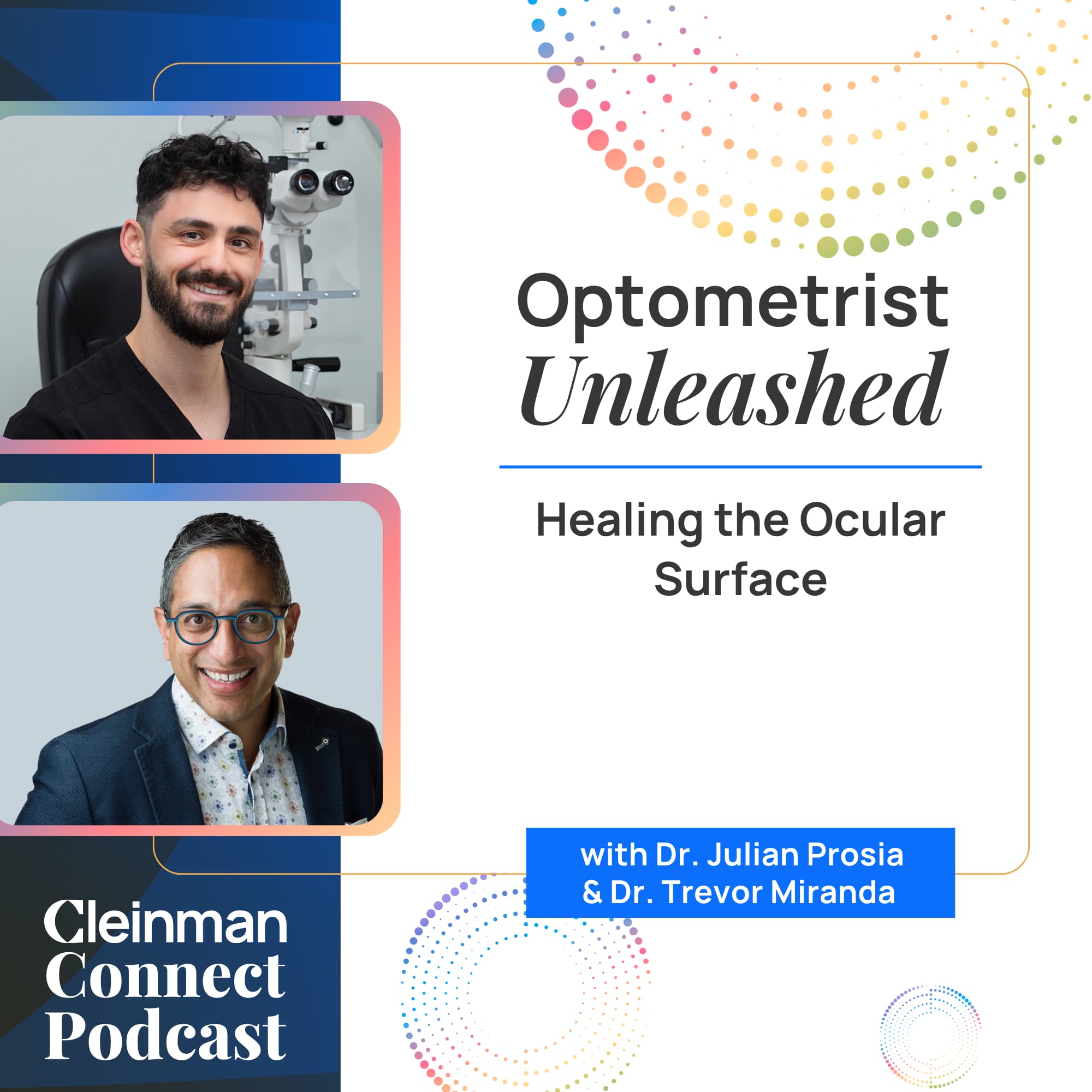
Dr. Julian Prosia is the CEO of Ophthalogix Canada, a company specializing in advanced treatments for dry eye and ocular surface disease. As a leading innovator in amniotic membrane therapy, Dr. Prosia has introduced Canada’s first doctor-owned amniotic membrane company and has personally performed over 2,000 amniotic membrane procedures while managing more than 50,000 dry eye cases nationwide. Beyond his clinical expertise, Dr. Prosia is a respected educator and speaker, known for training fellow optometrists and their staff in integrating regenerative medicine into everyday practice, and he is currently involved in pioneering research on nerve regeneration for ocular pain.



Here’s a glimpse of what you’ll learn:
- [03:45] The real-life case that sparked Dr. Julian Prosia’s amniotic membrane fascination
- [05:16] What amniotic membrane actually is and why it works
- [07:37] Top conditions ideal for amniotic membrane therapy
- [09:12] The latest on treating persistent and neuropathic ocular pain
- [13:52] Implementation tips for seamlessly adding amniotic therapy to practice
- [20:19] A glimpse into the future of regenerative eye care and new breakthroughs
In this episode…
Most eye conditions are managed, not truly healed. But what if we could actually regenerate the ocular surface instead of just maintaining it?
Drawing from his experience as a leading expert in ocular surface disease, Dr. Julian Prosia explains that true healing starts by addressing inflammation and nerve dysfunction at the root. He highlights how amniotic membrane therapy delivers growth factors that accelerate healing, reduce scarring, and even support nerve regeneration. The result is a shift from temporary relief to long-term restoration, fundamentally changing how clinicians approach stubborn ocular surface conditions.
In this episode of Cleinman Connect Podcast‘s Optometrist Unleashed series, Dr. Trevor Miranda is joined by Dr. Julian Prosia, CEO of Ophthalogix Canada, to discuss healing the ocular surface through regenerative medicine. Dr. Prosia outlines how amniotic membrane therapy works, when to use it in practice, and its role in managing dry eye and corneal disease. He also shares advice on implementing this technology efficiently in everyday optometry.
Resources mentioned in this episode:
- Kevin Wilhelm on LinkedIn
- Marketing4ECPs: Website | Instagram
- Click: Transform Your Business Through Digital Marketing by Kevin Wilhelm
- Cleinman Performance Partners
- Dr. Trevor Miranda on LinkedIn
- Dr. Julian Prosia on LinkedIn
- Ophthalogix
- Dry Eye Summit
Quotable Moments:
- “I kind of wanted to figure out how I could reach more patients, and outside of my own reach.”
- “And sure enough, we use amniotic membrane, and the patient never had to get surgery.”
- “You have something that now you could work with in terms of managing pain.”
- “It’s actually the hardest thing to treat because often we don’t even understand why these patients are in pain.”
- “When you make mistakes, look for the issue that, that you kind of found yourself in.”
Action Steps:
- Introduce amniotic membrane therapy earlier in treatment plans: Addressing ocular surface disease proactively can prevent progression and improve long-term patient outcomes.
- Educate patients on advanced treatment options: Providing awareness empowers patients to make informed decisions and increases acceptance of innovative care.
- Train staff to assist with new procedures: Delegating tasks enhances clinic efficiency and allows for smoother integration of advanced therapies.
- Focus on identifying root causes of ocular pain: Understanding underlying nerve dysfunction leads to more effective and lasting treatment strategies.
- Embrace regenerative medicine in clinical practice: Adopting new technologies helps clinicians move from symptom management to true healing and restoration.
Sponsor for this episode…
This episode is brought to you by Marketing4ECPs!
Working with them is like hiring a full-time marketing professional who knows the industry and understands your goals. Except, instead of one experienced marketer, you get a whole team in your corner.
Whether you’re an optometrist, ophthalmologist, or optician, they can help you grow your business with a plan that’s completely customized for you. Learn more here.
Powered by Rise25 Podcast Production Company
Episode Transcript
Intro: 00:00
Welcome to Optometrist Unleashed, a Cleinman Connect Podcast with Dr. Trevor Miranda, a monthly doctor-led discussion about everything surrounding the business of optometry.
Dr. Trevor Miranda: 00:15
Hello, everyone, and welcome to another episode of Optometrist Unleashed, a Cleinman Connect Podcast. I’m your host, Dr. Trevor Miranda, coming to you from beautiful Vancouver Island, where I’m going to golf later today. And we’re gonna today we’re gonna dive into regenerative medicine in optometry, specifically amniotic membrane therapy and how it’s changing the way we treat ocular surface.
This episode is brought to you, brought to you by Marketing4ECPs. Working with them is like hiring a full time marketing professional who knows the industry and understands your goals. Except instead of one experienced marketer, you get a whole team in your corner. Whether you’re an optometrist or ophthalmologist or optician, they will help you grow your business with a plan that’s completely customized for you. Learn more at marketing4ecps.com. That’s marketing4ecps.com.
Guys, I’m really excited. Today we have one of my buddies and resident ocular surface expert Dr. Julian. Julian, welcome.
Dr. Julian Prosia: 01:23
Thanks a lot for having me buddy, I appreciate it.
Dr. Trevor Miranda: 01:25
I’m going to tell everybody about you. You’re an optometrist and a leading innovator in amniotic membrane therapy in Canada. You’re known for your expertise in dry eye and ocular surface disease management. You’re introduced Canada’s first doctor owned Amniotic Membrane Company of Canada to expand national access to advanced ocular treatments. Over your career, Julian has performed more than 2000 amniotic membrane procedures and managed over 50,000.
That’s 50,000 dry eye cases. A respected speaker, educator and social media voice in the eye care community. He continues to shape the future of ocular surface disease management through clinical excellence, education, and innovation. And he’s a new dad, so that’s pretty exciting too. Yeah.
So Julian, welcome, welcome to the show. And yeah, so happy to have you here. Hey, I want to get into, you know, what’s your journey into ophthalmology and innovation? You’re such a innovative guy looking at what’s next. What made you get into this business?
Dr. Julian Prosia: 02:29
Yeah, I, I think that the number one driver for me is the patients seeing what. But going back to when I practiced in Florida, like I was seeing at one point, like 70 or 80 patients a day. And at that point, you don’t really have enough time to spend with every single patient, kind of like the way you get to do it when you’re doing dry eye with your private practice and optometry, right? So I kind of wanted to figure out how I could reach more patients and outside of my own reach. Not just me taking care of them, but helping others take care of them.
And so when I learned a little bit about what amniotic membranes were capable of doing, I kind of ventured out in that direction. And that led me to doing a lot of work with Ophthalogix USA and kind of acting as a medical director for them. And then eventually making the decision to actually venture off back to Canada and bring a portion of that company with me. And that’s what we did. And it’s amazing now that we have hundreds of practices and hospitals across Canada that are actively helping patients.
So.
Dr. Trevor Miranda: 03:36
Yeah, absolutely. I see it firsthand in my clinic using your amniotic membrane to help patients. You know, when did you first see the power of amniotic membrane in use?
Dr. Julian Prosia: 03:45
The first time that I saw it, it was a crazy, crazy case. I honestly didn’t even know what was going on. It was my fifth, fifth, or sixth day of actually practicing. And at this point, I was just kind of following the ophthalmologists that I work with around because I wanted to see like how he did things kind of not copy his flow, but take a little bit from each of the people that I worked with and kind of tweak it to make it my own. And there was this person that came into our office and the eyeball was an absolute mess.
I thought it was a corneal ulcer, but it actually was something called a descemetocele. And basically it’s when all the layers in the cornea just separate and create, almost like a very severe bullous keratopathy. And when I saw it, I was like, Holy crap, what are we going to do? Like surgery? And he’s like, no, no, no, we can actually use an amniotic membrane for this case and see if we can prevent this patient from having to go into surgery.
And sure enough, we use amniotic membrane and the patient never had to get surgery. Their vision wasn’t perfect again, but the fact that the surface of the eye was healed by using this, I was like, whoa, what else can it do? Right? It was pretty interesting.
Dr. Trevor Miranda: 04:52
And I think that’s the key. You know, clinicians click in. Hey, we need a better solution. And we have it right here at our fingertips. It doesn’t need to wait months or sometimes years to get into a specialist or sort of have a more invasive surgical procedure that that can lead to other negative outcomes.
So just tell our audience a little bit about what is exactly an amniotic membrane.
Dr. Julian Prosia: 05:16
Yeah. So an amniotic membrane is this little dehydrated tissue that I like to say is about three times thinner than a piece of hair. And it comes from the innermost layer of the fetal placenta. So, you know, donor mother is having a baby. The placenta obviously harnesses growth factors.
And we can actually use that and turn it into a little disk that is now capable of healing over like 32 different indications of the cornea. So it’s, it’s natural, it’s safe. And the one question I always get is, do you ever get rejection with things like this? And no, because this particular treatment is actually acellular. So it’s been removed of the actual cells.
And now it’s all of the growth factor in the fertilizer and the good stuff that the cornea needs to heal.
Dr. Trevor Miranda: 06:00
Yeah. And so what’s it what’s it helping in the cornea? Anti-Inflammatory anti-scarring. What exactly what are the indicators?
Dr. Julian Prosia: 06:07
Yeah, you’re exactly right. So anti-inflammation anti-scarring anti neovascularization and extremely sped up healing cascades to the point that research has now told us in the last 5 to 6 years that there are some randomized controlled trials that are doing healing within 14 days, over 95%. So when you see something like that, you’re like, okay, great. Now I have something that I can kind of do for those patients that you just kind of want to pull your hair out sometimes, right?
Dr. Trevor Miranda: 06:36
Yeah. Are they using amniotic membrane for other applications other than ocular surface?
Dr. Julian Prosia: 06:40
Yeah. They are the some, some of the cases actually we’ve been using behind the scenes here in Canada is a couple of different doctors out east are using amniotic membranes with conjunctival. Conjunctivochalasis treatments. So like plasma pen searing the conj, tightening the conj, and then actually putting an amniotic disc over top of that area to get the conj to heal better. Because when you’re doing that, you are disrupting goblet cells.
And this can actually heal and somewhat improve goblet cell density in that area after you just did that procedure. And then also, we see sometimes that people are trying to figure out how they can get it into a topical form, but that hasn’t really been truly studied and conclusively proven like the actual amniotic discs have.
Dr. Trevor Miranda: 07:25
What are some of the ideal conditions that optometrist like myself would see, you know, on a regular basis? That would be a good indication for amniotic membrane therapy.
Dr. Julian Prosia: 07:37
Yeah, well, the first one 100% everyone sees every single day is our dry eye cases. You got that superficial keratitis. That’s just not healing. That’s a fantastic thing that you can use it for. And another, another really good one that people often kind of go home is a recurrent corneal erosion.
There was some research actually done by Scott Hauswirth in the US, and I think it was presented at Oscars about 5 or 6 years ago. And what they found is that in this two year study that the bandage lens, the traditional bandage lens and débridement still had patients recurring. And in his study, not a single patient recurred within that nine month time or two year time span. So like you have patients that on average, we know with RC, it’s going to happen every 3 to 6 months. Even if we do everything we need to with an amniotic membrane, we’re starting to find that like it is actually addressing the root cause by strengthening those those attachments.
And, and we’re seeing a much lower recurrence rate. And I actually see that in my practice too. So RC is a big one that people are like, oh, I didn’t really know about that. And I’m going to start to use that for that.
Dr. Trevor Miranda: 08:44
Yeah, I used it for a couple of cases and very effectively as well. I’m really fascinated. I know doctor, you told me a little bit about how it can help with pain and sort of the neurotrophic pain and other issues with chronic pain. And I wondered what, what, what your thoughts are on reducing that, that ocular persistent pain that some of our patients, they don’t really have a solution for? Do you have any thoughts on that?
Dr. Julian Prosia: 09:12
Yeah. This is honestly the golden question because you have doctors in the United States like Dr. Hamrah, who are developing protocols to try and understand how we can get these patients out of pain. And there’s no real answer to say like, yeah, I have the magic bullet. It it’s actually the hardest thing to treat because often we don’t even understand why these patients are in pain. Sometimes you have, you know, pain disorders that are coming from Lasik, which is the most common, but I’ve even seen pain disorders coming from TMJ.
So we first have to understand the root cause. But the one thing that I love about the amniotic membrane is because of the way that it works on the nerve function by regrowing nerve density, by elongating the nerve fiber and actually treating the root cause of inflammation. You have something that now you could work with in terms of managing pain. So we’re actually right now working with a doctor in the University of Montreal, and we’re running Canada’s first ever nerve regeneration trial. And so we are planning to have those results published within the next year, hopefully.
But I can tell you without saying, obviously, what I’ve seen in terms of the cases I’ve already seen in that trial, it’s been insane. Insane. And it all boils down to the the nerve dysfunction, those those areas of the nerves that are inflamed leading to pain. So I think that going forward, while no one has the magic bullet, I think that amniotic membranes are going to play a huge role in terms of managing patients with neuropathic pain, for sure.
Dr. Trevor Miranda: 10:48
Yeah. And I just anecdotally, I had a severe dry eye patient. You know, we were trying different things. Obviously I’ve got all I’ve got all the gadgets, plasma pen, you know, IPL, everything. I put her in bilateral amniotic membranes and wow what a difference in terms of her subjective pain.
That was that was a big take home because this this elderly lady was in really severe pain. It was unbelievable. I mean, she her eyes were dry, but it really just the pain of, of being so dry was what was bothering her and her, her eyes are still dry, but the pain had really improved. So that’s very interesting to me.
Dr. Julian Prosia: 11:27
Yeah, I like that it has that ability to like oftentimes when you’re, when you start learning how to manage dry eye, you’re really focused. At least I was very focused on how can I maybe make the eye look better? And you do sometimes and you’re like, yes. But then the patient comes back and they’re like, I feel like someone is stabbing me in the eye with a pitchfork. So there’s also that other side of the story.
And knowing that it’s capable of addressing both sides, it’s a very, a very powerful tool that we can start to use in our practices.
Dr. Trevor Miranda: 11:58
What about post Lasik pain? Have you tried it on any of those patients?
Dr. Julian Prosia: 12:02
Yeah, absolutely. My first practice modality was with someone that did Lasik. He was a general ophthalmologist, but he did a lot of Lasik. And so what we actually developed as a protocol was every single patient that got Lasik that were at higher risk. So patients that had higher forms of myopia, thinner corneas, where we knew that the ablation was enough to do a little bit more damage than the average patient.
We would actually throw an amniotic membrane on right after. So literally day one after surgery. Throw it on. PRC’s got it as well to improve healing. and it was absolutely amazing.
If there isn’t an actual Health Canada approved protocol, but this is something that we were kind of doing in our practice, and I’ve kind of encouraged some of the ophthalmologists in Canada to start doing it. And they’ve also been very interested because it’s like if you’re doing PRK on that side of the story, yeah, you can heal the epithelium faster, but even with the Post-lasik, we know it transects 90% of the corneal nerves. So if we can get to that faster, then maybe we can bring back more nerves than we thought, right?
Dr. Trevor Miranda: 13:07
Yeah, 100%. Julie, I want to pivot to an area that’s really dear to my heart is implementation into optometry practice. You know, I think a lot of our colleagues, they think, oh wow, you know, we can’t do this. And you’ve shown so many of our colleagues through webinars and actual hands on labs that it’s, it’s totally possible to integrate this in, in any practice. You don’t have to be a specialty dry eye practice.
In fact, two of our ocular hygienists. Julian. You taught how to place the membrane so they. They can assist the doctors or I can assist them, I guess. And so I just wondered, what are some of your thoughts?
How easy is it for optometry to implement it? What kind of trainings required, you know, that type of thing.
Dr. Julian Prosia: 13:52
Yeah, I love that. You mentioned. I’m going to give a little shout out to the girls because they did absolutely phenomenal. They killed it. But I actually, I, I think that when, whenever there’s something new that comes in, it’s always daunting.
It’s like, oh man, I when do I try this? Like, how do I do this? When do I do it? And so what my goal has been is that alongside creating this business, I want to give doctors the opportunity to learn more. And so that hands on education, the didactics as well, doing anything possible that I can to teach as many people as possible.
That kind of adds to like my goal of trying to help as many patients as possible, right? We’re all banding together. And it’s like you said, you’ve seen it like you have two ocular hygienists that are proficient at doing this. I had six back in Florida that were proficient at doing this. And so it’s not that difficult.
It’s actually more of just understanding your hand-eye coordination than it is really kind of overthinking it of being this grand treatment, right? It’s, it’s simply like placing a bandage lens and just knowing the protocol.
Dr. Trevor Miranda: 14:54
Yeah. I think it’s a lot easier than you think. And, you know, to the point, I really believe in delegation. It doesn’t diminish your standing as a doctor. I think it enhances it.
To be frank, the more train your staff, your techs, your ocular hygienists are, the better it looks for you and the clinic. And so I really encourage to you to have your staffs involved in anything new, especially amniotic membrane. I know the Dry Eye Summit was was the place that they learned that. So that comes up every year or two to go to the Dry Eye Summit if you’re thinking of getting your staff involved. So Yes.
What what do you think about are there any surprises that people come up with that when they’re trying to learn how to place an amnio?
Dr. Julian Prosia: 15:43
Like surprises as.
Dr. Trevor Miranda: 15:44
Like when they like what surprises doctors when they start using it? Is it just that it’s so easy to use or that it’s really so effective? What are you, what are your, what are your takeaways that some of your colleagues give you feedback on?
Dr. Julian Prosia: 15:57
The number one thing that I notice is a lot of doctors will put it on the eye and then put the bandage lens on, and then they’ll step back and be like, wait, that was it. It’s because honestly, the, the ability for it to stick to the eye and then you simply just put a bandage lens over it. You hear about all these little protocols that I teach you about and how to do it and when to do it. But really, when you do it, you’re like, oh, we like, we do things in our day to day, like removing a piece of metal from the eye that are much more difficult than this. And so I’m a big preacher of keep it simple, stupid, because when you do that, it’s not as daunting.
And also getting your hands wet, like you know you’re going to make mistakes as a doctor. You know, you, you that’s how you learn, right? But this mistake, if you made the worst mistake possible with the amniotic membrane, even at the worst mistake, it wouldn’t harm the patient, right? You drop the membrane all you know, got to get off the logic to send me another one. And so just, like, get your hands dirty, you know, get out there.
Try. The more you do, the better you’re going to get. But it is a really simple process. Like, you know, your girls can do it like just like that, right?
Dr. Trevor Miranda: 17:00
So it really is simple. And I think we sometimes overthink it. I know a lot of my colleagues are perfectionists, like they want everything to fit perfectly. They want to like ironing board, you know, a shirt where there’s no crease. We have a little fold in there.
You’re still going to get the nutritional penetration into the cornea from the growth factors and all. No problem. Put the bandage contact lens on. You don’t have an issue. So it doesn’t have to, it doesn’t have to sit perfectly as long as you’ve got good coverage and that the heat from the cornea sort of starts to get it absorbing right away.
Dr. Julian Prosia: 17:33
Yeah, exactly. Yeah, you said it perfectly. And you know what? There are days that I do it and I have like a little fold and I’m not worried about that anymore. Maybe I was at the beginning, but I just want to make sure that it’s covering the cornea.
It’s staying in place and the patient’s following up properly because these this technology was created to make it easier for the doctor to worry less and just go home and come back and see that patient the next time that you do and, and get them to reap the benefits of it. Right.
Dr. Trevor Miranda: 17:58
And the other thing I wanted to talk to you about, Julian, is, you know, more of a first line option rather than waiting for the most severe case you can find. I think if you look at it, there’s a lot of patients that would be great candidates on a more early intervention scale, rather than waiting to a treatment of last resort. Your thoughts on that?
Dr. Julian Prosia: 18:21
Yeah, I mean, we got to ask ourselves this question. You go to the dentist and you have a small cavity. Are they telling you? Let’s just wait until you get got to get a root canal and then we’ll do the whole treatment. No, we remove the cavity before it absolutely destroys our mouth.
And so if we’re waiting and waiting and waiting, maybe we’ll just do conservative therapy. Why would we do that? Because we know that there’s barrier disruption. We know that now. DOS three is telling us that these nerves are starting to start, are going to become inflamed and and even die.
And so if we can get to it sooner, yeah, we may do it on a case of a one plus SDK, but at least you know that you’re protecting the patient. I’m much more of a preacher of prevention than I am of treatment, because often these patients that come in when I’m treating them, it’s damage control. When I’m preventing patients are happier, right?
Dr. Trevor Miranda: 19:13
Yeah, I agree 100%, Julian. I think it’s also the privilege of the patient to be informed of the opportunity for these treatment. I feel like sometimes we’re a bit paternalistic and hide sometimes amazing treatments that that the patient would benefit from and wouldn’t have in fact opted into because we think, oh, it’s the expense and such, and we don’t allow the patient their right and their privilege to, to make an informed decision.
Dr. Julian Prosia: 19:42
Yeah, you’re 100% right, Trevor. I mean, how many patients have we had come into our clinics and say, oh, I’ve never, I’ve never heard of that before. And if we did that extra kind of due diligence of the extra three minutes of saying, hey, you know, I’m going to give you a brochure, I think you’d be a great candidate. But maybe, you know, if right now you’re wanting to do conservative, just know that this exists and we don’t want to let it get too bad. Well, now with education comes more confidence in the patient.
And often together, the patient and the doctor will work more synergistically. Right?
Dr. Trevor Miranda: 20:12
100%. I want to talk about the future of regenerative eye care. Where is ocular surface medicine heading, in your opinion?
Dr. Julian Prosia: 20:19
I think I think it’s all headed towards bio regenerative Everything the stem cell market. Don’t quote me on the exact details, but in the last ten years, I believe stem cells in general, including cells, tissues and organs have grown anywhere from a couple hundred million to almost $5 billion. And they expect it to become a $50 billion industry within the next 20 years, all of which about 64% of that coming from North America. So when we hear things like that, when we see that there’s new regenerative types of medicine for other parts of the body, would it be safe to assume that these bio regenerative, targeted treatments are going to do the same thing for the eyeball, right? We already hear a little bit of more a little bit more about hormone targeted therapies and topical eye drops.
We’re starting to hear a little bit more about PRP, PRP, these different areas that we didn’t have about ten years ago, and a lot more doctors are using amniotic membrane. So I think that’s where we’re headed, is really focusing on that targeted. Targeted therapy.
Dr. Trevor Miranda: 21:27
Now I agree it’s probably going to become more mainstream. I think we’ll. Everybody will be using it, let’s hope offer the best for our patients. So what’s exciting for you in the next decade of eye care?
Dr. Julian Prosia: 21:38
Oh that’s a good question. I think the most exciting thing for me is getting the opportunity to share the changes that we’re seeing in Dry Eye with my colleague, with our colleagues. I’ve had this conversation with a lot of doctors at conferences, and we just kind of talk about how if we were practicing Dry Eye maybe 20 years ago, it may not have been as exciting, but practicing now we got to see. DOS two, dos three with massive changes in between and all of these new medications that are coming out and in the pipeline. So like to be able to share this with the colleagues, our colleagues in the next ten years, I think that we’re going to be like getting some pretty groundbreaking therapies.
And that’s exciting for both us as doctors to have more tools and for our patients.
Dr. Trevor Miranda: 22:27
I agree, I was just talking to today to a family physician patient of mine and talking to her about her dry patients. And I said, it’s unbelievable what we can do now, how much we can move the needle so your patients don’t need to suffer. So not only are we going to have amazing therapies, we got to get the word out to our colleagues in other disciplines in medicine so that they can refer in to our clinics, and we can help those patients. Okay, doctor, I’ve got the rapid fire round here for you. So are you ready?
Dr. Julian Prosia: 22:57
I’m ready. Okay.
Dr. Trevor Miranda: 22:58
What’s the biggest myth about amniotic membrane therapy.
Dr. Julian Prosia: 23:01
That it requires someone to have? That that we’re taking it from aborted babies or mothers that are aborting their child.
Dr. Trevor Miranda: 23:10
Right. And these are harvested from donor mothers in San Antonio. Is that really where you’re actually Florida.
Dr. Julian Prosia: 23:20
So it’s it’s done in Boca Raton, Florida. And just like most of the other companies, they all follow the American tissue bank standards. So it’s very, very stringent in how they do it.
Dr. Trevor Miranda: 23:30
Yeah. Amazing. One mistake doctors make treating ocular surface disease.
Dr. Julian Prosia: 23:36
Not looking at the cornea long enough with the right stains. I always encourage using lissamine green, and I don’t know if a lot of us learned that in school, but you can you can miss a lot of things. You could see maybe one plus inferior SPK, but you may miss four plus diffuse staining that could lead you to a Sjogren’s diagnosis.
Dr. Trevor Miranda: 23:55
Yeah, that’s a good tip. What’s a technology that’s going to transform optometry?
Dr. Julian Prosia: 24:00
I think it already has. And I think it’s going to continue to get better. Is intense pulse light therapy.
Dr. Trevor Miranda: 24:06
Yeah that’s a beautiful treatment. Isn’t it. Amazing. One piece of advice for entrepreneurial ODS out there.
Dr. Julian Prosia: 24:12
Make mistakes every single day. But when you go home, make sure that you understand why you made that mistake. Because if you don’t make mistakes every day, you’re not looking hard enough. And that could stunt your growth. So if you want to be a good businessman and you or a business woman and you want to grow.
When you make mistakes, look for the issue that that you kind of found yourself in and know how to navigate that the next time.
Dr. Trevor Miranda: 24:38
Yeah. And to me, it’s incrementalism. You know, you get better a little bit every day, every year, 2 or 3 goals and all of a sudden you’re world class. You know, we’ve done it at couch and Ikea one practice one one staffer I started with. And slowly, slowly, we added all these subspecialties in five clinics.
So you can certainly, you know, grow your business and make it better. If you’re committed to being better and, you know, amniotic membrane, partnering with ophthalmologists is certainly a good start. If that’s not on your goal list. Make sure you get it on your goal list here. Oh, one bonus little rapid fire question for you, dad, is what’s what’s the most surprising thing that that being a new dad?
What what’s been the most shocking thing for you?
Dr. Julian Prosia: 25:25
The most shocking.
Dr. Julian Prosia: 25:26
Thing is how my entire perception of life has changed. So coming out of school, like I graduated in 2021 and I was like, I got to do this. I got to do this. I’m very like goal oriented and very, I’d like to say ADHD. I just love to kind of get things done.
And now since I’ve had my daughter, I am slowly doing a lot less for myself in terms of my goal orientations and kind of setting myself ahead ten years to see how I can better be be a better father and better role model for my daughter.
Dr. Trevor Miranda: 26:00
It changes the game fully, doesn’t it? It’s just, I always say, you know, when the birth of your first child marks the beginning of time, the new chapter in time. Anyway, so congratulations to you. I’m really excited to see your growing family as time goes on here. Julian, thanks for joining us.
Just a little final rap message. You know, optometry continues to evolve and technologies like regenerative medicine are expanding what we can do for patients. The key is staying curious and embracing innovation. I want to thank you, Dr. Julian, for your insight and your time today. Our sponsor again is Marketing4ECPs. Check them out at marketing4ecps.com. That’s the show. And if you want to hear more from the Cleinman Connect Podcast, you can at client.com or wherever you listen to your podcasts. Thanks for joining us today.
We’ll see you soon.
Dr. Julian Prosia: 26:54
Take care everyone.
Outro: 26:56
Thank you for listening. At Cleinman, we take pride in helping our optometrists unleash their full potential. Subscribe to get the newest episodes or visit us anytime at Cleinman.com.