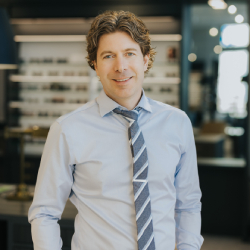
Dr. Warren Toews is the Managing Owner at YXE Vision Group, a Saskatchewan optometry group creating innovative, relationship-focused eye care experiences across multiple clinics. A Saskatoon-based optometrist for more than two decades, he leads with humility, trust, and a belief that culture drives impact. Dr. Toews focuses on helping teams deliver meaningful human connections, transformational patient experiences, and purpose-led growth in independent optometry.



Here’s a glimpse of what you’ll learn:
- [1:34] Dr. Warren Toews on building a relationship-driven optometry practice in Saskatoon
- [3:39] Dr. Toews’ path from ranch kid to optometrist after his grandmother’s vision journey
- [7:04] What being the visionary at YXE Vision Group means
- [9:17] Why young optometrists don’t need to wait to become leaders
- [17:03] How Dr. Toews uses hospitality to create transformational patient and team members
- [27:32] Removing the traditional front desk and creating a concierge-style patient experience
- [30:18] Dr. Toews explains why independent optometry allows freedom and flexibility
In this episode…
In an independent optometry practice, every interaction with a patient or team member becomes a chance to build trust, create connection, and show what the organization truly values. How can leaders turn those everyday moments into a culture that feels authentic?
The answer is to lead with intention, humility, and a genuine commitment to people. Dr. Warren Toews, an optometrist and leadership-focused practice owner, shares how authentic connection shapes patient care, team culture, and long-term growth in independent optometry. From replacing the traditional front desk with a more welcoming concierge-style experience to using “unreasonable hospitality” as a way to create meaningful moments, he offers practical reminders for leaders who want their values to show up every day. Dr. Toews emphasizes that leadership is not reserved for owners or seasoned professionals since every optometrist has an impact through each patient exam and team interaction. His perspective shows that connection is not a soft extra but a powerful leadership tool.
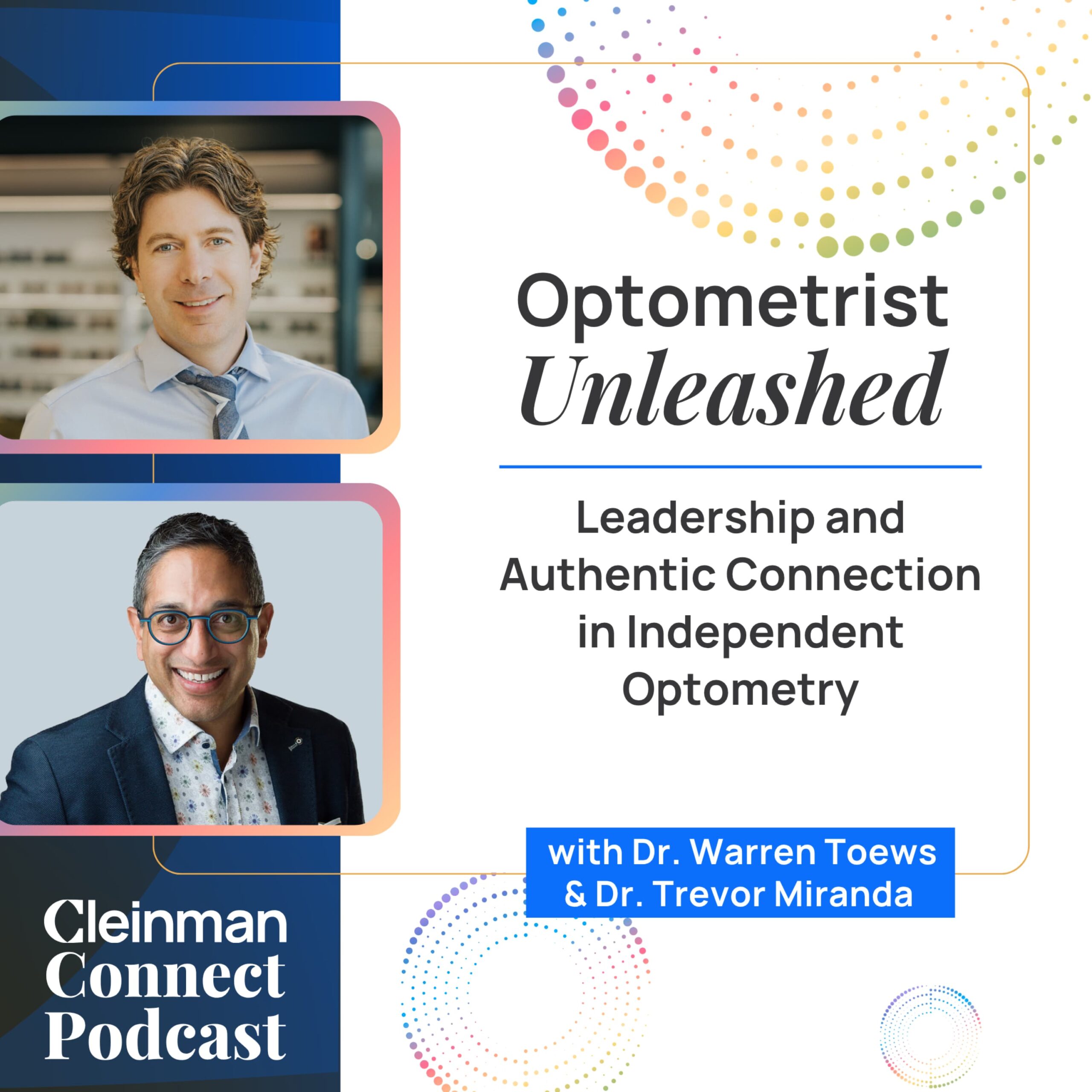
In this episode of Cleinman Connect Podcast‘s Optometrist Unleashed series, Dr. Trevor Miranda chats with Dr. Warren Toews, Managing Owner at YXE Vision Group, about leadership and authentic connection in independent optometry. Dr. Toews shares how to build trust, empower teams, and create meaningful patient experiences. He also touches on concierge-style care, local independence, and the future of optometry.
Resources mentioned in this episode:
- Kevin Wilhelm on LinkedIn
- Marketing4ECPs
- Cleinman Performance Partners
- POD Marketing
- Cleinman Network Events
- Dr. Warren Toews on LinkedIn
- YXE Vision Group
- Unreasonable Hospitality: The Remarkable Power of Giving People More Than They Expect by Will Guidara
Quotable Moments:
- “It’s growth with purpose; it’s growth with impact.”
- “Leadership is influence, and they already have influence.”
- “It’s about the impact… that we’re able to have.”
- “The hard times are what really defines us in terms of our culture.”
- “Every exam room that they walk into, they have influence into every interaction with every team member that they have.”
Action Steps:
- Lead with purpose, not just growth: Focusing on impact helps practices make decisions that strengthen culture, improve patient care, and support long-term success.
- Create meaningful patient connections: Listening with curiosity and empathy helps teams move beyond routine interactions and deliver experiences that feel personal and memorable.
- Empower the team to practice hospitality: Giving team members permission to show generosity and kindness helps them create transformational moments for patients and find more joy in their work.
- Build trust through consistent actions: Aligning what leaders say with what they actually do protects culture and shows the team that shared values are real.
- Use independence intentionally: Taking advantage of the flexibility of independent optometry helps practices adapt quickly, serve their communities well, and design experiences around what patients truly need.
Sponsor for this episode…
This episode is brought to you by Marketing4ECPs!
Working with them is like hiring a full-time marketing professional who knows the industry and understands your goals. Except, instead of one experienced marketer, you get a whole team in your corner.
Whether you’re an optometrist, ophthalmologist, or optician, they can help you grow your business with a plan that’s completely customized for you. Learn more here.
Powered by Rise25 Podcast Production Company
Episode Transcript
Intro: 00:00
Welcome to Optometrist Unleashed, a Cleinman Connect Podcast with Doctor Trevor Miranda, a monthly doctor led discussion about everything surrounding the business of optometry.
Dr. Trevor Miranda: 00:15
Hello, everyone, and welcome to another episode of Optometrist Unleashed, a Cleinman Connect Podcast. I’m your host, Doctor Trevor Miranda, coming to you from beautiful Vancouver Island. And today we’re diving into leadership with Doctor Warren Toews. Warren’s a Saskatoon based optometrist with a focus on thoughtful, relationship driven care.
He’s blessed to be a husband to Cindy and a father to Finlay and Jett. He has spent the past 20 years as part of the YXE Vision Group, an amazing group of people who believe in bringing love. I said that love to business. I want to dive into that and delivering transformational experiences to others. This episode is brought to you by Marketing4ECPs for working with them is like hiring a full time marketing professional who knows the industry and understands your goals.
Except instead of one experienced marketer, you get a whole team in your corner. Whether you’re an optometrist or ophthalmologist, an optician, or someone in the eye care space that wants to grow your business with a plan that’s completely customized for you, Marketing4ECPs. That’s marketing, the number 4 ECPs.com is, is your marketing team in your corner? Welcome, Warren.
How are you?
Dr. Warren Toews: 01:34
I’m really good, Trevor. Thanks for having me. It’s great to be here.
Dr. Trevor Miranda: 01:37
Oh, it’s it’s great to have you. And I know I’ve always wanted to talk to you. You know, you’re so fascinating to me. You’ve you’ve been building your business over the last two decades. Really in Saskatoon, right?
Dr. Warren Toews: 01:50
Yeah. 20 years now. It’s I’ve been in practice for 20 years. It’s it’s gone by and it’s like a blur.
Dr. Trevor Miranda: 01:55
And I’m so impressed with how you manage every interaction. Warren. I know that’s important to you. How do you stay grounded?
Dr. Warren Toews: 02:03
Well, that’s that’s a great question. I think, you know, sometimes it’s easy to get caught up in the whirlwind. And you know, this Trevor, like I’ve been, you know, thank you for your kind words. And I’ve been watching from afar kind of you as well. And, and all the amazing things that you, that you’ve done with your practice.
You’re a real innovator in this profession. And, and so it’s been great to kind of see what you’ve done and learn from you as well as other colleagues from across the country. But as you know, the, the whirlwind is real. And, you know, whether it’s the day to day patient care or working with the team or the some of the strains that come with growth, staying grounded is sometimes a challenge. And I think coming back to always keeping in mind why we’re doing it, the reason behind it, that purpose is so critical.
And then just staying true to those values that we’ve established for ourselves, that as an organization, that this is who we are, this is how we behave, and this is why we do what we do. And then just having people around us that is so critical, like it’s having a good team around us to remind us of those things. And, and for me, I’ve been blessed. I’ve, I’ve, I work, I’ve got three other partners, Doctor Skyler Feltus, Doctor Laura Prystupa and Doctor Phil LaForge. And they’ve.
And they’ve just been they’re wonderful partners and, and a real blessing to have because they kind of we keep each other focused on this task. Sometimes I think if it’s just us, it’s easy to drift. Right. But having others there to, to remind us of, of what we’re why we’re here is really important.
Dr. Trevor Miranda: 03:35
Yeah, absolutely. Did you always want to be an optometrist more?
Dr. Warren Toews: 03:39
Well, I was a ranch kid. There was a time I wanted to be a park ranger in in Banff National Park. Right around on my horse. I loved horses growing up. And then I realized that I get way too cold for that.
So that wasn’t going to work. And then then, and then for a while, I wanted to be a meteorologist because when you’re on the farm, everything ebbs and flows with weather. So but then I realized people don’t tend to like the weatherman very much. So. So then it was I wanted to do something medical.
And I, I really did want to do something medical. And, and my grandmother actually on my mom’s side ended up losing her sight in both eyes macular holes. And I was young at that. Quite, quite young at that age. I was about the ages of ten and 12 as she was going through this.
And, and I would accompany my mom as she would drive her to her appointments and, and she had several surgeries on both eyes with, with a great ophthalmologist doctor Murray Erasmus, I believe he lives in, in, in Victoria now. And, and she was able to, by the time I graduated optometry school and was able to do her eye exam at the examination near the end of her life, she was back to 2025 in 1 eye and 2030 in the other. And, and had and, and was able to kind of regain that vision and had a tremendous, tremendous, you know, rest of her life. And, to be able to see that transformational effect for her. I was hooked, right?
And so being and and being able to go along to those, those, those exams and those visits with, with the surgeon and see the different tools they used and how they did their work. It was it was very inspiring to me. So that’s what kind of formed my path.
Dr. Trevor Miranda: 05:14
Neat. That’s really cool. That’s really cool. You know, Warren, I, I know you’re, you’re an example that I, I think of a very humble leader. You sort of, you know, you’re not showy, but you’re really strong in your leadership skills, in my opinion.
And you know, what did what did younger Warren think success looked like? What did how have you evolved your leadership style?
Dr. Warren Toews: 05:37
That’s a great question. Well, you know, I think kids really keep you humble. I think that really that does really help with that. And thank you for your comments there. That’s nice to hear.
That’s nice of you. You know, I think younger Warren leadership, the kind of that success would have looked like growth probably. Right. You know, I think even coming from a farm background, you know, you the farm was continually growing and expanding and, and that kind of thing. And so early on in practice, I think success would have looked a lot like growth.
So growing the number of patients that, that we were able to see that maybe even the number of locations, team members, all of that that looked like success probably early on. And, and, and I think to some extent, that still is, you know, that factors into what success looks like. But we definitely now have a different mindset with respect to growth. It’s, it’s not necessarily growth just for the sake of growth. It’s growth with purpose, it’s growth with impact.
And I think that that’s where that mind shift has maybe happened more now. It’s like, it’s not just, it’s not about the numbers. It’s, it’s about the impact where that we’re able to have. And I know Trevor talking with you, I think you have a similar philosophy to that.
Dr. Trevor Miranda: 06:47
Yes, yes. Thanks, Warren. I do we share we share a lot of that importance on on culture and influence. And what did what gave you the impression you’re the visionary of your optometric group? What tell me what that means to you.
Dr. Warren Toews: 07:04
Well, I think one, it’s a real honor. I was I’m now the oldest partner. When I joined, I was with a another doctor. He’s since retired doctor Aaron Walters. I believe you knew him as well.
Trevor. And and great guy. And and really gave me the freedom to kind of express the vision that I had for where I wanted to take this practice. And he was so good about going along with that, even though I know he probably didn’t maybe even agree with it all the time, but he was he was so supportive in that way. And, and I think to me that that visionary kind of position is it’s it is a real honor, but it’s also a real responsibility because we have this group of people who, who, who, who basically have signed up to be part of this team, who give their working life to being a part of this team, and who want to know that.
They want to know that what they do matters and it has purpose. And so making sure that we stay true to that and that we set a clear vision that they’re able to follow, that they want to follow, they want to be a part of that. We’re authentic to that and that and, and, and that we’re able to be held accountable. You know, actually, one of the things that we have, yes, we have a visionary position. We talk about that, but it’s not necessarily me always saying, this is where we’re going.
That kind of it’s really me listening to our team, finding out where their passions are, where, where their purpose, all of our team members, you know, we’re close to 90 people now and, and, and hearing from them where as a group do we want to go? And then trying to form that into a new vision. So it’s not, it’s not Warren’s vision. It’s, it’s me trying to, to, to figure out and listen to our people and our other partners and all of these things. And in addition to that, we have, we have other partners who their job is to kind of do visionary management and and make sure that that.
Okay, so that’s great that you have this, that we have this idea, is it good to work? Right? And how do we make it work? And actually integrating that? And that is as if not more important than the vision itself, right?
So there’s many layers to this and how it all works.
Dr. Trevor Miranda: 09:06
Yeah. Awesome. As you know, my daughter is going to be graduating next week and as an optometrist. And what do you think younger olds misunderstand about leadership?
Dr. Warren Toews: 09:17
I, I think I can say this because I’ve been there. I think what they misunderstand sometimes is that that they are already have the potential that they don’t need to wait, that they don’t need to wait to be a leader. Leadership is influence and they already have influence, right? Every exam room that they walk into, they have influence into every interaction with every team member that they have. They have influence.
Every interaction they have with their friends, they have influence, right? And so don’t wait. They have, you know, they don’t need to wait till they’re, till they’ve been in practice five years or that they’re a partner, doctor or owner doctor to, to be a leader or that leadership is for someone else at some point down the road. You know, don’t wait. Start now.
Dr. Trevor Miranda: 09:55
Yeah. The opportunities right there. You’re de facto a leader just by your, you know, your doctorate designation as an optometrist. So that’s a really great point. I think the opportunities are there in every single action of your whole life to make an impact.
And I know you do that. Warren. What do older ODS sometimes forget?
Dr. Warren Toews: 10:15
I think that I think maybe older ODS, and I’m getting there now too. I’m in probably the second half of my career. Right. And I think sometimes is that we still have influence and still have impact and that the the younger generation, this generation that’s following us, relies on us to, to help encourage, to help guide our experience is going to be different than theirs was. But that experience really matters.
That insight of, of what we’ve gone through, they’re they’re thirsty for it. They’re hungry for that insight and that experience. And they may adapt it and they may use it in different ways. But, you know, they say, I think it was Mark Twain said, history doesn’t doesn’t repeat itself, but it rhymes. And so a lot of what we’ve gone through, they may not experience the exact same thing, but they’re going to experience something similar, right?
And so just being there to support and encourage is just so important. And not just kind of like, okay, I’ve done my thing and now I’m, I’m, I’ll just, I’m out. Right? And just staying involved and staying engaged.
Dr. Trevor Miranda: 11:13
Yeah. You know what I think too often is that sometimes forget that it wasn’t easy for us that we made mistakes and that we learned how to learn from those mistakes. And we need to be tolerant. I’ve had students for the first time learn. And, you know, sometimes you think, well, shouldn’t she know that?
Shouldn’t she know this? But I forget, you know, you’re you’re those 30 plus years ago, you know, so they’re learning and and and we need to be patient, tolerant and, and mentor them as they grow. How often do you talk to your team of, you know, almost 90 or 90 plus there Quite often.
Dr. Warren Toews: 11:48
Well, one of the things we do with our we have multiple locations, so we have seven different locations. And I don’t get to work in all of those locations. But we do try to keep. We do try to have partners in every location as often as possible. So we kind of rotate around.
I work regularly in three different offices, and then we have in two of our locations, we have kind of we have, we have two additional partners that, that are partners in only those locations. So we try to have, we try to have ownership presence in every location so that when people, if they do have questions, they have someone that they can go to on the regular. But besides that, we have a, a weekly team meeting using Microsoft Teams. We have a big we have a big TV set up in every office, and we live stream that actually all day, every day, so that at any given point, I can walk by that TV and I can look into every single office and they can, I can see them and they can see us. And, and, and then we every Friday morning, we have that team meeting, that huddle that we have.
And, and that’s an opportunity to Yes. To give like news and information. You know, operational news, but also just to do things like core value shout outs and, and things like that, cultural things. So, and then at twice a year, we get everybody together for what we call YXE University we actually just had one about a week ago. And actually earlier you had mentioned Marketing4ECPs, Kevin and Tyler from Marketing4ECPs was there and was able to give a little talk to our team, which was fantastic.
And, and that’s an opportunity to get together and, and obviously have some education, but, but really dig into the core values, the purpose side of the culture side of things and reconnect. Just get everybody face to face. I know Trevor, you have I believe is five locations. Is that correct? Yes.
Right. And so sometimes that’s a challenge, right? Even just even just keeping like sometimes they don’t get to see people from one location, don’t get to see the people from the other location for quite a while. And just that face to face connection is really, really important. And so it gives us that opportunity to get people together and reconnect.
Dr. Trevor Miranda: 13:51
Yeah. That’s awesome. You know, I think in optometry, sometimes we focus on clinical excellence and we underestimate the importance of leadership excellence. And you really focus that on that at YXE group. And so how, how, how have you been able to sustain this sort of growth over time, attract the right talent?
I know it’s sometimes challenging to get ODS to come to Saskatoon or to anywhere really.
Dr. Warren Toews: 14:15
Yeah, that’s that’s a great question. And I know that’s a challenge that a lot of practices are facing right now, especially, you know, especially my heart goes out to a lot of the people in rural practices right now, especially like it’s easier to attract to the larger centers, it seems. But I do feel that more than ever, I think people aren’t just looking for a place to work. I think they’re looking for a place that that gives their, you know, gives their work purpose and meaning that they can connect with the values of where they work, with the people they work with. They want to have that connection, right.
And it seems like the more we get into our phones in this virtual digital world, the more people are longing for that, that culture and that connection. So I think what’s been so important for us in, in terms of attracting people to this group, I really do believe this is, is the emphasis on the culture side of the organization. You know, that’s that feeling when you show up at work in the morning and you’re in that in your car that for that five seconds before you open the car door to go into work, is, is this your thought? I’m really excited to be here and see the people that I’m going to walk through the door and see. Or is it another day?
Here we go. Right. And I, we really hope that for our people, it’s the former, right, that it’s this idea that I can’t wait to see the people I’m going to walk through the door with and feel good about what I’m going to do that day. And so that’s been a really big, big piece for us. And then the other thing is, on the growth side of things, I would say we don’t we take a bit of a different approach to growth and that we don’t seek out opportunities and then try to find people for those opportunities.
We we don’t look for opportunities. We look to partner with great people who share, who kind of understand our purpose and share our values. And then we partner with those people and we and then we find the, the, the, or like the, the possibility or the opportunity that that’s going to work. So kind of a, I know it’s a very subtle, it might sound very subtle, but I think it’s an important distinction.
Dr. Trevor Miranda: 16:22
I think it’s really important that. So, you know, your greatest assets are your people. And then you can go from there. How do you how do you keep those people engaged long term? I, I know and you know, to your other point, you have that you have that commitment that you come to work and, and in a good frame of mind, and some of the people might struggle with that.
Like, how do you manage that differential?
Dr. Warren Toews: 16:49
Yeah, it’s, you know, that’s why we have the one. I think we have the other opportunity and the real blessing to be in a, in an industry, in a, in a profession that does get to deliver care to people. And so I think it’s a really, it’s a really, if you think about it, it’s a really easy, I think I believe profession to try to get. You get to see the results of what you’re doing right in front of you every day. And not every job has that as a benefit, right?
Sometimes sometimes that, that, that link to purpose is a little harder to see. That impact that you have on someone’s life is a little harder to see. But in our profession, Trevor and I know, I know you feel this because we’ve had so many conversations in the past about this kind of thing, but you get to see it right in front of you. You get to experience that and man like to, to do, you know, to, to, to know what you do matters and, to enjoy that work. What could be more fun?
Right. So I think, I think that’s a big part of it. And then we’ve set up the opportunity for people to, to kind of deliver what we call. And we didn’t name it this way. There is a great book.
It’s called Unreasonable Hospitality, and it’s by Will Guidara. And I’m sure a lot of your listeners have have read this book because it’s become a very popular book. We’ve had. We’ve really focused on this kind of unreasonable hospitality, generosity, and kindness as a way to achieve life changing, transformational experiences for, for patients and for our team members. And, and I guess how we, we think about that is when you have a day to day, how many you know, we have so many different interactions throughout the day, eye exams, people that walk into the office, people on the phone who call or call our company.
And, and then that’s an interaction. But we, we aim for connection, right? And, you know, and that’s this idea of, of connecting with another human being using curiosity and, and empathy and listening and and truly hearing what they need, that then we arrive at connection. But to get from connection to this life changing transformational experience, how do you get there? And I know that might sound that might sound woo woo, maybe to some, but I think you can get there.
And we believe we can get there because we’ve seen it by using this kind of unreasonable hospitality, kindness and generosity, something that that that when experienced, it just changes their perception just a little bit. Something changes in their mind that goes, this is different. This is different than what I’ve experienced in the past. And all of a sudden things look a little bit different now. That’s a really fun thing to be able to do.
And I guess this is a really long winded answer to that question. But I guess my point is, yes, our patients benefit from this when they get to experience that. But the biggest beneficiary has been our people, right? Because they’ve got to they’ve got to experience the joy in kind of delivering these experiences. And it completely, I believe, changes their view of what they’re doing in their work.
And so I think that’s one of the ways that we’ve we’ve tried to keep people engaged and, and moving forward along this path.
Dr. Trevor Miranda: 19:47
Yeah. And you’ve empowered your team to, to make, you know, amazing differences to, to have that unreasonable hospitality opportunity, take advantage of it. When you, when you get it. So they’re on the lookout for that and you celebrate that with your team. So that’s really good.
What, what, what kills culture? What do you think in your mind is a culture killer?
Dr. Warren Toews: 20:06
I think a lack of trust, right? If there’s a disconnect between what you say you’re going to do and what you do as an organization, I think that I think that’s a culture killer, right? And even the message we put out into the world, like if we’re, if we’re advertising ourselves or, or promoting ourselves in one way, but, but our people know that that’s not how we, that’s not how we behave or who we are. I think that kills culture. I think if we talk about how we treat our people in one way, and then we don’t live up to that standard in, in all in all situations that I think that kills culture, right?
Because it erodes that trust. Right? And, and, you know, you, we’ve all experienced this. You know, these the hard times are what really defines us in terms of our culture, right? It’s we went through that, you know, that Covid pandemic five, six years ago.
And, and I think that was personally for us, that was as an organization that was a real test for us. Right? How we responded in that moment, because we’d been preaching this people first love type based culture. And then all of a sudden this happened, this real threat to the business, to, to our health and how were we going to respond? Right.
And I think in the moment, how you, how you know, what you do in those situations really matters. Because if you’re not true to who you say you are, that just absolutely kills the culture.
Dr. Trevor Miranda: 21:22
Yeah, 100%. You know, the, the, the sort of the, the book leaders eat last where, you know, we’re modeling what we think is great culture. And, and that’s every single time, like everybody’s watching. Everybody’s learning, you know, from the leader. And so kudos to you, Warren.
You know, for, for, for doing such an amazing job. And I know it’s not, it’s not a show. I know you’re a leader in, in every interaction, every time I see you, even when it’s not with me and I’m watching, I really been impressed by how you lead. And I hope our, our listeners get a sense of your dedication to that and how seriously you take this. It’s not by accident that you’ve built an amazing culture.
It’s intentional. I think the opportunity there is to be intentional every single day in every single interaction, you’ve really proven that the reality is the success follows, that, you know, success follows that, and people want to follow you. I know you’re you’ve been invited to be okay with Cleinman and sort of mentor the next generation of ODS in this area. And I think you’ll be amazing. Do you have any thoughts on that?
Dr. Warren Toews: 22:29
I’m really excited about it. You know, obviously you and I both got to attend the Cleinman event in Austin a few weeks, I guess about a month or so ago now. And and it was an amazing event. And this, the peer to peer kind of sharing that takes place and issue solving and, and community conversations back and forth are so just hugely beneficial. You know, if we, if we have, we talk a lot in our organization about impact and, and this is just, I believe another way that if we have the potential to have impact and if we can, if we can help make things just a little bit better in some small way for any other group or individual, that’s what we want to be a part of, right?
And so that’s why I’m truly excited. And I really, you know, I really appreciate your comments, but this is the thing, Trevor. I just I’m just a representative. That’s all. I’m just, I, you know, I, I’m thrilled that I get to be on here and I get to talk with you today.
And I always say that I talk a lot, but I don’t speak a lot. So this is a different kind of format for me than what I’m usually. I’m more usually one on one in conversation, but I get to be an ambassador for the wonderful, amazing people that are in this organization and for my other partners. And, and, you know, this isn’t this isn’t my this isn’t my just my vision, my company. This is our organization.
And, and, and being able to be an ambassador for that and for these great people and to, and, and be a representative for that. It’s, it’s humbling. And, and it’s a real honor. And so I appreciate your comments, but I just want to highlight the fact that I just get to be this mouthpiece right now for this entire organization.
Dr. Trevor Miranda: 23:59
Yeah. It’s amazing. I’m looking forward to collaborating with you as well. Warren. With Cleinman, I want to talk about the future of optometry because I still am really excited. I’m bullish on our profession. Everybody’s got eyes or most people. And what excites you, Warren, about the future of optometry?
Dr. Warren Toews: 24:16
Yeah, I think it’s I think it is exciting. And I think optometry is just this really, like you said, there’s there’s new technologies coming down. And I know you’re such an an innovator in terms of bringing those technologies to patients. Trevor. I’ve always admired that.
And and, you know, I think there’s so many new advancements in, in opportunity diagnosis and treatment and all of these things. But it’s also, you know, it’s just this amazing profession where it’s this unique mix of, of medical. And then you also have this, this, this retail, like with respect to the dispensary and fashion element that comes in there. And the technical, scientific lens, optical side of things, it’s just this really unique mix. And, and that I think that mix allows us to really develop this connection with other people.
And I think on so many different levels. It’s, it’s, you know, and you can connect on the medical side in the examination on the personal side that we in that examination, and then on the fashion and optical side, it’s just it’s quite. And then, you know, with the industry, you know, how close the industry is this working together with, with respect to the profession, I think there’s just so much opportunity to elevate our role and not only in patient health, but in just in overall well-being of our. Maybe this sounds a little big, but in our society, I really do believe that we have a, an opportunity to play a role in the betterment of our society going forward. And I think if we embrace that.
Well, I think I think the future is very, very bright for optometry.
Dr. Trevor Miranda: 25:55
I love that. Is there anything that concerns you about where we’re going?
Dr. Warren Toews: 26:00
I think, you know, I don’t I don’t have a ton of concerns to be honest. Maybe I’m a bit naive in that respect. You know, there’s always been there’s always been, you know, the talk of threats, whether it, you know, whether it was online and different things like that. You know, I, I really do believe that, you know, if you focus on what you do and do it to the best of your ability with people that share the vision and, and the values, you know, those, if you focus really on, on what what you can do, the things that are in your control. And you know, also, you know, sometimes we look down the road and we try to make decisions based on what we think is going to change.
And sometimes it’s okay to step back and look down the road and say, okay, let’s make some decisions on what we think is not going to change. Right. Because that’s a little bit easier to predict. And, and I believe what’s not going to change is what I’ve already mentioned. And you’re probably getting tired of me mentioning is this need for human connection.
I don’t believe that’s changing. I don’t believe it’s going away. I think it’s getting. I believe it’s getting more important than ever. And so if we’re able to do that and do that well to, to truly see the needs of our patients, what they’re looking for, that if you’re if we’re good at that, then the threats I believe are, are minor.
Dr. Trevor Miranda: 27:19
Yeah. And you know, to that point, Warren, you’ve sort of changed how your practice looks. You’ve you’ve sort of taken away the front desk and you’ve introduced a concierge. And do you want to explain that to our listeners a little bit?
Dr. Warren Toews: 27:32
Yeah, I sure can. And thank you. So this was a decision we made back, actually. It was prior to 2020. It was we we wanted people to have a different experience when they came to the office.
And so the idea of having like kind of the big reception desk, and I understand why it’s there, because we need to answer phones, incoming phones, that kind of thing. But we said, okay, well, what if we didn’t do that? What if we took all the things that weren’t patient facing, you know, that didn’t immediately impact the patient that were standing in front of us in the office if we took that out. And so that the people in our office could just focus on the, on the people walking in the door, the people that were right in front of them. And so what we did is we created what we call it mission control.
So it’s a centralized administrative center. We actually created a company around it. We call it Wiki Vision Services. And that company and within that, we have a, we have a call center that receives calls patient from for all the offices. And we also have an inventory department.
It was responsible for HR, which we call people and culture. All of those things are kind of centralized. So all the accounts receivable, payables, everything, all the administrative functions that happen there. So anything that’s not patient facing comes out of the office. And what that’s allowed us to do is, yes, we didn’t need a big reception desk anymore.
We have a little host station, right? And that person is responsible. And that host is an incredibly important position because obviously they’re there to greet people and, and, and welcome them to the office. But they’re also the eyes on every person that’s going through that office, making sure that everybody’s being cared for in a timely manner, right? That they’re not having to wait.
They can go immediately into pre-test and see the doctor to keep things flowing, being respectful of the patient’s time and just making, you know, whether it’s offering them coffee or a bottle of water, whatever, you know, just making checking in with them, having a conversation, if they are waiting with them just to kind of see if there’s anything else that we can do, or just checking in with them to see how their day is going, right. So that has really kind of changed the dynamic and flow in our offices. And I believe for the better, I believe it’s enhanced the patient experience. And I know several other you know, we’re not unique in this. I think there’s other offices across the country that are doing similar things, and I applaud it.
I think it’s fantastic. And and I know, Trevor, you guys do I think something similar in your group as well. And, and I believe that that just helps to elevate that patient experience and help differentiate maybe from, you know, the traditional, you know, eye care experience.
Dr. Trevor Miranda: 29:54
Yeah, I love, I love that you’re experimenting as you go with this interaction at the front. How can you create better touch points despite the age of AI and some of the other back end technologies would just help free up our team to interact directly, face to face with with our patients. What do you think about independent optometry? Do we have an advantage in this area? What would you say the advantages are?
Dr. Warren Toews: 30:18
Oh, I think absolutely. I think the advantage that we have is independent optometrists in right now is that it gives us that autonomy, that freedom to do what we need to do to make the changes we need to make, to act quickly, right to make, to make quick adjustments to see where things are going. Look, I’m I’m the last person to talk about AI. I’m not a very technical person. I’m I’m still more of a of a ranch kid than I am.
Anyone who understands that kind of a thing. And but, but I do know changes are coming. And I do know what’s important. And I know it matters. And it’s important to embrace these things.
But being independent really gives us that freedom, I believe, to do that in a, in, in a very quick and easy way. It allows us to care about what the people we care about, care, care about. I know that’s a mouthful. Independent optometry allows us to care about what the people we care about, care about. And, and I, and I also think it’s important to like, just like right now, there’s a big push about local, right?
And local being big. And I, and I get it and I think, but I think it’s both independence and local. They’re not virtues unto themselves. It’s what I believe. I believe it’s what they allow us to do like it’s independent.
There’s not a lot of virtue in being just independent. If we’re not going to make good choices with that independence, right. I think the, the, the what’s so important about being about independent optometry is what it allows us to do, not independence just for the sake of independence. And same thing with local, you know, I think we’ve all walked into local businesses that maybe haven’t necessarily provided the best service. Right.
So just because they’re local doesn’t necessarily equal equal great experience or great service. But I think what local, it’s what people perceive local to be that community, that connection, that deeper understanding, they’re going to understand my needs. Right? And that’s if if lived out to its full potential, that’s what that’s where the virtue is in being in local. That’s where the virtue is in independence.
Does that make sense, Trevor? Do you?
Dr. Trevor Miranda: 32:10
It totally makes sense. It allows you the opportunity. I think that’s all it gives you. It allows you the opportunity to be excellent. And you know, your group in, in, in Saskatoon is really taking advantage of that.
I just wanted to pivot to something a little bit lighter and just get some insight on you, you know, okay, it’s sort of this or that or 1 or 2. Here we go. Coffee or tea?
Dr. Warren Toews: 32:34
Coffee.
Dr. Trevor Miranda: 32:35
Coffee, drink. Do you start the day with coffee?
Dr. Warren Toews: 32:38
Yes, yes, I do like a four shot Americano at the beginning of the day. Yes. Wow.
Dr. Trevor Miranda: 32:43
Okay. I’m sometimes worried about too much coffee for me. I’m already hyped up.
Dr. Warren Toews: 32:48
You have lots of energy. I get.
Dr. Trevor Miranda: 32:49
My eyes. I turn into Kash Patel. It’s like. That’s probably.
Dr. Warren Toews: 32:54
That’s.
Dr. Trevor Miranda: 32:56
Probably not the best hockey or CFL football.
Dr. Warren Toews: 33:01
I would say football.
Dr. Trevor Miranda: 33:03
Yeah. Football writers, go riders.
Dr. Warren Toews: 33:06
Go riders. Yeah. And my son is actually very big into NFL football as well. He’s a big Kansas City Chiefs fan. So I have watched my share of NFL football as well lately.
Dr. Trevor Miranda: 33:15
That’s fun to do on Sunday.
Dr. Warren Toews: 33:17
Yeah it is. Absolutely.
Dr. Trevor Miranda: 33:18
Yeah. Yeah.
Dr. Warren Toews: 33:19
And to share it with him. That’s a lot of fun too.
Dr. Trevor Miranda: 33:22
Yeah. My wife recently I think it’s the Taylor Swift phenomenon she recently got more with In the Heights podcast and things like that with the Kelce brothers, and.
Dr. Warren Toews: 33:30
It’s definitely brought some attention to it, that’s for sure.
Dr. Trevor Miranda: 33:32
Yeah, it really has. How about running or cycling for you?
Dr. Warren Toews: 33:38
100% running. Love it. Yeah yeah yeah absolutely. That’s my that’s my de-stress my debrief. Yeah.
Absolutely.
Dr. Trevor Miranda: 33:44
And what’s the longest you’ve run.
Dr. Warren Toews: 33:47
Oh I don’t I don’t run very long races. I, I tend to run kind of maximum ten, 12K maximum is what I would do more, more often I would run anywhere from 6 to 10K in a day. I try to do about 35K in a week.
Dr. Trevor Miranda: 34:02
Okay. That’s great. How about traveling or chilling out at home?
Dr. Warren Toews: 34:09
Traveling?
Dr. Trevor Miranda: 34:10
Yeah. What’s your favorite?
Dr. Warren Toews: 34:11
I’m not. I’m not a real chiller person.
Dr. Trevor Miranda: 34:13
Yeah. You’re quiet in a certain way, but I know you’ve got an intensity there, which is great, which is why you need to run like me. Yes. We gotta burn that fire a little bit. You know, cooler.
So we gotta we gotta get some of that extra energy out, though. Yeah, I appreciate that. Where are you? Anything on your bucket list to go someplace soon?
Dr. Warren Toews: 34:34
Oh, well, actually, we’re doing so we’re we are as a family. We’re a big Disney family. Actually, I’ve learned a lot from that organization. Those trips, it was eye opening to me the first couple times we went there. And actually we’ve we’ve incorporated a lot of Disney isms into our organization.
In fact, even one of our core values, we, we call Imagineer. And, and we’ve taken that from the Disney experience. So but in terms of this summer, we actually, we’re going to go to Europe for the first time. And my daughter graduates high school. She graduates grade 12 this year.
And. And so I’ve never been. And so we’re, we’re going to take that opportunity to go to Europe and, and see some sights there. And, and my wife has been a couple of times she’s excited to go back. But just to have that experience with our kids before they get too old.
Dr. Trevor Miranda: 35:15
Yeah. That’s amazing. Warren, I want to thank you for, for your time and for your sharing. And not just that in the Optometrist Unleashed podcast, but as we go forward, I’m, I’m excited with you helping mentor, you know, my daughter’s generation of optometrists that are coming into the profession. I hope if you’re listening, connect to Doctor Warren Toews and Warren.
I look forward to a lot of laughs and fun and learning from you as we as we connect in the future. Thanks for joining us today on Optometrist Unleashed.
Dr. Warren Toews: 35:46
Well, thank you, Trevor. This has been it’s been an absolute joy. I appreciate that all you’ve done for and continue to do for our profession. And I just absolutely look forward to working with you closely on this Cleinman endeavor. And I think it’ll be fantastic.
So all the best.
Dr. Trevor Miranda: 36:01
Yeah. And to you. Thanks, Warren.
Dr. Warren Toews: 36:03
Thank you.
Outro: 36:04
Thank you for listening. At Cleinman, we take pride in helping our optometrists unleash their full potential. Subscribe to get the newest episodes or visit us anytime@Cleinman.com.