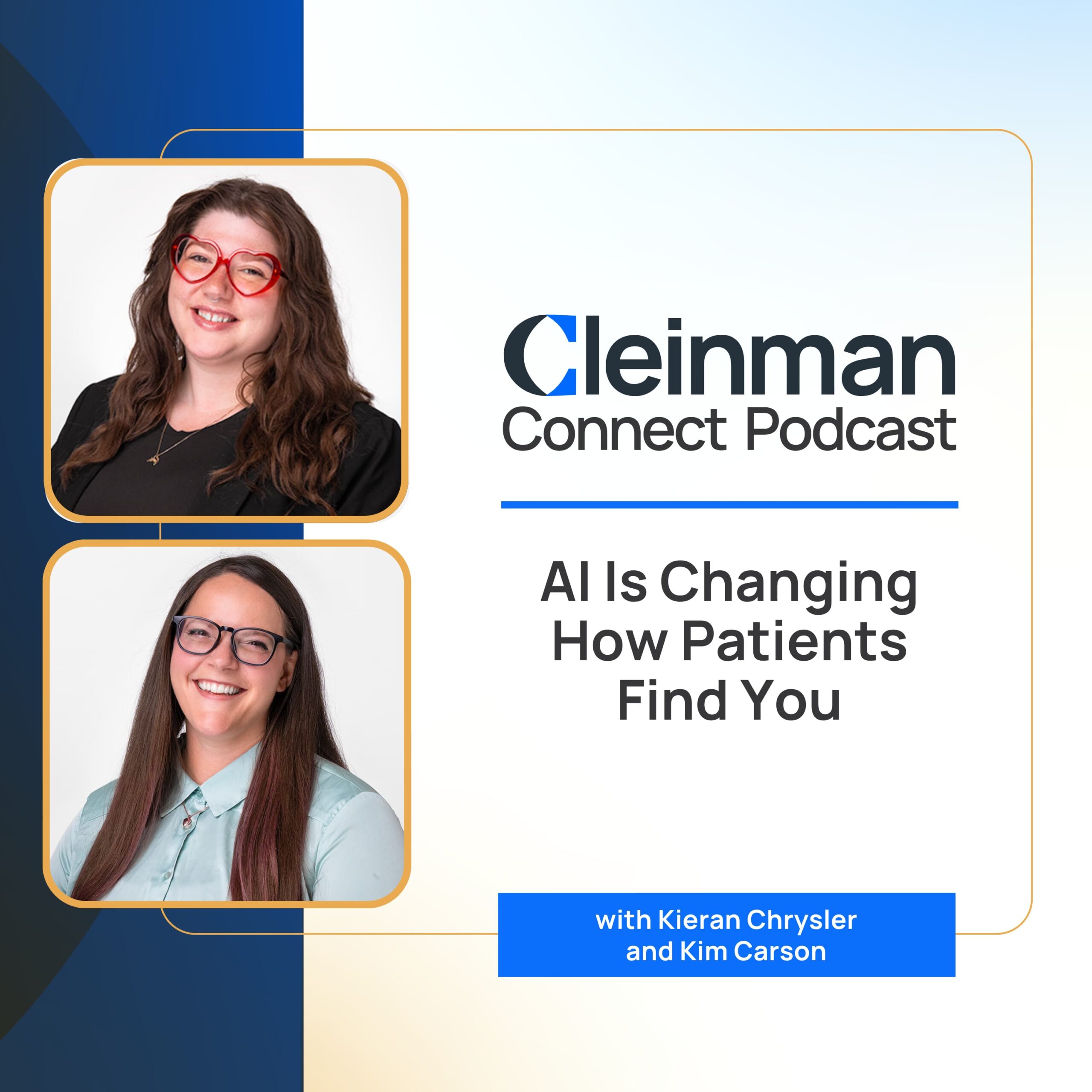

Kieran Chrysler is the Manager of Organic Strategy at Citizen, a marketing agency helping senior living brands grow through digital strategy and AI-era search visibility. In her role, she manages a team of strategists and helps communities bridge classic SEO with generative engine optimization, ensuring AI-driven discovery still reflects authentic human experiences. Kieran brings experience across healthcare, government, retail, publishing, and eyecare marketing, with expertise in SEO, GEO, brand visibility, and practical AI workflows.
Here’s a glimpse of what you’ll learn:
- [2:41] Kieran Chrysler‘s diverse background and career path
- [6:09] How search is evolving beyond traditional SEO
- [8:09] Kieran’s perspective on today’s major AI search platforms
- [9:14] Why people are changing the way they research and make decisions
- [12:17] What businesses can do to show up in more specific online searches
- [17:22] Kieran explains the growing role of reviews, trust, and social proof
- [23:15] Community presence, brand consistency, and practical ways to use AI more effectively
In this episode…
Search is becoming less about typing a few words into Google and more about asking detailed questions and expecting tailored answers. As patients use AI tools to find care that matches their exact needs, how can an optometry practice make sure it shows up?
Kieran Chrysler, an SEO and GEO strategist, explains that the answer starts with clarity, specificity, and consistency across a practice’s digital presence. Instead of relying only on broad keywords, practices need to clearly communicate what they offer, what makes them different, and where that information can be verified through reviews, community presence, and trusted third-party channels that help patients choose confidently. Kieran emphasizes that AI search is becoming more personalized, which means businesses must make their unique selling points easy for both people and AI crawlers to understand. For practices, the path to stronger visibility now means making sure the website, brand story, patient experience, and social proof all reinforce the same credible message.
In this episode of the Cleinman Connect Podcast, Kim Carson talks with Kieran Chrysler, Manager of Organic Strategy at Citizen, about how AI is changing how patients find optometry practices. Kieran explains GEO, AI-driven buyer behavior, and the role of reviews in search visibility. She also touches on community branding and using AI to simplify internal workflows.
Resources mentioned in this episode:
- Kevin Wilhelm on LinkedIn
- Kim Carson on Linkedin
- Marketing4ECPs
- Cleinman
- Kieran Chrysler on LinkedIn
- Citizen
- Breaking the ‘Non-Creative’ Label in Professional Spaces” with Jada Mazury on the Cleinman Connect Podcast
Quotable Moments:
- “The models generally function similarly. It’s mostly where they’re pulling information from that will vary a little bit.”
- “I think the biggest shift that we’re seeing is how people are using AI to understand what they’re buying.”
- “So whatever your unique selling proposition is, you can really hammer that home and just talk about it as much as possible.”
- “It comes back to the more positively your brand has talked about, the better you will appear in any digital search.”
- “If you’re trying to automate something, just ask the robot if it can help you, and it will tell you if it can’t.”
Action Steps:
- Clarify your unique selling proposition online: Clearly naming your specialty services, frame lines, treatment technology, and availability helps AI tools understand when to recommend your practice.
- Keep your website useful for real patients: Making information easy to find supports both AI discovery and the human experience once someone lands on your site.
- Strengthen your review strategy: Positive third-party proof helps AI models validate what your practice says about itself and rank you more confidently.
- Align your brand across every touchpoint: Consistency between your website, reviews, community presence, and in-office experience builds trust before patients ever walk through the door.
- Use AI to improve internal workflows: Asking AI what it needs to automate a slow or manual task can reveal practical ways to save time in the practice.
Sponsor for this episode…
This episode is also brought to you by Marketing4ECPs.
Working with them is like hiring a full-time marketing professional who knows the industry and understands your goals. Except, instead of one experienced marketer, you get a whole team in your corner.
Whether you’re an optometrist, ophthalmologist, or optician, they can help you grow your business with a plan that’s completely customized for you. Learn more here.
Powered by Rise25 Podcast Production Company
Episode Transcript
Intro: 00:07
Welcome to the Cleinman Connect Podcast, where we discuss marketing, ownership, growth strategies and everything else surrounding the business of optometry. Cleinman is Optometry’s trusted business partner for over 35 years.
Kim Carson: 00:28
Hello, I’m Kim Carson, hosting Kieran Chrysler, manager of Organic Strategy with Citizen, on this episode of the podcast. Past guests of the show include James Johnson of Cleinman and Jada Mazury of Marketing4ECPs and SmileShop Dental Marketing. You can listen to those episodes now at Cleinman.com or wherever you like to get your podcasts.
This episode is brought to you by Marketing4ECPs. Working with them is like hiring a full time marketing professional who knows the industry and understands your goals. Except instead of one experienced marketer, you get a whole team in your corner, whether you’re an optometrist or ophthalmologist or optician, they can help you grow your business with a plan that’s completely customized for you. Learn more at marketing4ecps.com.
And I’m joined by Kieran Chrysler,an SEO leader. Hi. Currently navigating the tricky transition into the world of AI search. Having dabbled in everything from healthcare and government to retail and publishing, she’s learned to get comfortable with the unknowns and loves trying something new, including even maybe a podcast with me. As the manager of Organic Strategy at Citizen Marketing, Kieran manages a talented team of strategists and helps senior living brands bridge the gap between classic search and the new world of AI driven discovery. Her focus is on making sure the transition to GEO generative engine optimization doesn’t trade away the authentic human touch that drives real results. Thank you for being here.
Kieran Chrysler: 01:57
Thank you for having me. Yay!
Kim Carson: 01:59
Of course. I right before we started, I did say that generative is one of my most hardest words to get out properly.
Kieran Chrysler: 02:12
I did great.
Kim Carson: 02:13
So yeah, I feel you know what? We’ve just started and I already feel accomplished.
Kieran Chrysler: 02:17
So yeah, wrap it up.
Kim Carson: 02:20
You know what? Let’s end it here. Well, no, thank you for joining me today. I would love to start by getting to know you a bit more. So in your bio, I mentioned healthcare.
I mentioned government retail publishing. It’s all a jump. It’s all a big jump to what you do now. What has led you here?
Kieran Chrysler: 02:41
Absolutely. Yeah, my background’s kind of all over the place, but everything has really been stepping stones to get into marketing. So by the time I finally got here, it just kind of felt like everything I’d ever done was really coming together When I was in university, I did a Bachelor of Commerce at the U of a Alberta University of Alberta.
Kim Carson: 03:03
Yeah. Okay, great.
Kieran Chrysler: 03:04
Yeah. Up there. So we know where it is. Up in Edmonton. But while I was doing my degree there in human resources, my real passion was in kind of the arts.
So I did a lot of volunteering with the student newspaper there, worked there for a bit, did some other like arts and culture writing, and realized that was kind of more interesting and things that I like to do kind of bridged all the writing and my business background to work for the Government of Alberta for a little bit. And then from there, post grad is always a little bit all over the place. So worked in retail space for a long time, worked in dentistry for a bit, but everything I was doing was really, I ended up kind of taking on the marketing pieces wherever I could because that was really where my interest lied. And then in 2022, post pandemic. At that point, I would say I was hired at pod marketing, worked with for EPS, doing some SEO things.
And now I’m kind of focused in the senior living space, which has been really fun, but a journey for sure. Yeah.
Kim Carson: 04:12
Wow. What would you say has kind of drawn you in about, I guess, the senior living community and like the Citizen division of our companies specifically?
Kieran Chrysler: 04:25
Absolutely. I love the challenge it takes when it comes to marketing, because the personas that you’re targeting with senior living, marketing is kind of opposite ends of the spectrum because you have the senior who is looking for potentially independent living or a solution to some of the problems that they’re having, but you’re also targeting the adult child. And now often the adult grandchild influencer who’s kind of supporting their loved ones into finding care and just making sure that they’re kind of living the best life that they can. So it’s a bit of a challenge to kind of navigate both sides, but it’s such a rewarding industry to be in and it’s been really great.
Kim Carson: 05:09
It’s interesting that you bring up the adult grandchildren of the people that might be searching for some of these places because as you know, marketers, I think we are challenged with the idea of like, who is your audience? So what a broad audience for you to have to think about really like.
Kieran Chrysler: 05:29
Absolutely. And it’s an industry too, that has historically not necessarily been cutting edge all of the time, but there’s not really an option to not be paying attention to these new services and technologies that we have access to and actually sifting through all the information. So it’s fun to kind of take this pretty historic industry and bring it into the future.
Kim Carson: 05:58
I agree. I want to get a couple acronyms out of the way. So we’ve already tackled GEO. Are there a couple more that we should know?
Kieran Chrysler: 06:09
Yes. So all of these have kind of bubbled up in the last few years. While we’re seeing more searches transitioning from Google or Bing only to these other areas like the ChatGPT, the clothes, the Geminis, the Grox, the everything that in between that comes through. So SEO is search engine optimization. We know it, we love it.
It’s been a discipline of marketing since Google kind of took over the internet 20 years ago. But generative engine optimization or GEO, as you mentioned, is kind of doing the SEO principles. But for the purpose of coming up in those answer engines. So like all of the AI models we just talked about. We’re also seeing people calling it a lot of different things.
I attended an SEO conference in the UK last year, and pretty much every talk was titled A EOGEOLMNOPO. But there’s a lot of different acronyms that are essentially saying the same thing. You’re optimizing to show up on these kinds of models that people are doing their research on now. So that’s kind of what we’re talking about when we get into all these acronyms. I’ve had my title changed three times when just people talking about what I do and it’s like, oh, you do this now, you’re the g o lead.
Okay.
Kim Carson: 07:36
I feel like we need to maybe after this podcast, we need to come up with a new one for CEO related related back somehow. Absolutely. So, okay, we’re getting into the different AI models. We’re looking at how people are now actually searching for things. It’s not the traditional ways.
You mentioned a couple AI platforms. Are there any in particular that are used more like, are we considering some more than others in this conversation today.
Kieran Chrysler: 08:09
The models generally function similarly. It’s mostly where they’re pulling information from that will vary a little bit. But the farther we get into this technology, the more they’re becoming more similar and how they’re scraping websites and delivering information to people. Popularity wise, I think ChatGPT and Claude are really coming up, but Google is becoming a bigger contender kind of as time passes. We saw a period where the Google models weren’t quite as strong, but they’ve recently changed how they’re actually structuring their search engines to kind of focus on the AI search.
And Gemini is just getting better every day. Knowing that Google does kind of have a bit of a monopoly on how people use the internet, for the most part, my theory is that Gemini is going to be the eventual winner, but we’ll see what happens when OpenAI has an IPO later this year.
Kim Carson: 09:06
Yeah, absolutely. How would you say that AI is changing buyer habits?
Kieran Chrysler: 09:14
For sure. So I think the biggest shift that we’re seeing is how people are using AI to understand what they’re buying. Last year, OpenAI worked with Harvard to release a study on how people are using ChatGPT specifically. And the peak at the beginning was right off the hop. Everyone was using it to write all their emails, to kind of just have a lot of outputs that were coming.
But as we’ve seen people kind of understanding where the tools are strong and maybe not as strong, we’re seeing that the primary use for something like ChatGPT is to do research and to seek information, because you do have the ability to give a very context rich prompt that kind of gets to the heart of your answer a lot quicker. So, for example, historically, I might have said, I’m looking for an eye doctor near me because that is how we’ve been trained to search within Google for so long. Whereas in Gemini I can go, I need an eye doctor in this specific neighborhood in my city. I want them to have weird frames that I can buy, and I want to be able to get an appointment next week, and it’ll take all of that context and serve me the answer kind of on a platter. Whereas with Google, you kind of couldn’t get that much context because it would just default to what’s closest to you.
Kim Carson: 10:35
Right? There was limitations with Google, whereas AI just has like kind of different is scrapers, like a weird word to use there. It has different scrapers, different crawlers.
Kieran Chrysler: 10:46
The crawlers? Yeah, they are a little bit different. It’s less so the crawlers and more just it can take more information, synthesize it, pull in more sources, and then give you something that’s different than a traditional search result because you’re kind of talking to it more like it’s a person. Whereas you talked to Google like it was Google. Like I remember learning in school how to search in Google because there was a specific cadence to how you could actually get the result you’re looking for quickly.
And we don’t really need that with ChatGPT and Claude and as much because you just brain dump everything you want into it and it comes back to you. So it’s helpful when you’re shopping though, because you can give it exactly what you want, even if you think about buying a white t shirt. It’s like I’m going on a trip to a Soyuz in August, and it’s going to be 35 degrees and I need a white t shirt. Here’s the perfect one. That’s going to be like anti sweat wicking these kinds of things.
Kim Carson: 11:47
Yeah.
Kieran Chrysler: 11:48
Retail coming out.
Kim Carson: 11:49
Well yeah there’s the retail portion of of your past.
Kieran Chrysler: 11:53
Exactly.
Kim Carson: 11:56
So with all of this extra, I guess like nuance that you can add to the thing you’re searching, how can people rank? Like how can anyone listening get their practice to show up? If there is this ability to be so specific in what you’re searching for?
Kieran Chrysler: 12:17
Part of the key is we go further is we’ve talked about keywords for a really long time when we’re talking about ranking online, and we’re still seeing that to be true, but you have to be even more detailed than you possibly did in the past. So if you know that people are searching for a very specific kind of frame, for example, like I think the meta glasses are a good example, they’re starting to get buzzy. People are looking for it. If you’re carrying them in your practice, but you’re not advertising and you have no mention of the fact that you have them anywhere on your website, there’s no way for the crawler to grab that and be able to serve it to someone looking for an eye doctor close to them who has the glasses or has specific dry eye treatment machines, or you can kind of apply it to anything. So whatever your unique selling proposition is, you can really hammer that home and just talk about it as much as possible, because that’s going to be a signifier that’s going to show up to someone who is looking for you.
Kim Carson: 13:18
Yeah.
Kieran Chrysler: 13:19
I think the trickiest thing to wrap your head around is that with the AI models, if you’re trying to think about optimizing for those, you’re kind of only targeting one person because the prompt is only one person is going to have that kind of context match. So you need to kind of layer the two because you need to still find as many clients and patients as possible, but you need them to also be able to find the specific thing that they’re looking for. And that’s where we’re going to see AI search kind of change how people make decisions is it’s getting so personalized.
Kim Carson: 13:57
And I wonder too does because traditionally, and please correct me if I’m wrong and I very well could be. Traditionally, traditionally a bounce rate also mattered. So if you’re building a page and it is just hammering home the same message again and again and again, people, actual humans that are on that site are not going to stay for a very long time, affecting the bounce rate to be higher, I guess because the time spent is lower. Does that impact it at all too? Like, are we considering like multiple multiple layers of who is searching and what is searching when we’re building pages?
Kieran Chrysler: 14:38
I think with your, when you’re building pages, you still want to have it be read by a person. You just want to have the information that they’re looking for. Easy to find, especially as we’re seeing the crawlers get more and more specific. It’s tough with things like bounce rate because it’s not a metric I hold as closely anymore, because we do know that a lot of traffic coming to sites is actually AI bot traffic, either from the models are just scraping for information that they’re then going to serve, or it’s a retrieval of someone looking for information. So it’s tough to hold that as closely as a metric anymore, simply because I don’t think any of the website trackers have caught up to the fact that there’s this huge influx of traffic that is not real people.
It’s the models that are being trained.
Kim Carson: 15:26
I see.
Kieran Chrysler: 15:27
So bounce rate is obviously it’s always going to be important, and it’s the sign of a poor web page. If like all of your pages have really high bounce rate, that’s something to explore. but the key still and the guidance from all of these companies is you still want the person that eventually gets to your website to be able to find the answer they’re looking for quickly, because none of us have an attention span anymore. Yes.
Kim Carson: 15:53
Someone used the term the other day that they were trying to come up with a slogan, or we were doing like some creative activity, and they said, I couldn’t think of anything. I had AI brain, and I just really wanted to ask ChatGPT. And I was genuinely horrified to hear that. But I think it’s like becoming a thing.
Kieran Chrysler: 16:14
It is definitely. And people are starting to talk in the inflection of ChatGPT when they use it a lot and structuring arguments in that way. So personally, I try not use it as much when I’m not doing something that needs it. You still got to work the brain, but it’s it does have its purposes. It’s just becoming reliant on it is where it’s like, I don’t know if this is the best thing for my brain health. It’s a bit dicey.
Kim Carson: 16:45
I would love to know. Traditionally, buyers at least like this is some of my experience. There’s some social proof before I make a buying decision. In this world where research is happening through AI models, how would you say that? Like the patient journey has been changing from, you know, reading a review instead of reading something that chat or Gemini says to find the practices near them or to make these decisions.
Kieran Chrysler: 17:22
I think what’s getting more and more challenging as we see buyers become more comfortable with this technology, is the models are also understanding what makes a valuable answer for people. And the reality is, when people are looking for a small business or something that’s local, they’re looking for the best in their area. And as much as you can claim that you’re the best in your area on your. Well, you can’t actually claim that legally on your website. That’s against all the college rules.
But.
Kim Carson: 17:54
Oh.
Kieran Chrysler: 17:55
Crazy was in eye care as well. But if you’re claiming that you’re the best on your website and that’s not reflected in your Google reviews, that disconnect is going to make the model say, I’m actually going to listen to the third party channel because it’s not your owned channel, and this is actually what people are saying. Kind of the logic where there was the period of time, kind of early in the ChatGPT days, where if you were looking for anything, it would source Reddit. And the reasoning was because Reddit is a place where real people are giving their real experiences with anything, and that’s why people go there for medical advice. Yikes.
Which is a different conversation. We know that’s not great, but knowing that people are looking for the best practice in their area, if your reviews don’t reflect what you are saying about yourself, you’re not going to be ranked in the same way. So the best thing you can have is that social proof, be it looking for Google reviews, looking for Yelp reviews anywhere else, great. MD all of these places where you can be getting people talking positively about you is going to help you rank higher in those kinds of searches.
Kim Carson: 19:10
Okay. I guess that that would also maybe flow into this idea of omnichannel marketing and making sure that your brand is reflected throughout all of your kind of digital footprint rate. Also, up until someone walks through your doors, would you have anything more to say about the importance of a brand. Like it’s not just so that AI is like thumbs up when they look at your content, but could you, you know, kind of elaborate on the importance of a brand.
Kieran Chrysler: 19:42
For sure when it comes to ranking in the AI model specifically? The best example I’ve ever seen of this is again, it’s an e-commerce example, but it kind of makes sense and helps kind of paint the picture. So if you’re looking for ethical denim or ethical blue jeans, if you type that into Google, often the first things that will come up are going to be gap, banana Republic, just big jeans retailers, right? And it’s not that they’re not ethical. It’s just when someone is searching for ethical jeans, usually my first thought is not somewhere I can go in the mall.
I’m looking for someone that like proven slow fashion pays their manufacturers probably a higher price point if we’re talking about something like that. And if you did the same search in ChatGPT, when this example was first being kind of talked about, you would get a lot of small brands that were kind of really actually living that ethos. And you can apply that to your brand as well as a practice. If you’re saying on your website that you are cutting edge, have all the latest technology, but people walk in and they find that you’re like running windows XP and you don’t have the latest and greatest when it comes to the technology within your practice, you’re not actually a high end brand. And if people are talking about you online, that’s not how they’re going to speak to you either.
So you need to think about the brand that you want to be showing online, and then actually live it in person. Because the more we get into this technological road that we’re going down, and the more AI people integrate with on a daily basis, the more we want human experiences and we actually trust the human experience more than we do anything we’re going to read online. So you need to make sure your brand is reflected online, but you have to actually live it within your practice doors.
Kim Carson: 21:38
Yeah, I think about I actually just went for an eye exam and I was looking at a couple places and one of them had their facts listed before their phone number, before their address. And I moved on. So I was like, there could be a risk, a possibility of me having to fax something to this place. No. Also, the fact that it’s so high up on the contact options.
No, we’re not gonna be getting along, I don’t think.
Kieran Chrysler: 22:12
Which is wild, because the logic behind that could just be that they have a lot of referrals that are coming from medical stuff. When I was working in a dental office, we faxed so much. I can still use a fax machine. That’s my fun fact.
Kim Carson: 22:27
Honestly. Impressive. Impressive. I think I faxed two things in my entire life, and both of them took me longer than I care to admit on a recorded platform.
Kieran Chrysler: 22:37
If you had to do it today, I don’t even know where I would find a fax machine.
Kim Carson: 22:40
That’s the thing. I’m like, I don’t know. Like, could I do it? Maybe. Can I do it?
Actually, I don’t know. I don’t have the tool. The.
Kieran Chrysler: 22:51
The one giant tool, the one giant tool.
Kim Carson: 22:57
I would like to know. So we’ve discussed that you’re in the senior Living Communities Marketing division of our company. What are some ways that you suggest those communities build their brands that could be transferable over to the eye care industry?
Kieran Chrysler: 23:15
Absolutely. I think the nice thing is that brand building in as a small business is applicable across industries. The tenets remain the same, and it’s obviously having an online brand is really important. We know that we’re a digital marketing company. Totally.
But thinking about your brand in the community can be just as important and impactful. So this can be anything from, do you have a partnership with a local school or senior group potentially where you’re educating them about eye care topics? Are you bringing people into your practice for like thought leadership, for example, or is there a way that you can speak in the community about eye care topics, identifying dry eye things about cataracts and senior living communities, all of these things, and integrating yourself with your community is a way to get your brand out there. And so people have actually interacted with you. The other thing is thinking about kind of online outside of your owned channels, so your website and your social media.
So if you are getting out in the community, how will people know about it? Something that can be really effective is reaching out to your local publications. So like your local newspaper, as much as print is slowing down, there is still a lot of online articles that are happening, and those newsrooms are still looking for local stories that they can talk about, because that’s really what the driver is to a strong community. So if you are participating in a charity run or doing one of these thought leadership projects within a school or something similar, are you reaching out to the publications saying, hey, we’re doing this. It’s about we’re trying to raise awareness for this.
Do you want to come and talk to us? And maybe we can see if we can cross collaborate or just have this published somewhere? It comes back to the more positively your brand has talked about, the better you will appear in any digital search. So it’s just finding ways to really get out of your practice and into your community.
Kim Carson: 25:27
Yeah. I like the. I completely agree. I like the idea of going to, you know, a school or something like a senior, like any age, any age, people have eyes and they need to see. So making those partnerships with anyone, even if you were in, you know, you’re not a standalone building, you’re in kind of a strip mall.
Go to those businesses around you. Like, what can you guys do to help each other?
Kieran Chrysler: 25:57
Absolutely. And like sports teams, like local teams as well, they need safety glasses. Local construction companies. Possibilities are endless.
Kim Carson: 26:06
Construction companies. That’s a good one.
Kieran Chrysler: 26:09
We gotta have their PPE. Can you give them cool or PPE that actually has prescription in it? Ooh.
Kim Carson: 26:19
Okay, well, I have one last question for you or for you. And before I ask, I will point people to our sponsors website again. That is marketing for ask.com. My final question for you, Kieran, is many of our listeners use AI scribe and some AI note taking technologies in their practices. But at Cleinman, we often hear from our optometrists the question of how can I be using AI more?
Or at least if not more, more effectively? And do you have a direction that you could send them in to answer that?
Kieran Chrysler: 26:55
My favorite thing to do with the AI models, if I’m trying to figure out how to integrate it into workflow, is to honestly ask it what it would need from me or what it can do for me, because it feels a little bit like you’re talking to a robot, but at the same time, it can be really effective for actually laying out the process of working it into your workflow if that’s what you’re looking for. So I know for me, something that I’ve was able to kind of prompt it through was I have this data that I need to have looked at. I need it to do, perform this task for me. How would I do that? And can you help me figure that out?
And through a bunch of prompting back and forth, it ended up helping me write a custom script for Google Sheets that I could then implement, and it has made my work a million times faster. So if you have a process or anything that you’re finding, like this is kind of slow, this is kind of manual, is there a way to automate this? Just ask whatever model you’re using, what it would need from you as a prompt to get from A to B, or if it’s even something that’s possible, because often it will answer in a way that you aren’t even really thinking about, because the system just works so differently than our human brains do. So that would be my suggestion. If you’re trying to automate something, just ask the robot if it can help you and it will tell you if it can’t.
Kim Carson: 28:20
Ask the robot what it needs, what it can do, what you should say. Okay, that’s I’ve never thought to do that. I just ask it like I put my data in or whatever task I’m trying to do. I put my task in. Then I go, can you do this thing for me?
And it’s like, here’s what I think you want. So I should have backed it up. I should have asked it first.
Kieran Chrysler: 28:44
Yeah, they work the best with the dialogue, I find, because we were kind of talking about the context rich prompts that people are using for like buying decisions. You can apply that to your any task you’re trying to automate as well. You just need to feed it enough information that it understands what it’s trying to do before you get to the output. So you can also say, I don’t want an output until I know you are going to do exactly what I want you to do. And if you tell it that, it will ask you all the questions.
And when I was writing a script, I can’t code. But it was like, you have to open Google. What’s the extension? You have to use Google Apps script. And then what is that?
How do I get it? And then it told me so you can have it walk you through step by step automating something. You just have to tell it that that’s what it’s doing.
Kim Carson: 29:35
Okay, that’s excellent advice. Thank you so much. Well, thank you for this episode today. And that’s our show. If you want to hear more of the podcast, you certainly can at Cleinman.com and wherever you like to listen. Thank you for joining me, Kieran.
Outro: 29:56
Thank you for listening. At Cleinman, we take pride in helping our partners unlock their full potential. Subscribe to get the newest episodes or visit us anytime at Cleinman.com.