
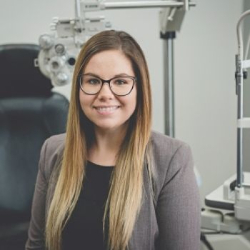
Dr. Alanna Wilson is the Owner and an Optometrist at Lakeland Family Eyecare, a family-focused practice offering comprehensive eye care, eyewear, contact lenses, dry eye therapy, and specialty services in Bonnyville and St. Paul, Alberta. Dr. Wilson brings experience in family eye care and ocular disease, with training that included externships at a VA hospital and a LASIK/cataract surgery center in Florida. She helps lead patient care, team culture, and practice operations across this multi-doctor, multi-location business.

Olivia Leduc is the Manager of Strategic HR Services at Cleinman, where she leads the HR support team to ensure that HR policies, processes, and documentation are compliant, efficient, and built to support scalable business operations. With experience in leadership, HR, and recruitment process development, Olivia drives improvements in operational efficiency and talent retention for clients.
Here’s a glimpse of what you’ll learn:
- [1:06] Dr. Alanna Wilson’s two-location practice structure and HR challenges
- [3:29] Why foundational HR tools can create more consistency across the team
- [6:26] How anonymous feedback helps uncover opportunities for better communication
- [8:30] Dr. Wilson’s approach to regular check-ins, feedback, and employee recognition
- [11:36] What stronger team engagement can reveal about workplace culture
- [16:41] Dr. Wilson’s process for defining values that guide both staff and patient experiences
- [28:03] Olivia’s advice for building alignment before rolling out core values
- [37:57] Olivia’s perspective on proactive HR, clearer expectations, and employee retention
In this episode…
Practice growth is often measured through new patients, revenue, expanded services, or stronger marketing. But the experience patients remember is shaped every day by the people answering questions, solving problems, and carrying the culture into each interaction. When employees feel heard, recognized, and aligned, how much more effectively can a practice grow?
Dr. Alanna Wilson, an optometrist and multi-location practice owner, and Olivia Leduc, a strategic HR services leader, both see employee engagement as a growth lever rather than just an HR concern. Dr. Wilson shares how anonymous engagement surveys helped uncover what her team needed most, including clearer communication, consistent feedback, and more intentional recognition. Olivia explains that practices often expect employees to perform consistently before they have defined expectations, core values, and performance conversations in place. The takeaway is simple but powerful: engaged teams are more likely to stay, contribute ideas, strengthen culture, and deliver a patient experience that supports long-term practice growth.
In this episode of the Cleinman Connect Podcast we have a featured episode of 4theRecord! Tyler Kemp chats with Dr. Alanna Wilson, Owner and an Optometrist at Lakeland Family Eyecare, and Olivia Leduc, Manager of Strategic HR Services at Cleinman, about employee engagement as a driver of practice growth. Dr. Wilson and Olivia discuss surveys, feedback, and core values. They also touch on recognition, one-on-ones, and proactive HR systems.
Resources mentioned in this episode:
- Kevin Wilhelm on LinkedIn
- Kim Carson on Linkedin
- Marketing4ECPs
- Cleinman
- Tyler Kemp: LinkedIn | Instagram
- Olivia Leduc on LinkedIn
- Dr. Alanna Wilson on LinkedIn
- Lakeland Family Eyecare
Quotable Moments:
- “Having the survey be anonymous was, I think, key to having the staff really open up and be honest.”
- “Honesty and transparency goes a long way.”
- “It just really is about team building and hopefully creating positive experiences for them to reflect on that.”
- “The number one thing is that I advise them to talk to their team first.”
- “You can catch so many things in those conversations about feedback.”
Action Steps:
- Use engagement surveys as a growth diagnostic: Gathering honest feedback helps leaders identify the communication, recognition, and workflow issues that may be limiting team performance and the patient experience.
- Turn feedback into visible action: Showing employees that their input leads to real changes builds trust, improves buy-in, and makes the team more invested in the practice’s success.
- Create consistent one-on-one conversations: Regular check-ins help managers spot concerns early, support career growth, and keep employees aligned with practice goals.
- Define core values with team input: Involving staff in shaping values creates stronger alignment, clearer decision-making, and a more consistent experience for patients.
- Build proactive HR systems before problems arise: Clear expectations, performance processes, onboarding, and recognition systems help reduce turnover and create the stability needed for sustainable practice growth.
Sponsor for this episode…
This episode is also brought to you by Marketing4ECPs.
Working with them is like hiring a full-time marketing professional who knows the industry and understands your goals. Except, instead of one experienced marketer, you get a whole team in your corner.
Whether you’re an optometrist, ophthalmologist, or optician, they can help you grow your business with a plan that’s completely customized for you. Learn more here.
Powered by Rise25 Podcast Production Company
Episode Transcript
Intro: 00:07
Welcome to the Cleinman Connect Podcast, where we discuss marketing, ownership, growth strategies and everything else surrounding the business of optometry. Cleinman is Optometry’s trusted business partner for over 35 years.
Tyler Kemp: 00:27
Welcome to our next episode of 4TheRecord. Today I am extremely excited to be joined by my friend and colleague, Dr. Alanna Wilson. So today we’re doing something a little bit different. We are doing a collaboration with Cleinman Performance Partners, and we’re going to be talking with Alanna about how her team has utilized the HR services through Cleinman. This is why I really wanted to connect now because within six months, you have had the opportunity to see how some of that evaluation behind the scenes goes, maybe start to integrate some of the tools that have been brought forward. But ultimately, let’s start from the beginning here. Can you tell me a little bit about Lakeland Family Eyecare?
Dr. Alanna Wilson: 01:06
So we have two practices, two locations, one in Saint Paul and one in Bonnyville. There are four of us doctors who own the practices, and they’ve been well established. Doctor Chuck’s been around the Lakeland for a long time. And then as other doctors have joined him over the years and we. I practice at both of the offices where some of the doctors are only at one or the other.
Tyler Kemp: 01:31
Okay. So thank you for bringing up that key point that within your practice, you have four doctor owners. Some of you practice at one, some of you practice at both. That’s a lot to take on when we consider running a business, it’s always challenging when you have partners and you’re trying to make decisions. But now you have two locations that are going to have their own nuances that are going to have their own staff, and ultimately they’re going to have their own HR.
Opportunities and challenges to deal with. So can you tell us a little bit about why you chose to start with the Cleinman HR program?
Dr. Alanna Wilson: 02:08
I was the most recent owner to join the practices. So when I joined, I noticed that I was having trouble kind of balancing work life HR because I’m a doctor first, so I’m not trained in the business aspect of things I’m learning every day. But having guidance and help, especially when it comes to HR or things that have guidelines and rules that need to be followed. Compliance. It’s nice to have something I can rely on to help me with that.
And having two offices, I have double the staff to deal with. So as you said, there’s lots going on at one or the other at any given time. So I was excited about the opportunity to have help with that because I find it a little bit intimidating.
Tyler Kemp: 02:59
So when you actually started meeting with Cleinman and talking through the HR details, I imagine there was a lot to focus on. But I think there’s a misconception that HR is really only referencing the hirings and the firings and the really minute details, but there is a lot more that goes into it, especially with this HR program. Can you talk a little bit about how you started and kind of like what steps you took at the beginning to kind of get the whole ball rolling?
Dr. Alanna Wilson: 03:29
There was an onboarding process explained to us, which was very appealing. It was kind of a get to know us, do the employee engagement surveys, which were very helpful just to get feedback from current staff to see where they stand with how they think the clinic is being run. Getting that feedback wasn’t always easy to hear, but I think it was necessary. I believe the four of us owners are very aligned. It just helps keep us that way.
After we did the onboarding, there’s also different projects that the HR program offers that we found very appealing. For example, the employee handbook. We’ve we have one or had one. It was printed off probably ten years ago, has a few edits here and there. And then one of my colleagues updated the Bonnieville one, but we hadn’t had time to update the Saint Paul one.
So it was very appealing to me to have someone just help us do that in a cohesive way and just get a project done that was always getting pushed to the back burner. So that was a really important thing, which is done now already we have our new employee handbook. It’s great. So the second project that we signed up for is the performance management system, which helps us with more of the day to day HR issues that can come up, dealing with people day to day when issues come up. When there is a performance management problem or like meetings to reward people when they’re doing well at their job.
So having a little bit more structure to that system is something I’m really looking forward to.
Tyler Kemp: 05:10
I want to come back to the I want to come back to the the employee handbook. I want to come back to basically the on, on the spot performance management piece and, and how you set that performance management going forward. But the one thing that I want to jump into first, because I feel like the moment a, the moment the average practice owner hears a employee engagement survey, I can just feel the shivers go down people’s spines to say, oh, everything feels good right now. Maybe I don’t want to know what I don’t know. Something that I’ve always admired about working with you is that you and your group have always been very focused on.
Great. Let’s look at what’s working well. But let’s also look at the opportunities. Let’s find those kind of hidden things. The the small things that can turn into big things if they’re not addressed early.
And a lot of that is very challenging to simply get out of a staff member in a general conversation. So can you talk more about the experience of the engagement survey and maybe, maybe even some of the things that came out of it right from the start that surprised you or even confirmed something that you’d been thinking, but it was great to hear that feedback from your team.
Dr. Alanna Wilson: 06:26
The entire process was really smooth start to finish. Having the survey be anonymous was, I think, key to having the staff really open up and be honest. I think we had pretty good response to it. So I think over 80% of the staff did follow through with the survey and give us genuine feedback, which was really helpful. I wasn’t necessarily surprised.
There was definitely things that they pointed out that we need to work on. Those types of things. I think most people can grow and learn from, which is excellent. They mentioned communication, which I think can be a challenge when you have four owners. So that is something we’re trying to learn and grow from for sure.
Clear communication, which during this process we’ve been working a lot on by making sure we’re emailing them every step of the way when we’re doing these things and making these changes, also reassuring them that this isn’t something that we’re doing because we think there’s a problem. We’re doing this because we want to just make it better.
Tyler Kemp: 07:33
The point that I want to hone in on that one is that I also think that the misconception could be that the results that come back from this, as you’re asking your team for what they feel about everything, is that it might be a it might be an avenue to complain or say the things that they’re really not happy about. But what you’re saying sounds like there is actually some quite actionable feedback that got delivered to you. So with that actionable feedback, then I imagine that being in a multi-location multi owner practice that gave you the chance to not just hear about something that’s happening at one location and make the changes there, and maybe let it organically cascade over to the other location. But it was something that you could talk about as a whole and start to figure out how to input into both practices to keep the consistency amongst all of the staff. Can you talk a little bit about maybe some changes that you’ve already been able to make?
Dr. Alanna Wilson: 08:30
We’re in the process of implementing some of these changes. It’s hard to say that there’s one specific thing that we’ve done to make a difference, because we already do quite a bit. What we’re trying to make it better. So I think in our journey with the Clean Air Program. We are going to address a lot of their concerns with these little projects along the way.
So for the performance management system, we have intentions of meeting with the staff once or twice a year consistently, when maybe that hasn’t been happening in the past, and they’re telling us they want more feedback, they want more one on one time to talk to us, even just to know that they’re doing okay. So we try to tell them here and there. And I think I’m more aware of that now too, of just in the moment saying, hey, thank you for staying extra today. Or thank you for going above and beyond, which I’ve always tried to do, but I make more of a point of it now because that feedback was definitely something that came up in the survey as well. Not always knowing where they stand or how they’re doing.
We have intentions of making these meetings happen, but when day to day going on, we get busy and it doesn’t happen. So with this performance management system. I think all four of us are more committed to setting a goal and sticking with it. When it comes to having these meetings once or twice a year and having the management more involved with meeting more frequently.
Tyler Kemp: 09:59
I’m going to pull a quote from a mutual contact of ours at at visualize. But Ann had said to me at one point, when we measure something, we can improve upon it. And it sounds like that’s exactly what you’ve done that you’ve always known and have always tried to deliver that proper feedback to your team to, to kind of give that kudos where it’s due. But the reality is, like you said, things get busy. You are a doctor and a practice owner first.
And then when it comes to the HR side and the business and the people management side, there is always an opportunity to learn kind of tactics to implement into your daily routine that can help improve that relationship between you and the staff, that can help improve the relationship between staff members and basically anything that you and the other owners do that, that. Kind of starting at the top mentality and growing that way can permeate down to. Anyone within the organization. What kind of changes have you seen within your team? In the way that they interact with each other or the way that they show up to work or interact with the business?
What are some of those things that now that you’re kind of putting a more focused measurement towards actions from an HR and a business management standpoint, or you’re even just integrating some of these tools that maybe you’ve spoken about with Olivia, or you have built in the performance management side of things, or really just learning how to put that kind of thing into the business from a team who is dedicated to understanding the HR and the business consulting and the business management side, like, what kind of things have you seen come up within the practice?
Dr. Alanna Wilson: 11:36
I would say more participation overall, especially staff meeting engagement. And we recently, as a part of this performance management project, did a little bit of a workshop at our staff meeting to help us develop our core values, which is part of the performance management side of things. So we can speak to the core values when we’re having these meetings and discussions and have a bit more alignment there, because we don’t have an actual established set of core values. So we’re working on that right now. We had a meeting a week or two ago with Olivia, so that’s exciting.
But they were very involved and I can tell that they care about where they work. And that is something that means a lot to me as an owner. So I take a lot of pride in what we are, in our culture and in our office. And I want to keep it that way. So I find that the team is definitely supporting us through this journey, which is what I wanted to see.
And I think they understand. At the end of the day, we’re doing this to try and make everything more enjoyable for everybody so that they can be more engaged and be more or more part of the team.
Tyler Kemp: 12:48
I love the way you said that, and I have the specific example of the fact that a few weeks ago, your team came down for a conference in Calgary and something that I rarely see practices do, which I think was just an amazing testament to the kind of business that you have developed, is you brought down your whole team. There was almost 30 people in a room between the two practices that came down for some education, for some fun, and I had the privilege of being able to sit down in a room with all of you and talk to you about a bunch of things. And what I really, really liked was that your team, from an ownership standpoint, actually requested that we talk through everything we do with the marketing and kind of explain the whole journey that way. And the reason that I like that wasn’t just because I got to talk about marketing for an hour. It felt like from an ownership perspective, your team really wanted everyone to be on the same page of what they were doing and how their actions on a daily basis, or how they show up to work, or even what you’re doing to be a part of the community.
From a marketing standpoint, that often happens really behind the scenes. Your team now has a full, in-depth understanding of what you’re doing, why you’re investing in certain things, how you’re trying to take the amazing things that they do, like creating awesome reels on Instagram. I show your Instagram to a lot of practices as a way that your staff can really get involved with pushing the business forward. I think it’s an amazing testament to what your team has put in place to say, we don’t just want our team members to work for us. We want them to be a part of the business because ultimately, they’re the ones who help drive forward the patient experience.
Can you talk a little bit about why it was so important to you to bring an entire team down for that educational piece, and to be a part of the conference for the weekend, versus just the four owners coming down and then relaying that information, because I feel it has some really great parallels to what you’re doing with the HR program.
Dr. Alanna Wilson: 14:53
We really try to embrace team building when we can, and we find these events usually accomplish that. So it’s not the first time that we’ve actually taken the majority of the team to something like this. And some of them have worked with us a long time, actually look forward to these events, which also means a lot to me, but it’s really important from a team building perspective also to just kind of take a break from the hustle and bustle of the clinic, get to know each other a little bit more outside of work. So these types of events are a little bit of a different way for us to show our appreciation to them as well, because we want to kind of spoil them a little bit. Take them out to dinner.
Have a weekend in Calgary on us. And it just really is about team building and hopefully creating positive experiences for them to reflect on that. Hey, if I didn’t work there, I wouldn’t have gotten to do all that.
Tyler Kemp: 15:53
So let’s get back to something you said a little bit ago, and that was focusing on the core values and how you’re actually building those out, because coming from a business here where every staff meeting that we have at four EPs, we celebrate the core values by actually nominating our colleagues. For someone who has done something in the past month that relates back to those core values and everyone here, it’s actually one of the things that on the first day you are taught the reason behind the core values, what they mean, and on a very regular basis, it is always tied back to. So I know you said you’re kind of just starting that process, but can you talk a little bit about the about the why and the experience so far of trying to very consciously choose what your core values are and how your business is represented by that.
Dr. Alanna Wilson: 16:41
I admire what your company does. I think that that’s an awesome way to be cohesive and use something that everybody can relate to. And like you said, celebrate. I think that that’s an amazing take on a core values. So we did a workshop with our team’s staff meeting at each office and had them go through questions and give out, like, suggest words that they think would be representative of the questions that we asked.
And then we took basically the common denominators. And then the four of us met to decide which ones we were going to focus on. So we’ve decided, and then we’re currently in the works of defining them and getting it ready to use as something that we can rely on to show even the patients what our business stands for. We have had a mission statement in the past, but I find with the core values, it just simplifies it. It’s got these specific words that you can revert back to.
And then also be proud of at the same time.
Tyler Kemp: 17:44
What this is telling me is that the efforts that you’re making from the HR side are actually going to support what you and I talk about on a monthly basis from the marketing side, because one of the questions that has become very prevalent in almost any meeting that I’m in, in these last few years, as the barrier to entry into opening an optometry practice has seemed to, it seems like there’s an optometry practice on every corner right now. And one of the questions that we ask people is, why would someone drive 10:20 other optometry practices and choose to come to you? And I think what’s very cool about the effort that you’re making and something that you said with the, with the core values, is that it’s not just about how the owners feel. It’s not just about how the employees feel, but it’s also about your patience, understanding what your core values are and actually weaving that into the message of why come to us? How important is it to you to communicate those core values to your patients and and to future patients?
Dr. Alanna Wilson: 18:52
I think it’s extremely important. So I’m really excited to establish something that we can use and resort back to and put on our website and have for people to really look at what we stand for. We are in a pretty small community, two small communities that are very community driven, and we like to be very supportive as well. So I think having those values helps patients make decisions on where they choose to support. When you’re in a small community like that as well, and the staff, even when we did the workshop, were very passionate about the words they were choosing.
And that shows me that I think they’ll appreciate having these values to be able to look up to as well.
Tyler Kemp: 19:42
And that is how I believe team members get invested in making the business something that they can be proud of. And it’s not just where they work, but it is a part of their identity. I feel that very fully at marketing for IPS. I consider myself ingrained in the business in my own head, because I feel like I share a lot of the similar values. I appreciate what we’re doing, and I and I love what we can do for the clients and practices that we work with.
It sounds like the fact that your team had involvement in choosing those core values, and they weren’t simply just told, these are our core values, these are your core values, but they weren’t consulted on it. That would be that would be a little strange, I would imagine. Going back to your team and saying, this is what you believe in. Even though this is what all of the owners came up with without insight from you.
Dr. Alanna Wilson: 20:35
Yeah, we try to keep them involved in a lot of the things we do. And obviously we can’t always do every idea or suggestion, but I do hope that they see that. We try to try to take ideas where we can and keep them involved in a lot of the decisions that we make, because they genuinely have a lot of great ideas, and we often, like, ask them for input and hope that they want to participate in adding to the business in any way. And we’re always listening, so we appreciate their involvement in anything that they suggest.
Tyler Kemp: 21:13
Alanna, can you tell me a piece of management advice that you’ve learned over the past few years here? I’d love to. I’d love to pick your brain a little bit in this, because I know that I know that coming in as the newest owner, you probably had different takes than what might have been status quo or doing something differently beforehand before you joined the ownership team. I’d love to hear a piece of management advice from you.
Dr. Alanna Wilson: 21:40
Honesty and transparency goes a long way. The staff do. They do like to be involved, and they want to know why we make decisions the way that we do. So when we include them and explain it to them, it helps them understand the why behind decisions that we make. And I have an open door policy.
They can come and talk to me any time about anything. And I think with that, they, they give me more feedback and they, they do approach me about things. So my advice is always welcome. Any criticism, good or bad or comments or questions or concerns. That’s how you learn and you learn.
Learn more about them to. Maybe what management style works for one person, doesn’t work for the other. Some people need meetings more often, some don’t. So having that open door where they feel comfortable to come talk to me when I can, when they can, or when they want to, I think is an important part.
Tyler Kemp: 22:37
I think that’s perfect. And I think one of the, one of the things that I wanted to ask you was kind of a bit of a vulnerable question in the sense of what is something that has perhaps come to light in maybe your management style, in maybe the way that you can be interacting with the team differently? What is something that has perhaps surprised you, or maybe you’ve had a bit of an epiphany that, oh, I need to integrate this a little bit more? Since having these discussions with Cleinman.
Dr. Alanna Wilson: 23:06
That comes back a little bit to the engagement survey and some things that came up because they they didn’t hold back when it came to that feedback. Some of it was humbling and took some time to digest and reflect on. But I do believe those types of things are things we can work on and grow from. We tried our best to take it as like a constructive type of feedback, but the communication was part of it. There were some comments made about just wages and things like that, that we can do a better job of showing them where they stand or giving raises if they’re due.
So those kind of things weren’t necessarily surprises, but they were definitely a common theme, something we should and will continue to try to work on.
Tyler Kemp: 23:58
It is opinions that your team is bringing forward, and it sounds like your team is doing a really great job at actually valuing that and saying, we don’t know how to put this into practice yet, but we have it on our radar now. We can talk with our HR consultant, we can come up with plans and overall just let the team know these are the issues that as a group you brought up, and these are the things that we’re going to do to start improving them. Alanna, is there is there anything else that we didn’t necessarily cover today that you’ve found that is kind of a key part of the value that you’ve found from working with the Cleinman HR program? Any final thoughts?
Dr. Alanna Wilson: 24:33
I think we did cover most of it. I’m looking forward to even more projects. And then when those projects are completed, I will feel a bit of a weight off my chest as far as having a more established system in place for HR and just having those performance management meetings and having templates we can use, and there’s always going to be things to work on, but we’ll have such a solid foundation made already that anybody coming in to work for us will be like, oh, this is how it works here. Even just employee onboarding systems like that and looking forward to, to implementing training programs. If that’s, that’s something that we, we have a system, but I do think we can improve on that as well.
So I’m looking forward to continuing working with them and then having our HR specialists there when I need them.
Tyler Kemp: 25:28
So Alanna, what I really appreciate that you’ve done today is talk about some of the big picture pieces that you’ve been able to talk about as a group, really get your feedback from your team and start to implement these. So the next part of this conversation is I’m actually going to be speaking with Olivia from our HR side of Cleinman, and I’m going to be talking to her a little bit about how she helps implement these tools with practices like Lakeland and how we can start to see and measure some of these improvements. So, Alanna, thank you so much for your time today. It was great to get your feedback on this. I’m so excited for all the things that you’ll continue to implement from the HR side, and I can’t wait to continue working together on the marketing side.
Dr. Alanna Wilson: 26:06
Thank you. Thanks for having me.
Tyler Kemp: 26:08
Okay, Olivia, just to break the ice here, can you tell us a little bit about who you are, what you do here?
Olivia Leduc: 26:14
Yeah, I am the Manager of Strategic HR services here at Cleinman. I’ve been with Cleinman for about a year and a half now and really building the HR program from the ground up, which has been really cool. It can vary day to day, for sure. Sometimes it’s helping clients with compliance questions and issues. So maybe they have an employee that’s not following dress code or someone who is consistently showing up late.
So kind of guiding them through those conversations and how to set those expectations. But it’s also on the other side, project based. So maybe it’s helping a client build their core values for their team that they haven’t had before, or building a performance management system. So everything from like, how do you have one on one conversations to performance improvement plans?
Tyler Kemp: 27:01
Now I’ve heard the term core values tossed around for years because that’s been a huge thing with for you about your, about our core values. In fact, every staff meeting, we talk about those core values and we nominate for. We nominate people who have done things related to our core values and helping things move forward. That way. It’s all easy until it’s your time to actually do it, and it’s your time to do it really well.
And I’ve seen the value of what setting up core values very intentionally can do for a business, and how it can really help to not just drive the business forward from the perspective of the owners, but how people start to understand the business that they’re in. So you walk into, you walk into a meeting with a brand new HR client, work through. We’ve met them through four EPs. They’re an eye care practice. They’ve never done this exercise before.
The owners know who their business is. They know what makes them a special brand. Where do you even start with that with them? What kind of questions do you ask them?
Olivia Leduc: 28:03
I think the number one thing is that I advise them to talk to their team first. Well, they have their core values and they kind of know what they look like to a certain extent. They also need to get their team’s buy in, especially with the smaller practice where everyone is so close knit, it’s important to get their buy in on those core values first. And it’s not necessarily that they have to take every single core value that their team shares with them, but it gives them good insight on where are we kind of where do we kind of connect the dots together?
Tyler Kemp: 28:33
We talk all the time about the analogy, rowing the boat in the same direction. So in this case, different people in the company could believe that they’re going in the same direction, but be getting there an entirely different way and actually be understanding what we’re talking about as the core values of the brand very differently, which could actually lead to opposing initiatives and keep the business stagnant or even moving a step back. Have you seen that from your experience, where the ownership truly believes that it’s understood, and then when they really talk to their staff, there is such a key divide in the overall understanding that, wow, we are not going to help this business move forward until everyone gets on the same page.
Olivia Leduc: 29:14
Yeah. Exactly that. Like there’s, you can have your core values and you can have it to certain things. But if they’re not clearly defined with examples of like what you want to see versus what you don’t want to see as well, then yeah, they can kind of completely take a core value the wrong way. And like you said, kind of you’re rowing in opposite directions now.
You’re opposing as important as it is to actually have your core values. It’s also just as important to make sure they’re clearly defined and understood as well.
Tyler Kemp: 29:43
So I’m going to ask this from a marketing perspective, because this is a marketing podcast. Why would this be so important? Not just from the internal side of the business, but to understand your core values and then basically implement them into your marketing, into the core of your business? Why is it so important that that is fully understood from the staff perspective, so that they can communicate that outwards?
Olivia Leduc: 30:04
Yeah, I think it’s really important for many reasons. Like I think about myself, for example, coming to You. Cleinman and I heard about it because of social media and marketing and the core values, I felt I really resonated with them, and that’s why I applied here. So from that perspective to like having those core values in place, it helps the employees, but it also helps potential patients and then also future employees as well.
Tyler Kemp: 30:34
I believe HR gets a a bad rap or gets put into a box as it is only the reactionary department. It’s the HR rules. It’s what’s stopping things from happening when in reality, when ownership is on the same page as management and they are on the same page as the staff, less problems arise. So would you say that putting a performance plan and basically performance management strategies in place early to spot the yellow flags or the red flags before they become issues, is that one of the key parts as to what you would be doing on the HR side of Cleinman.
Olivia Leduc: 31:14
Yeah, definitely. Yeah. I processes and setting expectations or something that is just so important. Like practice owners will come to me all the time and be like, this person’s not following dress code or this employee is not doing this and I want them to do this. And then you just ask, well, is this an expectation that’s been in place?
Or is this a process that’s been in place or a conversation that’s been had and they go, no, no, it hasn’t been. So practice owners are looking for their employees to be consistent when there aren’t consistent policies in place. So it’s leading to those inconsistencies and having those policies set up ahead of time or for performance management, like having one on ones with people. You can catch so many things in those conversations about feedback. You can have expectation conversations, you can kind of cover all those things that get missed if they’re not being done consistently.
Tyler Kemp: 32:10
So I’d like to dive more into the one on one side, because that is something that has been a fundamental piece of what four EPS has been over the past ten, 11 years that it’s been around. And it is the weekly one on ones with managers. And I’m sure that within different businesses, within practices that you work with, there’s different cadences to do that. But can you speak to the value from your perspective as to how important it is to have one on ones with team members?
Olivia Leduc: 32:38
It’s so, so important. And to your point, just on the cadence, like in practices, I understand it’s completely different. They’re not sitting at their computers all day for eight hours like we are, and have that time when there’s patients coming up and employees coming up. But even setting aside 15 minutes per month where that employee knows, like every Thursday at 1 p.m., I’m gonna meet with my manager. This is my time to have with them to talk about issues, to talk about my growth.
And it just makes such a difference for employees to know that they have that time set aside for them.
Tyler Kemp: 33:12
Why do you feel it’s so important to have those regular talks about the positive things happening and kind of career development, and maybe even growing that person to a stage where they outgrow the role that they’re in? Why is that so important that we need to focus on that?
Olivia Leduc: 33:26
Recognition is just so important. Like if you’re not getting it, you don’t know where you’re at. And some people will take that as if they don’t get recognition, oh, I’m doing a really great job. And then other people will say, oh, I’m not doing a great job. And that’s where your top performers might feel like they’re being missed.
The number one thing that comes out of engagement surveys is the need for recognition and feedback as well. Employees want that and they all want it like a little bit differently too. But it’s the number one thing that people are asking for.
Tyler Kemp: 34:00
You and I are in an interesting case where we kind of sit between a couple of generations or I mean, maybe at the end of one and the beginning of another with a new generation of employees. There are different expectations as to how they want to and like to receive feedback. And that isn’t necessarily just, well, I pay you and you’re employed. And when you do a great job, you’ll be promoted. There are many different things that go into that.
So how from how from your seat, do you tend to coach business owners on how to work with this newer generation of employees that maybe want something different, want a little bit more recognition, and want to really understand not just where they’re doing well, but how they can improve, how they can get better.
Olivia Leduc: 34:47
I think the number one thing that I recommend is just for the business owners or management, to have that conversation with each individual. There’s so much that you can learn about a person through kind of figuring out how they want to receive recognition and feedback. Is it in front of a big group or is it one on one, or is it do they like handwritten notes? You have to tailor it to what each employee wants, and it’s through having that conversation. It seems quite simple, but you learn so much from how do they actually receive it and want to receive it.
Tyler Kemp: 35:19
From that, from that side. Then how do you how do you even start with a practice to kind of get them into the stage where they can begin learning those preferences with their teams? Because I’m assuming there’s guidebooks, I’m assuming there’s things like assets that you can work through. Lots of questions like how do you help them set this up so they’re not having to come to you every time they have a question like this, how do you help them kind of do this on their own?
Olivia Leduc: 35:46
Yeah, I think the first step would be kind of that engagement survey with them to figure out what their overall team consensus is on what they need. And typically it will be that recognition or feedback piece from there to it’s something I worked with, with another practice on recently is they kind of sent out like a mini survey to their team where it was like, how do you like receive feedback recognition? So one on one in, in groups, whatever that kind of looks like. And then taking that information and then having one on ones with each team member to kind of facilitate that conversation, because usually they don’t know where to start, but the employees already filled it out how they want to receive it, and they just need to take that as a guide and kind of dive a little bit deeper to figure out what exactly that means to them.
Tyler Kemp: 36:32
Can you tell us a few of the questions that we could find on a typical engagement survey? Because I’ve been fortunate to do this for 5 or 6 years now, and I see very common questions each year. In fact, I believe they’re the same questions that that continue to go out with very small changes just so that it’s consistent year over year, that when you look at an evaluation, it’s not that you’ve changed the questions to get a better score. In fact, keeping those questions the same and then seeing some years when the score isn’t as high, that can really kind of poke holes in what you believed was everything’s going great. Can you talk a little bit about some of the other questions that that we might find on a typical engagement survey, and how they lead to improvements at a business?
Olivia Leduc: 37:16
Common one to so recognition and feedback for sure. But also I have the tools that I need to do my job successfully. Do I know my accountabilities? Like, do I know, do I have a job description? Do other people have a job description?
Which brings me to another question. Is my colleagues perform their job to the best of their abilities or such?
Tyler Kemp: 37:37
What is the most common problem that you see a practice dealing with that maybe they don’t even know it’s a problem when they first come in to meet you. But after asking the questions and discovery, what’s one of the most common things that practices discover and go? That is a major thing that we need to work on in order to improve the HR side and the people management side of our business.
Olivia Leduc: 37:57
I think it’s honestly a little bit different for everyone, but it boils down to not having processes or expectations in place, whether that comes from performance management or harassment policy. Like you don’t have those things in place until you need those things. So going from proactive rather than reactive and putting out all these fires, a lot of these practices don’t think they need these things until they kind of happen. So fix the roof when the sun is shining or whatever that goes is they need to think more strategically rather than reactively to issues when they come up.
Tyler Kemp: 38:39
I think what you do and what your team does is the uncomfortable work, actually planning for the issues that could arise rather than focusing on what’s going well and kind of just continuing to push in that direction, because we can build the structures of a team based on the top performers. But the reality is, most of the time that we have top performers, it’s going to be very hard to find people who live up to that same quality. So setting those standards in place of the expectations that everyone lives by, the standards that everyone lives by, how you’re going to be evaluated, and basically how you provide feedback on a regular basis. It’s extremely important to set that ahead of time so that when problems do arise, or when you’ve brought someone in that you feel is going to be fantastic and they’re just not cutting it, you can actually talk to them, or you can talk to your management team about the, that feeling of maybe they’re just not cutting it. How is that actually defined?
If there is nothing written down and no process developed to say what doing the job really, really well actually looks like?
Olivia Leduc: 39:49
Yeah, there’s kind of two parts to that. And like core values is a huge thing. Like, are they actually going to do they fit into your core values? And that’s one that I see a lot where maybe they’re like on the fence about teamwork or positivity, where it’s like, no, they have to, they have to be positive. They have to be a good team member.
And I had this conversation with a practice owner recently, and they have an employee on their team that they were literally like the hairs on the back of my neck stand up every time I’m near this person. And they couldn’t really define it more than that, but it did come down to their core values and their job responsibilities and their behaviors. But they they couldn’t really define that feeling until we had that on paper. Like, this is what you need to look out for.
Tyler Kemp: 40:39
Olivia, is there anything else from an HR side that any, any additional kind of HR advice or from a perspective of how someone knows whether working with you as their practice, it would actually really benefit them? Like something that they’re dealing with on a regular basis. Anything that we haven’t touched on today that would make someone go, yeah, it would definitely be worth getting in touch with Olivia and the Cleinman HR team.
Olivia Leduc: 41:03
Yeah. In this industry, there is a lot of turnover with employees, and that can come down to hiring practices that could come down to are they your core values? Are they aligned? Are these expectations set? There’s so many different places turnover can come from.
And part of the HR services is we can help kind of dissect where that’s coming from. Are you asking the right questions in the hiring process? Are you having performance conversations with your team? Are you giving regular feedback and recognition? But we can kind of help dissect where that’s coming from.
It’s usually one of those areas. But yeah, we can kind of help with that. Overall employee retention and engagement. A lot of practices make this mistake where they don’t actually know what they’re hiring for and just post a job ads, and they don’t think about those red flags or yellow flags or things that made previous employees unsuccessful in their role. And it seems simple, but just like taking that step back and really understanding what they actually need out of a certain employee is huge.
So it does come down to hiring as well. And you’re going to make mistakes like no one’s perfect at hiring, but it’s recognizing that before it affects team culture.
Tyler Kemp: 42:23
Olivia, thank you so much. I know how busy you are with all of your clients. Thanks for taking the time.
Outro: 42:30
Thank you for listening. At Cleinman, we take pride in helping our partners unlock their full potential. Subscribe to get the newest episodes or visit us anytime at Cleinman.com.