
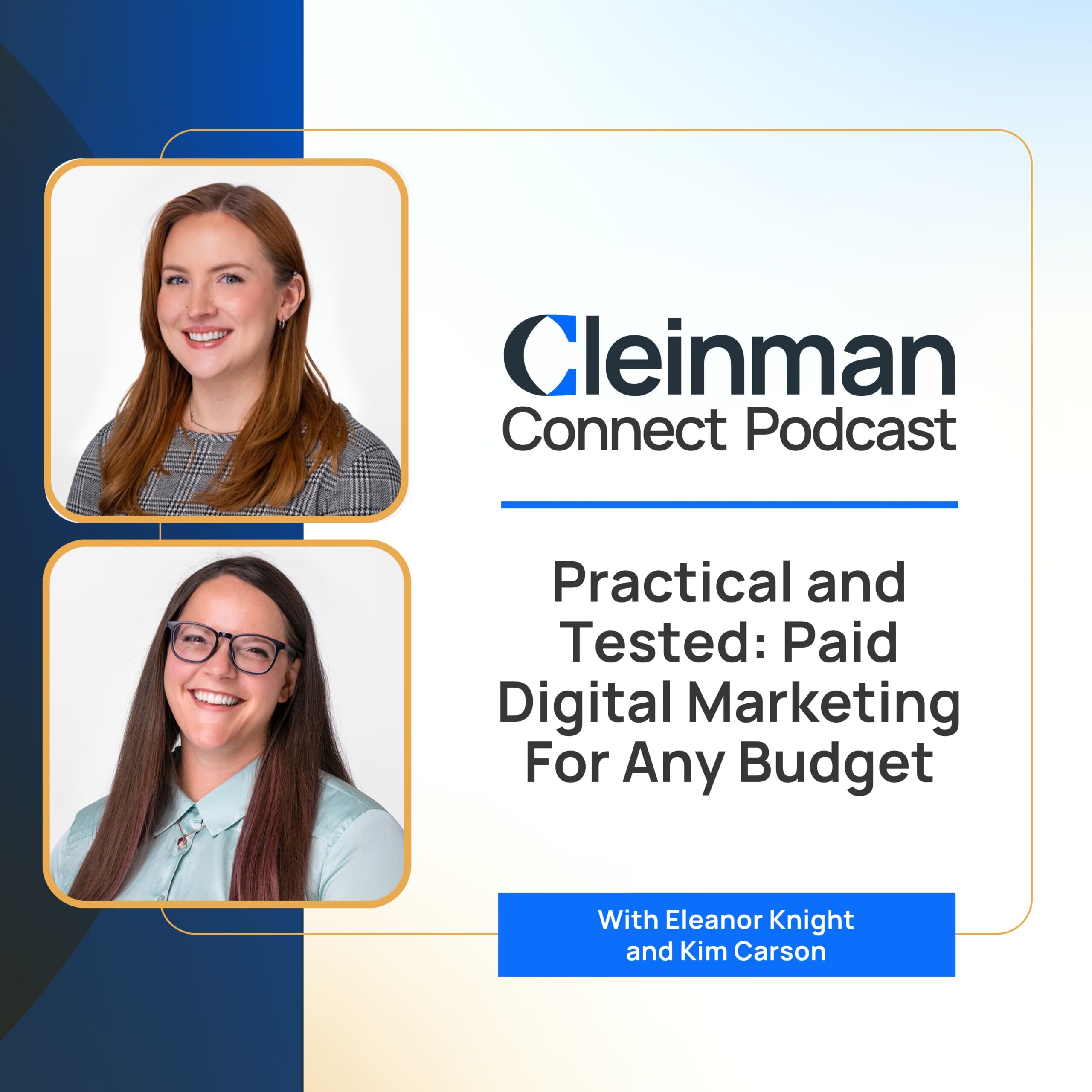

Eleanor Knight is the Senior Digital Marketing Strategist at Marketing4ECPs, a digital marketing agency that provides tailored marketing solutions for eye care professionals. With a management degree focused on marketing from the University of Lethbridge, she brings experience from agency, platform, and in-house roles. Eleanor specializes in paid media strategy, audience targeting, and campaign testing, helping eye care practices make smarter decisions across search, social, display, and geolocation advertising.



Here’s a glimpse of what you’ll learn:
- [1:37] Eleanor Knight’s path from marketing studies at the University of Lethbridge to agency, platform, and in-house roles
- [3:30] How Eleanor balances client requests with data-backed paid media recommendations
- [4:59] Where geolocation, display, paid social, and paid search fit within the marketing funnel
- [7:15] Why audience targeting changed after Apple’s privacy updates and Facebook’s audience shifts
- [10:42] A campaign restructuring that increased conversion rates by 15% month over month
- [17:45] Eleanor’s surprising display campaign conversions for an anniversary party
In this episode…
Paid digital marketing works best when it is treated less like a guessing game and more like a series of smart, measured choices. When every budget has limits, how do practices know where to invest and what to test?
The answer is to align strategy with goals and let the data guide the next move. According to Eleanor Knight, a communications-minded marketing strategist with experience across agency, platform, and in-house roles, paid search often sits closest to driving action and conversions, while display, geolocation, and paid social help build awareness and consideration. She explains that stronger results come from sharper structure, like grouping keywords more thoughtfully, tailoring ad copy to match search intent, and testing one variable at a time, so even small-budget campaigns can produce useful insights.
In this episode of the Cleinman Connect Podcast, Kim Carson is joined by Eleanor Knight, Senior Digital Marketing Strategist at Marketing4ECPs, to discuss practical paid digital marketing for any budget. Eleanor covers how paid search, display, geolocation, and social channels fit within the marketing funnel, how audience targeting has evolved, and why testing one variable at a time can make a big difference. She also shares how a display campaign delivered 97 bonus conversions.
Resources mentioned in this episode:
- Kevin Wilhelm on LinkedIn
- Marketing4ECPs
- Cleinman Performance Partners
- Eleanor Knight on LinkedIn
- “Digital, Traditional, and Best Practices for Marketing in Optometry” with Kate Virzi on the Cleinman Connect Podcast
- “[Optometrist Unleashed] The AI Evolution in Eye Care: From Scribe to Strategy” with Dr. Eric Jennings on the Cleinman Connect Podcast
- “[Optometrist Unleashed] Myopia Management and Going Beyond the Blur” with Dr. Marie Bodack on the Cleinman Connect Podcast
- “[Optometrist Unleashed] Healing the Ocular Surface” with Dr. Julian Prosia on the Cleinman Connect Podcast
Quotable Moments:
- “Paid social mostly includes awareness and consideration, but with the right kind of creative and the right kind of audience targeting, you can even get it up to that action and conversion piece.”
- “Different locations and different audiences respond differently to different creatives.”
- “That’s generally our bread and butter here, but that’s focusing on that action and conversion.”
- “What we don’t realize is that when we put ourselves against someone else, we’re being ranked in the same way.”
- “The best way to test is obviously with an A/B test running at the exact same time with the exact same audience.”
Action Steps:
- Align paid strategies with your marketing goals: Matching each channel to the right stage of the funnel helps practices build awareness, encourage consideration, and drive conversions more effectively.
- Use data to guide client conversations: Backing recommendations with performance data and historical experience makes it easier to balance client preferences with strategies that actually support their goals.
- Refine audience targeting across platforms: Exploring broader audiences on social media and niche communities on platforms like Pinterest and Reddit can help practices reach the right people at the right time.
- Structure paid search campaigns thoughtfully: Grouping keywords cohesively and tailoring ad copy to match search intent can improve ad strength, competitiveness, and conversion rates.
- Test one variable at a time: Focusing each test on a single element, such as creative format, imagery, copy, or tone, produces clearer insights that can improve future campaigns.
Sponsor for this episode…
This episode is brought to you by Marketing4ECPs.
Working with them is like hiring a full-time marketing professional who knows the industry and understands your goals. Except, instead of one experienced marketer, you get a whole team in your corner.
Whether you’re an optometrist, ophthalmologist, or optician, they can help you grow your business with a plan that’s completely customized for you. Learn more here.
Powered by Rise25 Podcast Production Company
Episode Transcript
Intro: 00:07
Welcome to the Cleinman Connect Podcast where we discuss marketing, ownership, growth strategies and everything else surrounding the business of optometry. Cleinman is Optometry’s trusted business partner for over 35 years.
Kim Carson: 00:28
Hello, I’m Kim Carson, hosting Eleanor Knight, Senior Digital Marketing Strategist for Marketing4ECPs on this episode of the Cleinman Connect Podcast. Check out our monthly Optometrists Unleashed podcast episodes with Dr. Trevor Miranda. You can listen to those episodes now at Cleinman.com or wherever you like to get podcasts.
This episode is brought to you by Marketing4ECPs. Working with them is like hiring a full time marketing professional who knows the industry and understands your goals. Except instead of one experienced marketer, you get a whole team in your corner. Whether you’re an optometrist or ophthalmologist or optician, they can help you grow your business with a plan that’s completely customized for you. Learn more at marketing4ecps.com.
I’m joined by Eleanor Knight, Senior Digital Marketing Strategist at Marketing4ECPs. She’s a communications expert with a knack for crafting compelling stories and building brands. She brings an energetic mix of strategy, creativity, and curiosity to every conversation. Well, thank you so much for joining us today, Eleanor.
Eleanor Knight: 01:23
Thank you so much for having me. I’m very excited to be here.
Kim Carson: 01:26
Yes, of course. And could you please tell the audience just a little bit more about yourself, like, you know, saying all these wonderful adjectives about you are completely true, but I know that there’s so much more.
Eleanor Knight: 01:37
Yes. So I have a degree in management with a focus in marketing from the University of Lethbridge. I did my degree at both the Lethbridge campus and then also at the Calgary campus. Like I split up my time there, which was really cool. Got a very unique perspective on terms of like professors, whereas, you know, staying at the one school, you may just get 1 or 2 marketing profs.
And then when I graduated, I got my first job in an agency before moving to a platform side. And then I went and worked in-house at a local brand. And now I’m back in an agency again. Which I think gives me a very unique perspective on all things marketing and being able to see things from a variety of different, a variety of different perspectives. Yeah.
It’s very, it’s a, it’s a cool perspective to have.
Kim Carson: 02:28
Yeah. That’s awesome. I think, yeah, having the varied professors is a big deal. Absolutely. Even Kate Virzi, who we’ve had on this podcast before, you know, she loves email marketing.
That’s kind of her, I guess first love. So we all have our, I guess, preferred ways of marketing. Like obviously they have their time and place, but we all have our preferred ones. So it’s good to have varied educators.
Eleanor Knight: 02:55
Definitely. No, no bias here.
Kim Carson: 02:57
Yeah. I would like to ask you a little bit about kind of Marketing4ECPs internal process. Just like I get asked every now and then, you know, if a client was really like, I want this, like I, I know that I need this to solve all my problems. And you as a professional and an expert in your role were like, that’s absolutely not what you need. Actually, how do you kind of put that line down? How do you give the client what they want while also keeping in mind their goals?
Eleanor Knight: 03:30
It is a very fine balance. So I think the first thing is that an account manager works really closely with our practices and our doctors to make sure that they are using the right solutions for their goals, whether that’s getting new patients or just spreading more awareness. And so when the paid media team comes into the picture, it’s kind of balancing those like finer nuances of like specific visions for a campaign or wanting to make sure that they focus exclusively on dry eye versus myopia or or what have you. So it comes down to some, in a lot of cases, we are able to integrate that into whatever channel or creative that they’re using. And then in other cases, it’s, it’s always we use data to back up those decisions and those conversations, historical experience with other clients.
And then sometimes if we have to say no or draw a line on something, it’s we’ll revisit it in the future. Or maybe we can incorporate it at a later date, right?
Kim Carson: 04:34
A no, but maybe this instead.
Eleanor Knight: 04:36
Exactly. Yeah.
Kim Carson: 04:38
Yeah. We have talked a little bit on this podcast about the marketing funnel, which I know that you’re very aware of awareness, consideration, action, conversion, all the lovely phases. We don’t have to, you know, list off every single one. But where would you say that some of the paid strategies for digital marketing fall?
Eleanor Knight: 04:59
Yes. So geolocation is kind of that awareness and consideration piece. Display ads also are that awareness and consideration piece. It’s very rare that you would see a conversion coming from those two channels. Paid social mostly includes awareness and consideration, but with the right kind of creative and the right kind of audience targeting, you can even get it up to that action and conversion piece.
But it’s very dependent, and I wouldn’t want to ever promise anything with that just because a different locations and different audiences respond differently to different creatives. And then the last piece obviously is paid search. That’s generally our bread and butter here, but that’s focusing on that action and conversion. But again, it can go all the way back up to, you know, awareness and consideration depending on the strategy, the keywords you’re targeting, the location, how much consumer awareness there is for your product or service in that area.
Kim Carson: 06:03
And maybe this is a silly question because it’s kind of in the name. Paid search. What does that entail? Like if someone came to us and they wanted to buy paid search ads. How does that look on the consumer side?
Eleanor Knight: 06:17
Yes. So you may have even probably seen them yourself. When you’ve submitted any search into Google, it pops up as almost like an organic listing. It looks quite native to the searches, but it’s a sponsored piece and it shows up, I believe, the first three spaces and then further down the page as well. Okay.
With 2 to 3 headlines and then a couple descriptions about your practice or about the service or product that you’re selling.
Kim Carson: 06:47
Yeah. Okay. Amazing. Sometimes when we talk about our terms, I’m like paid search. Like, what is that?
What do people have to search?
Eleanor Knight: 06:56
What does it look like? Yes.
Kim Carson: 06:58
Yeah. When we were talking about doing this podcast episode, you had mentioned that you have a special interest in audience targeting. I would love if you could explain to all of the listeners what that is and the importance of it.
Eleanor Knight: 07:15
Yes. So a few years back, just after I started my career in marketing. Apple released a massive privacy update. It ensured apps like Facebook needed to ask your explicit permission before tracking your activity across other apps, and I’m sure you’ve seen it yourself when you download something new onto your iPhone. But you have to allow the app to track you.
The aftermath of that is that those multitude of niche and specific audiences that we saw on Facebook have become depleted and kind of merged together. So instead of it being like buys luxury sunglasses, often it’s just sunglasses. Now it’s not so specific. It’s more general. And that’s not to say that the audience is bad or that the audience is on Facebook are bad.
It’s just that my specific interest comes from finding those more broad audiences and making assumptions about them, and why they might be good for your product. So I thought about this before the call and how to explain this or about thought about this before the podcast and how to explain this. But like someone who is planning a vacation might be a really good fit for a sunglasses ad because they’re going somewhere new and exciting. So just finding those, those alternate audiences so that you gain more impressions and reach overall. And then as a secondary thing is, is looking at some of these other platforms like Reddit and Pinterest specifically to fill the gap.
What I really like about Pinterest specifically is that there is an in-house search function or an in-app search function, which allows us to take that and then serve ads to those people. And then with Reddit, there’s really niche communities. For example, Pinterest, you can assume that someone who’s searching professional office outfits has a professional job that likely comes with insurance, or is maybe starting a new job that comes with insurance. They would probably be a really great person to serve an ad for an eye exam to, or someone on Reddit in a subreddit for new moms. That would be a really good person to serve an ad about child friendly eye exams and important and the importance of testing eyesight early, right?
Kim Carson: 09:27
It’s almost like the Facebook groups of the past.
Eleanor Knight: 09:30
Exactly.
Kim Carson: 09:31
Where you can get a bit more specific. Like you said, like people who buy luxury sunglasses was possibly a group on Facebook. Now it’s a subreddit. Now it’s something that is searched on Pinterest.
Eleanor Knight: 09:43
Yes, exactly.
Kim Carson: 09:44
Okay, perfect. And then why would that be so important? Like I, I think about maybe it’s a quality versus quantity type of consideration.
Eleanor Knight: 09:55
I think the importance of serving your ad, especially with awareness to the right, to the broadest amount of people. I’m reminding people about eye exams or letting the most people in your area know that you have a new practice open. That’s a really great piece of quantity, right? Where almost everybody needs an eye exam. Actually, everybody needs an eye exam.
So for real, everybody needs an eye exam. But someone buying luxury designer sunglasses, that’s not everybody. In a lot of cases, that’s where the quality of the audience is far more important. And making sure that you’re hitting that right person at the right time.
Kim Carson: 10:31
Could you share an example of a time when narrowing down an audience to something smaller, or something a bit more specific actually kind of exploded a client’s conversion rate?
Eleanor Knight: 10:42
Yes. So I once had a client that I took over from another strategist, and their strategy was very general one ad group, one ad, a lot of keywords, and they were really expecting that to return good results and not to get too into the weeds of the Google nitty gritty, but what Google rates your ad upon is the match of the keyword to the copy in the ad, and then the match of the copy and the keyword to what’s on your website. And so what we found was that by separating out some of these keywords and grouping them more cohesively and customizing that ad copy to really hit on those keywords made our ad strength skyrocket, which put us ahead of other competitors in the auction, which is always a key goal of ours. But within the first month, we saw the 15% increase in conversion rate month over month and then a 10% increase in conversion rate, which was really awesome to see.
Kim Carson: 11:44
Right, by removing keywords from the group.
Eleanor Knight: 11:47
Yeah. Removing them, restructuring it so that maybe not necessarily removing it, but taking it out and then targeting it with a separate ad.
Kim Carson: 11:57
I see. Yeah. That’s amazing.
Eleanor Knight: 11:59
Yeah, it was really, really rewarding to be able to share those results.
Kim Carson: 12:02
Yeah, it’s kind of like I have heard it said never. This is not advice. Please, nobody ever do this. You know, having a blank kind of web page that’s unlisted on your website and just having every single keyword like it’s, it’s basically a dumping ground for keywords so that your website could show up through paid search through, you know, SEO and Google is smarter than that. Google will crawl that and be like, this is a trash site that, and this is a trash page that nobody has ever spent time on, has a 0% visit rate.
And. So yeah, that just makes me think of that where you could have all these keywords and, and, you know, be like, our website has all these things, but it actually might not. And Google is searching those things to compare the copy to what’s on the page, you know, is it misleading? Is this an ad that we want to serve to people?
Eleanor Knight: 13:03
Yeah. And in some cases as well, like even comparing yourself to the competitors in your area. I think what we don’t realize is that when we put ourselves against someone else, we’re being ranked in the same way. And so if someone else’s website is better than yours or has more relevant copy to the ad, they’re going to get a higher position than you on the page or even sometimes show up when you aren’t, which is an interesting little tidbit.
Kim Carson: 13:29
Do you run, I guess, tests on some of the ads that marketing reps puts out and like, how do you determine? I guess I’ll let you answer first. Do you run tests on the outs?
Eleanor Knight: 13:44
Yes, we run tests on ads sometimes not congruently like a B testing it. And I say that just because, you know, sometimes we have smaller budgets. That’s all we’re able to put into awareness specifically is where we mostly do our testing. It isn’t to say that you can’t test with a smaller budget, it’s just saying, we may not run an A/B test specifically for your ad, right?
Kim Carson: 14:11
How do you I guess budget is a consideration. But then how would you structure some of those tests that you run to make sure that you’re getting clear answers?
Eleanor Knight: 14:20
Yeah. So the first piece is always just making sure that you’re testing one thing. Whether that’s the, you know, the creative format, whether it’s like a video or a GIF versus a static image, or you’re testing the imagery in the ad, whether that’s, you know, a couple of people or an image of just the practice, that’s a really good insight. And then copy as well. And even like tone of voice within copy, or I’ve even gone as far to test emojis, you know, and whether or not that really resonates with people.
The best way to test is obviously with an a B test running at the exact same time with the exact same audience. When we have a smaller budget, I don’t want to cross testing out at all. And there’s still assumptions that we can make quarter over quarter based on small changes, right? You let your ads run quarter over quarter or for a quarter with as they’ve been written. And then the next quarter, we can go in and adjust and change and modify one thing and then make comparisons to the previous quarter and say, okay, factoring in, obviously maybe we’re into summer and so click through rate might be down, but would it be this far down or this far up?
Based on these small changes and then we can gain insights for the next time we run ads. So is it did a static ad perform better? Did a video ad perform better? Do the users in Calgary, Alberta like emojis? You know, that’s the kind of thing that we’re able to take from that.
Kim Carson: 15:46
I think I mean, yes, they definitely do.
Eleanor Knight: 15:49
Everybody likes an emoji.
Kim Carson: 15:51
Who doesn’t? I’m wondering if there are some pieces of content that you find perform consistently. Well, I know that for different types of ads and, you know, different purposes, like if someone is talking about an anniversary party or if they’re talking about a trunk show or, you know, stuff like that, obviously those come with their own differences. But is there a place that you always kind of start and you have results that you expect to see from that?
Eleanor Knight: 16:22
I wish the answer was as simple as yes, even within the same account, even within the same, you know, practice, we see differences depending on the topic of the ads, right? Like a promo is definitely always going to get a higher click through rate than, you know, a new practice, right? People are always enticed by it by a deal. So maybe that’s the right answer. But you know, if we run a promo one month with a static ad and then a promo video ad, the next month, we may see totally different results or even congruently like at the same time, we might see vastly different results month over month.
Kim Carson: 17:03
Dang. You know, I think that anyone who has listened to this show for more than a couple episodes knows that I love to ask. It depends. Questions?
Eleanor Knight: 17:12
It depends. Yeah.
Kim Carson: 17:13
It depends. Dang it. Another one.
Eleanor Knight: 17:17
Gosh darn it.
Kim Carson: 17:19
So I do have one last question for you, Eleanor. And before I ask it, I will point people to our sponsor website. Again, that is marketing4ecps.com. You could work with wonderful strategists like Eleanor if you hit up that website and contact them. So my final question for you is, have you ever had anything perform beyond kind of what your original thoughts were on it?
And what was it?
Eleanor Knight: 17:45
Yes. So we launched a display campaign in, I want to say March for an anniversary party that one of our practices was having. And I believe I believe me and the account manager were on the same page that we just thought it was going to get a lot of eyes on it, but not a ton of clicks and certainly not any conversions. And in fact, we saw, I believe, 97 conversions over the last three months. Like another client of mine has received far fewer than that.
And it resulted in a conversion rate of 4.4%. And this other client that I’m speaking about currently has a 0.33. So it was a very big surprise, but also a really great win that obviously, the people in their area are very engaged with the practice itself.
Kim Carson: 18:39
Yeah. Oh that’s amazing. And with a display ad you wouldn’t I mean, that’s a if we’re talking back about the funnel, that’s an awareness. You wouldn’t expect to see a conversion off that. So 4.4% is crazy.
Eleanor Knight: 18:51
It’s magnificent. Yeah. It’s a, it’s a we call them bonus conversions because again, yeah, the goal is awareness. The goal is spreading your message as far as we can. And so to get any conversions is what we call a bonus conversion.
But to get 97 and three months is pretty much unheard of.
Kim Carson: 19:09
Yeah. Stunning. Well, it’s all those tests. It’s all that restructuring of keywords. It’s everything you’re doing.
Eleanor Knight: 19:18
Exactly. Yeah.
Kim Carson: 19:19
Well, amazing. Thank you so much, Eleanor, for a very fun episode today.
Eleanor Knight: 19:23
Of course. Thank you so much for having me. It was really fun to be here.
Kim Carson: 19:26
Yeah. Great. Well, that is our show. If you want to hear more of the podcast, you certainly can at Cleinman.com and wherever you like to listen. Thanks for joining us today.
Outro: 19:38
Thank you for listening. At Cleinman, we take pride in helping our partners unlock their full potential. Subscribe to get the newest episodes or visit us anytime at Cleinman.com.