
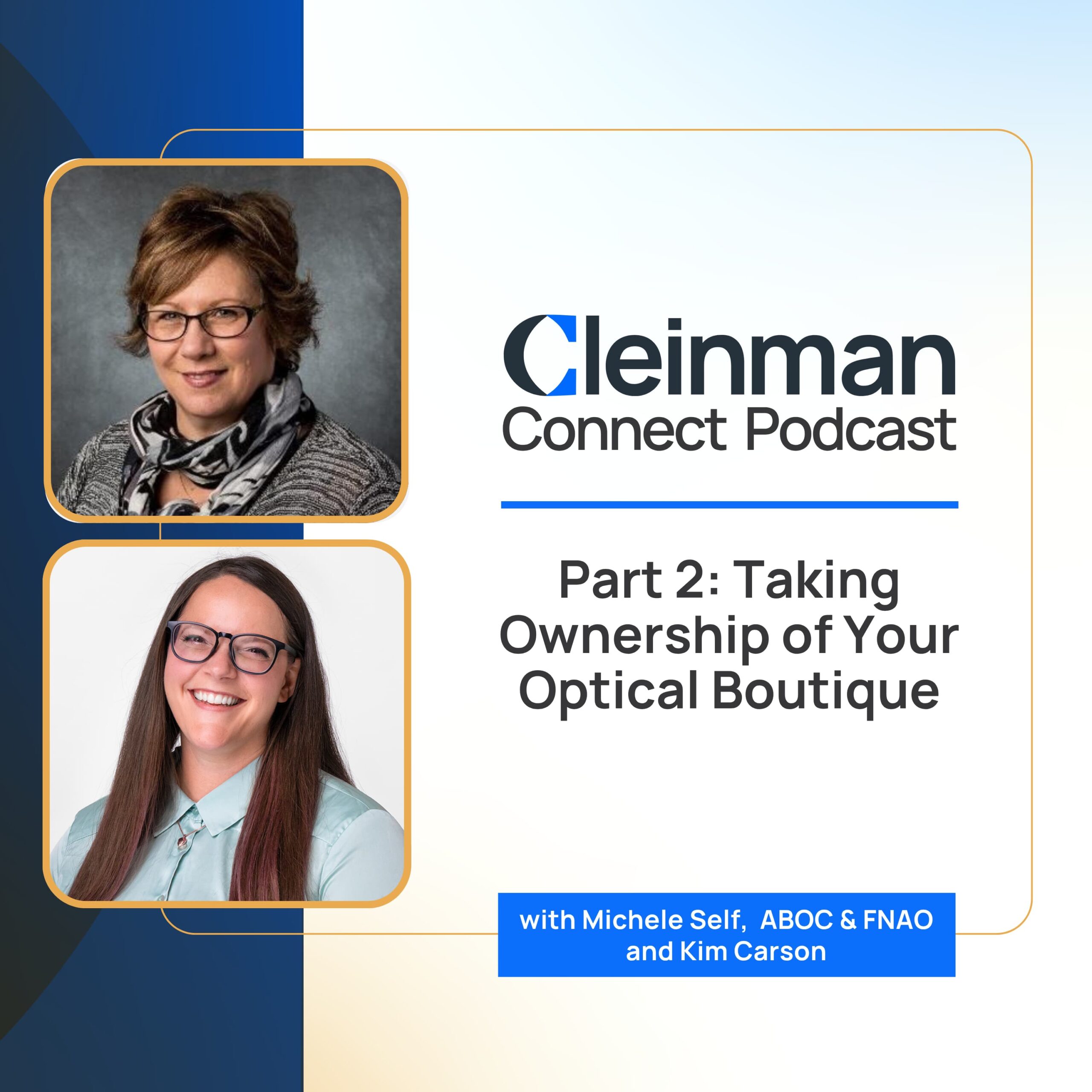
Michele Self is the Program Facilitator at Cleinman, a consulting firm that helps independent optometry practices improve operations, strengthen teams, and grow sustainably. She facilitates FrameWorks, Cleinman’s peer-to-peer program for opticians, where she guides discussions, shares optical best practices, and helps teams improve performance, patient care, and profitability. Michele is also the Owner of A Spectacular Gaze LLC, which provides on-site optician training and inventory management for private practices.
Here’s a glimpse of what you’ll learn:
- [01:53] Michele Self discusses handling lab remakes and the importance of proactive patient communication after errors
- [02:33] How daily lab job tracking helps prevent delays by monitoring turnaround times and flagging overdue orders
- [10:28] Michele breaks down prescription error risks and how early review can reduce downstream remake issues
- [13:02] Training and measurement consistency strategies used to reduce optician fitting and accuracy mistakes
- [19:19] Certified opticians and their impact on optical performance, including a reported 33% production increase
In this episode…
In optical practices, small operational gaps can quietly shape the entire patient experience, often surfacing only when trust is already strained. Delays in communication, unclear job status, and inconsistent coordination can all build unnoticed over time. So what actually keeps these breakdowns from happening in the first place?
Michele Self, an opticianry and optical operations expert, points to ownership, communication, and system visibility as the foundation of stronger performance. Rather than reacting to lab issues after the fact, she stresses proactively contacting patients when problems arise to preserve trust. Michele also emphasizes daily tracking of lab jobs to catch delays early and reduce risk beyond standard turnaround expectations, while noting that many remakes stem from preventable fitting or measurement errors. Her core message centers on building consistent systems that stop issues before they reach the patient.
In this episode of the Cleinman Connect Podcast, Michele Self, Program Facilitator at Cleinman, is back with Kim Carson to discuss improving communication, accountability, and workflow systems in optical practices. Michele explores patient communication during lab errors, tracking job delays, and reducing remake rates through better processes. She also covers lab flexibility, prescription accuracy, and how optician education and training improve overall practice performance.
Resources mentioned in this episode:
- Kevin Wilhelm on LinkedIn
- Kim Carson on LinkedIn
- Marketing4ECPs
- Cleinman
- Michele Self on LinkedIn
- Shamir
- HOYA
- ZEISS
- EssilorLuxottica
- American Board of Opticianry & National Contact Lens Examiners (ABO-NCLE)
- United Opticians Association (UOA)
Quotable Moments:
- “The first thing that that practice should be doing is picking up the phone and telling the patient, we made a mistake, or there’s been a problem at the lab, we need to remake those.”
- “You can pay attention to inventory all you want.”
- “They all have very similar products. It’s all going to depend on price and customer service.”
- “I think it’s going to be ultimately and really important for the doctor to know what that prescription truly is, that the previous prescription that the patient was wearing.”
- “I always like to say don’t like the remakes to be of 9% in any practice.”
Action Steps:
- Bring patient communication to the front line: Contacting patients immediately after lab errors helps protect trust and prevents frustration from escalating when issues arise.
- Build daily visibility into lab tracking: Monitoring job status consistently ensures delays are caught early, reducing the risk of patients discovering problems first.
- Reduce remake drivers through workflow discipline: Strengthening frame adjustments, measurements, and prescription checks helps prevent avoidable errors before jobs reach the lab.
- Use remake data as a coaching tool: Reviewing patterns in errors allows practices to identify training gaps and improve optician performance over time.
- Invest in optician education and certification: Ongoing training and credentials strengthen clinical accuracy and improve overall optical practice efficiency and outcomes.
Sponsor for this episode…
This episode is brought to you by Marketing4ECPs.
Working with them is like hiring a full-time marketing professional who knows the industry and understands your goals. Except, instead of one experienced marketer, you get a whole team in your corner.
Whether you’re an optometrist, ophthalmologist, or optician, they can help you grow your business with a plan that’s completely customized for you. Learn more here.
Powered by Rise25 Podcast Production Company
Episode Transcript
Intro: 00:07
Welcome to the Cleinman Connect Podcast, where we discuss marketing, ownership, growth strategies and everything else surrounding the business of optometry. Cleinman is Optometry’s trusted business partner for over 35 years.
Michele Self: 00:28
And you know, the thing about customer service as well is, so, okay, we do have a lab error. We did make a mistake. The first thing that that practice should be doing is picking up the phone and telling the patient, we made a mistake, or there’s been a problem at the lab, we need to remake those. Please hang in with us. We’re going to do our best.
The last thing you want to do is have that patient call you to find out that something happened. And I’m going to just give you a little, little taste of this. So I ordered some neural lenses for my daughter. She’s been having some issues and I ordered them from a practice who did not communicate with me. And, and I was kind of upset about that because I knew what the procedure was supposed to be.
Come to find out, they had reordered the lenses two days before I called in to say, hey, what’s the status? Oh, there was a problem. We reordered them. We ordered them incorrectly. I we had to reorder them.
Okay, well, thank you for telling me. And I waited a couple, few more days, 2 or 3 more days and found out that they had gotten delayed in shipping. And they didn’t call and tell me that these I mean, if I can get bad customer service, anybody can get bad customer service.
Kim Carson: 01:51
Yeah. Yeah.
Michele Self: 01:53
So that’s just an example of that. So, you know, you can have lab remix. It’s how you Handle the lab remix. Handle that customer service.
Kim Carson: 02:05
Yes. Calling the customer. Taking accountability. Having I mean, I don’t even want to call it initiative, like having the O decency seems like a strong word to, but like to, to call the person who is paying for this product to say like, hey, yeah, it’s, we ordered it incorrectly. We’re reordering it right now correctly.
It should be in by this day. If it’s not going to be, I’ll call you with more updates. Like that’s, that’s totally part of it.
Michele Self: 02:33
It seems like it should be so simple. And, and really, this should be maybe a daily one person’s job to keep track of this. And get that report. They can see where in the process it is. If it’s been longer than normal, norm, maybe you’re, you’re used to the jobs coming back in 7 to 10 business days and on the 10th day, you still haven’t received it.
Someone should be calling the lab to find out. What’s this? What’s the status of this job? And if they’re not? But it’s not happening everywhere.
Kim Carson: 03:10
Yeah. Yeah. Well, if I mean, like you said, you’re going into practices and this report isn’t being sent or seen or for whatever reason, it’s not showing up in the hands of the person in the practice who needs it. So if something is on its 10th day or 11th day or 12th day, how are they even to know it’s not being tracked? It’s not being watched in any way.
Michele Self: 03:35
I really just wanted to talk about this and bring this to light. For the doctors out there that are so busy doing everything else that they do. This is something that really needs to be tracked. You can pay attention to inventory all you want. Okay.
You can pay attention to medical diagnosis all you want, but if 40 to 50% to 60% of your money is going to come out of your optical dispensary, you need to be aware, doctor, that these things are happening or not happening. And this is vitally important for you.
Kim Carson: 04:20
Yeah. And I mean, even in your case, where you’ve ordered the neuro lens for your daughter, maybe in a year or so, you know, you might need another product or sooner than that, you might need another product and you might go somewhere else. You might go to a different private practice and this practice that, you know, couldn’t call you or, you know, for whatever reason, they’re going to wonder like, oh, I wonder why she never came back. Well, I have we just have no clue. We have no clue why she didn’t come back.
Michele Self: 04:51
You know, you know you well and people wondering why they’re why they’re no shows are so high. You know, you can track no shows all you want, but if nobody’s telling you why they didn’t come back. These are reasons why these are silent killers of a practice. Yes. Basically.
Kim Carson: 05:09
Yes, absolutely. So so I the remakes. Yes. Pay attention to them. I want to ask, and maybe this is revealing a gap in my knowledge, which is okay, I don’t know everything.
If you had a case where you know someone is getting the report from the lab, a practice has their daily and their monthly kind of progress of projects list. And this lab is continually making mistakes. They are continually, like they say, 7 to 10 days and it’s always taking 11 to 15. Are there other options for labs? Like how easy is it for a practice to move where they outsource this to.
Michele Self: 06:00
It’s an easy process, honestly. There are big labs, there are labs that, you know, all the sellers and the Shamir’s and the Luxottica labs and the, and the HOYAs and and all that. It’s easy to move. But if you don’t want to move necessarily go change from a HOYA lab to a ZEISS lab. There are other HOYA labs that are available.
You can check to see what kind of customer service you could get there. So really, when you have a HOYA rep, a ZEISS rep, or an SLR rep, you can talk to that rep and they can recommend other labs within their network for you. So you don’t have to learn. You don’t have to leave completely the products that you’ve become used to and the things that your, your patients have become accustomed to and the types of lenses that you’re used to fitting. You can move from lab to lab.
You don’t have to move from product to product. Yeah, okay. There are plenty of labs, so let’s just say two. FYI, most offices have more than one lab that they deal with. Most of them do.
A lot of offices have one main lab, like a hoy or a ZEISS or, or, or an Essilor. And then they also maybe have a lab that they, they purchase uncut job uncut lenses from so they can cut lenses in, in house. Okay. And that’s how they save money. Okay.
So most offices that I know of have at least two, sometimes three could be more. But you want to be careful spreading out that love too much because then your buying power goes down. Okay. But but you’re asking how easy is it to move place to place? It’s easy.
Now, if for whatever reason, those big three aren’t making you happy and you want to. Maybe you’re. You’re you don’t no longer want to deal with SLR and you want to try some other products. It’s easy to change that as well. You just have to be careful of what’s happening with your warranties, with the other products that you’ve already purchased.
So you don’t want to shut off one account to try another.
Kim Carson: 08:22
Right.
Michele Self: 08:23
Okay. So all of them have very similar products, just to be honest with you. They all have very similar products. They. It’s all going to depend on price and customer service.
And for me, customer service is a huge thing. I don’t want bad customer service and neither do your patients because guess what? If you get if I get bad customer service as their customer, my customers are going to get bad customer service from me. And guess what? I’m the one that has to deal with my customers and I have to answer to my doctor for the bad customer service I’m receiving and the complaints that are coming in to him or her as their practice.
We want to be careful with that. We don’t want to lose patients over bad customer service from anyone, whether it be a lab, whether it be an equipment company, whether it be frames, whatever.
Kim Carson: 09:26
Yeah. No, absolutely. I would like to ask about as well. You know, we have like you said, there’s coaching moments. If you are tracking why remakes are happening, there are coaching moments for maybe one person in particular in the practice that is submitting errors or they’re just, you know, constantly missing the same thing.
Like there’s obviously a teaching moment there, a training moment there. I want to go back to when the doctor makes changes or errors. Do you have any ways to mitigate that? Like, especially when it comes to changes, is there like a double check process? Is there something that could help with remakes in those cases when they come up?
Michele Self: 10:11
You mean from the doctor’s error?
Kim Carson: 10:13
Yeah. From like, like you said, when a doctor makes a change to make the customer happy, is there a way that we could make that change before it’s at the lab stage, before it’s at the remake stage? Is there anything that could be done? Do you think?
Michele Self: 10:28
Well, I mean, from the doctor’s standpoint, doctors are going to make errors because that’s just part of that, you know. But I think to to mitigate some of that to to keep some of that down, I think it’s, it’s going to be ultimately and really important for the doctor to know what that prescription truly is, that the previous prescription that the patient was wearing. You know, so they know what that is, so they have a better and clearer understanding of where they need to go with that prescription. Sometimes if there are doctors, there is. Normally the doctors themselves will maybe change the cylinder too much, change the access, and they’re going to understand this podcast.
No, change the access too much for the amount of cylinder that there is. And if we go too far out of what we call American Ansi standards. That will be something that they have to clearly pay attention to, to make sure now what, what we did for us at the School of Optometry, because we were a school, we had students making these errors. And what we would do is if the patient got their glasses with us previously, we would go back into their old RX, their old prescription, the one that they’re currently wearing, and see how much the new prescription changed. Okay.
If we made a change that was very drastic and did it too fast and too much, we knew that there was going to be a problem. That was just going to be a problem waiting to happen. So if you’re asking about the doctor’s changes and they’re well aware of this, they know exactly what I’m talking about. If they go too far with it too fast, we would just tell the students, okay, I want you to take this prescription and cut it in half and, and, and have an and have an educational moment with the patient saying you had a lot of a change, or maybe it’s been 5 or 6 years since you’ve had a change in your glasses. I’m noticing there’s a good bit of drastic change, but I don’t want to change it too quickly because I don’t feel like you’re going to accept that.
Well. And we’re going to work with them to say, this year, I’m going to change it this much. And then when you come back next year, we’re going to change it a little bit more. So that’s how that can be taken care of.
Kim Carson: 12:53
Yeah. Okay. Perfect. I. Yeah, I.
I don’t know if I asked that exactly right. But thank you. You did? Yeah.
Michele Self: 13:00
It was perfect.
Kim Carson: 13:01
Okay. Amazing.
Michele Self: 13:02
Yeah. So from a, from a standpoint, what we normally will see when there’s a, when there’s an error, normally it’s they’re not pre adjusting the glasses before they make the measurement. Right. Normally they will. Not pay attention to whether or not that frame is fitting properly.
Okay. The frame has to be pre adjusted and you have to make sure that it fits before you do any measurements or offer that to that patient. And they these are all educational moments. These are things that opticians should know before they even sit down with the patient. So there are always educational moments with opticians.
And again, people will make errors. That’s just that’s going to happen. I mean, I can’t say that I didn’t make 100 errors in my career, you know? But it’s all a part of. How passionate are you about the job that you’re doing?
Okay. And then if you’ve had those education education moments, let’s just say this is happening a good bit. I always like to say don’t like the remakes to be of 9% in any practice. Okay. Anything above 9% really needs to be looked into.
So 9% is my number. Okay. If it’s above 9% and there are educational moments for the opticians, that’s where you get the opticians together and you have Michele come in or you have another optician say, we’re going to have an educational moment and let’s let’s do some role play. Role play. Let’s pick some frames.
Let’s do some heights and measurements. Let’s see how everybody’s doing it. So the first time you would get everybody together. Then you do these trainings and you make sure that there you’re clear about your expectations, right? And then after you had those expectations, that’s when you start.
You would start taking people aside. Okay. And then you would have expectations and, and make sure that that optician understands their job. So after you have that first or second initial education, make sure that the optician understands what their role is and how to do their job. And then if that’s not working, then maybe you need to go elsewhere.
Kim Carson: 15:25
Yeah. Yeah for sure. You said there’s 20 or 22 states that are licensed or that opticians have to be licensed in. Do you find that sometimes those teaching moments, those training moments are more in states where they’re not licensed? Like, like you’re saying that you need to set expectations and make sure that they know how to do their job.
And I’m just thinking like, you know, if they’re if they’re certified in some way, like there’s a certain expectation that comes with that, that they would know how to do it. But do you find that that these are basic level conversations that are needing to happen?
Michele Self: 16:08
There are basic level conversations that need to happen in every state, even though states, 22 states are licensed. We want to make sure that, well, let’s just put it this way. There are a lot of schools of opticianry out there or good online schools that teach this. We just need to make sure that the license states are teaching and making sure that the doctors don’t have a lot of people working under them that aren’t licensed without education, because that still can happen. Okay.
I find it less in licensed state licensing states than I do in non licensing states, but the A, B O or the UOA the United Opticians Association is working really hard to make education a priority for all people calling themselves opticians around the country. This is a big goal of theirs. This is a we’ve had a big jump start in the last year that in. More and more doctors are going to see that. And I would encourage all doctors to get their opticians educated and send them to continuing education, and I would encourage them to become at least a B certified.
Because when you have to study for the A B O certification, it really is for just basic education, but it’s going to give them that general knowledge that they need to get them started in that practice, and the doctors will see a huge improvement in how things are done in the practice that they would do that.
Kim Carson: 18:01
Yeah, yeah, something like that would certainly empower maybe a newer optician just to know, to know their field a bit more and to be able to better help patients. I would think.
Michele Self: 18:15
It seems like the opticians in the practices are somewhat somewhat of a revolving door. Yeah. So we have a problem with that. I think that opticians need to understand that they have again, from the beginning I said this is a profession that they’ve chosen. We need to show them that this is a profession that they’ve chosen and that they’re valued.
And don’t just accept the fact that you’re, you know, optician. Knows very little. Don’t accept that. Get them educated in some kind of way. The problem that we do have sometimes is that we have people working in these practices that have been there for a long time and have never really truly learned the skills that they need.
They’re just doing what they’ve always done. But, you know, I find that you’re always going to get what you always got if you always did what you’ve always done.
Kim Carson: 19:17
Oh, yes.
Michele Self: 19:19
That’s my, that’s my thing. Okay. Get your opticians educated. Yes. I did a video when I was the president of the American Board of Opticianry on the value of a certified optician increases the amount of money coming out of your optical by 33%.
Kim Carson: 19:43
Wow.
Michele Self: 19:43
I did that study before I did that video. Yeah, it’s super, super important. And your first line of defense for this is your lab errors. The knowledge is out there. The studies are out there.
The statistics are out there on the paper to you every day and every month. Make sure you’re taking full advantage of this to better your practice. You know, it’s not. We want to make sure that you are well rounded. Practice.
You’ve got these amazing medical opportunities now for optometry. I love that so much. We have amazing opportunities for the technicians to learn. We’ve got amazing opportunities for opticians to learn. There is no reason why private practice should not succeed in the United States of America or Canada or anywhere, honestly.
Kim Carson: 20:44
Anywhere. Yeah. Well thank you. Thank you so much. I do have one last question for you, Michele.
Before I ask it, I will point people to our sponsor’s website again, that was marketing4ecps.com. My final question for you, as someone who is so passionate about Opticianry and you have so many accolades in this field, I would love, is there something that you would like to say and that you feel that all current and future opticians should know as they move forward in their careers?
Michele Self: 21:22
They should know that this is a career.
Kim Carson: 21:24
Yes.
Michele Self: 21:25
This is something that they can have for the rest of their lives. And they’re of such value right now. There is such a need for educated opticians in this field. Your possibilities are endless as far as career, money, growth, whatever you want, your life is what you make it. Okay.
Be the best at what you are and what you are and. And be the person who everybody wants to come back to at the practice that you’re at because you’re fantastic at what you do and you have the personality that everybody wants to be around.
Kim Carson: 22:07
Okay. You heard it here first. Thank you so much for joining me on this episode today, Michele. And that’s our show. So if you want to hear more of the podcast, you certainly can at Cleinman.com and wherever you’d like to listen.
Thank you.
Michele Self: 22:23
Thanks, Kim.
Outro: 22:27
Thank you for listening. At Cleinman, we take pride in helping our partners unlock their full potential. Subscribe to get the newest episodes or visit us anytime at Cleinman.com.