Dr. Wes McCann is the Founder of Doctors Vision Group, a network of 15 Ontario optometry practices delivering modern, full-scope eye care. He leads practice acquisitions, integration, technology investment, financial strategy, and team development. Dr. McCann is also an optometrist, educator, and speaker who has lectured at hundreds of industry events and published in Review of Optometry and Review of Myopia Management. A 2024 Contact Lens Institute Culture Award honoree, he is recognized for improving patient experiences and practice outcomes.
Here’s a glimpse of what you’ll learn:
- [0:45] Dr. Wes McCann’s approach to measuring practice performance and focusing on the numbers that matter most
- [3:00] Why Dr. McCann believes strong teams and effective delegation are essential for sustainable practice growth
- [6:01] How benchmarking can reveal opportunities for improvement across practices, providers, and teams
- [8:58] What to consider when deciding whether to improve, adjust, or abandon a struggling initiative
- [14:01] Dr. McCann explores adaptability, continuous improvement, and the importance of staying open to change
- [18:03] Dr. McCann’s perspective on practice ownership, taking calculated risks, and building for long-term success
In this episode…
Buying an optometry practice takes more than finding a good opportunity — it requires knowing which numbers matter and where to invest first. How can owners use practice metrics and ROI to make smarter decisions and build a stronger business?
Dr. Wes McCann, an optometrist and experienced multi-practice owner, recommends using measurable performance to guide both acquisitions and ongoing practice improvement. Revenue per patient, dispensing rates, imaging capture rates, and revenue per doctor day can help owners identify opportunities, benchmark performance, and coach their teams more effectively. Dr. McCann stresses understanding the barriers behind an underperforming initiative before abandoning it, while delegating to strong team members and specialists instead of trying to manage everything alone. The goal is to combine good data with flexibility, disciplined investment, and continuous improvement.
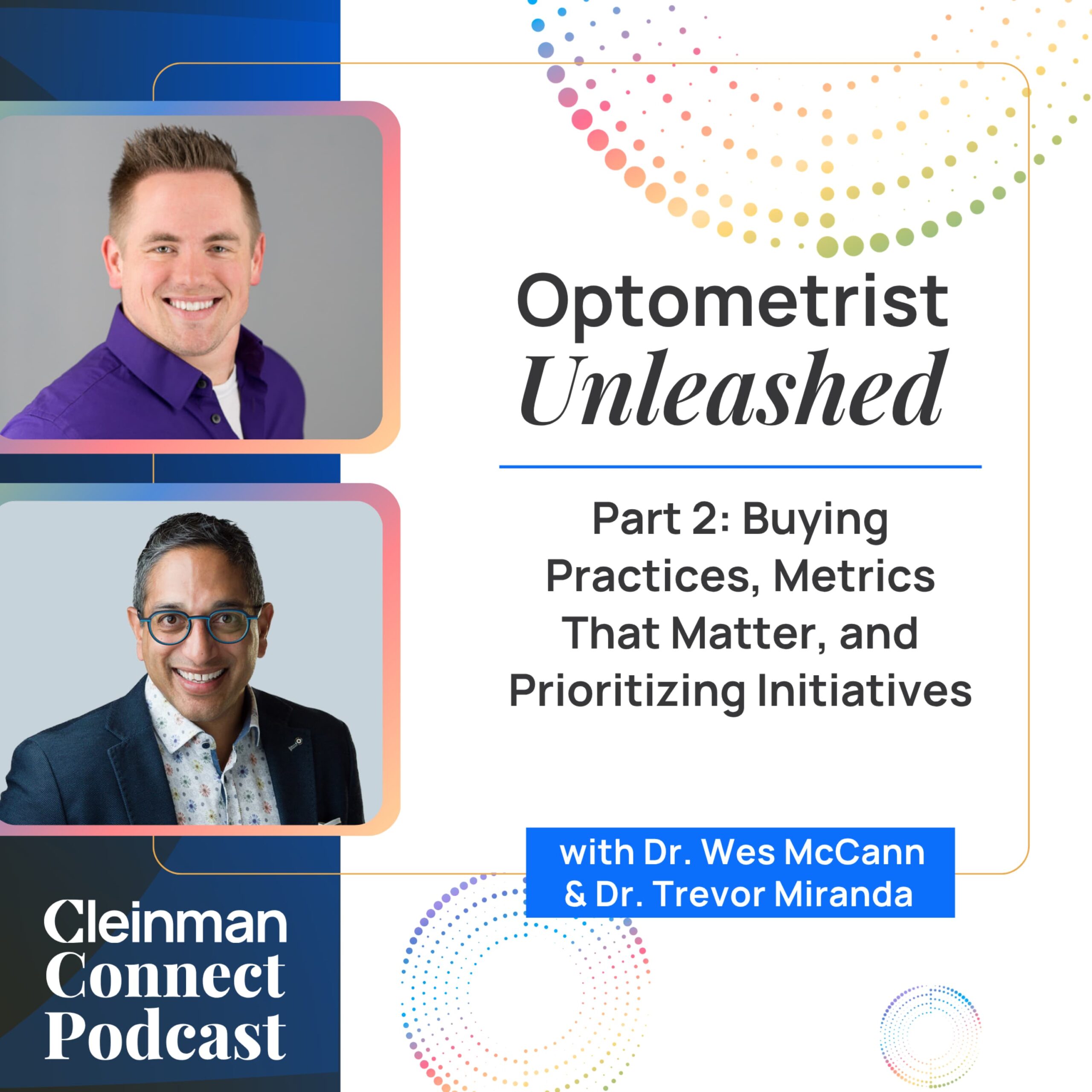
In this episode of Optometrist Unleashed, a Cleinman Connect Podcast, Dr. Trevor Miranda continues his conversation with Dr. Wes McCann, Founder of Doctors Vision Group, about buying practices and prioritizing growth. Dr. McCann covers key practice metrics, benchmarking, and ROI-driven initiatives. He also discusses delegation, innovation, and overcoming fear around acquisition debt.
Resources mentioned in this episode:
- Kevin Wilhelm on LinkedIn
- Kim Carson on LinkedIn
- Marketing4ECPs
- Cleinman
- Dr. Trevor Miranda on LinkedIn
- Dr. Wes McCann on LinkedIn
- Doctors Vision Group
- “[Optometrist Unleashed] Part 1: Buying Practices, Metrics That Matter, and Prioritizing Initiatives” with Dr. Wes McCann
- Eye Recommend
- Canva
- Google Ads
- Google Looker Studio
- Neurolens
Quotable Moments:
- “I like dollars per patient because I feel like that’s a more normalized metric.”
- “So again, dealing with metrics and numbers again, but don’t try to do everything yourself.”
- “I just love to know what the gap is and how do I help you fill that gap.”
- “Don’t be afraid to make that jump if you’re ready to make that jump.”
- “It’s really neat where this industry is going, and I think it’s ever-changing and fun.”
Action Steps:
- Track your most important practice metrics regularly: Monitoring revenue per patient, dispensing rates, and imaging capture rates reveals performance gaps and opportunities.
- Benchmark performance across practices and providers: Comparing results internally and externally creates meaningful coaching opportunities and establishes clear improvement targets.
- Identify barriers before abandoning an initiative: Understanding bottlenecks and testing practical solutions prevents owners from giving up on promising programs too quickly.
- Delegate responsibilities to capable team members and specialists: Empowering skilled people frees owners to focus on leadership, strategy, and operational improvement.
- Remain flexible while pursuing clear goals: Being willing to pivot, seek team input, and adjust implementation methods helps practices overcome resistance and achieve results.
Sponsor for this episode…
This episode is brought to you by Marketing4ECPs.
Working with them is like hiring a full-time marketing professional who knows the industry and understands your goals. Except, instead of one experienced marketer, you get a whole team in your corner.
Whether you’re an optometrist, ophthalmologist, or optician, they can help you grow your business with a plan that’s completely customized for you. Learn more here.
Powered by Rise25 Podcast Production Company
Episode Transcript
Intro: 00:00
Welcome to Optometrist Unleashed, a Cleinman Connect Podcast with Dr. Trevor Miranda, a monthly doctor led discussion about everything surrounding the business of optometry.
Intro: 00:16
This is part two of Dr. Trevor Miranda and Dr. Wes McCann’s episode of Optometrist Unleashed. If you missed part one, you can go back and listen to it at Cleinman.com or wherever you like to listen to podcasts. We will join this interview. Already in progress.
Dr. Trevor Miranda 00:32
Yes, thanks. Thanks, Wes. What? What three monthly numbers would you say if you could only see three? I’m a big, metric guy. I see more than three. But what would be the three most important ones that speak to you?
Dr. Wes McCann 00:45
It’s hard to take it down to three, but if I was to pick three that are most impactful on the practice, I would say, dollar per patient. and you can calculate it as dollar per odd hour or dollar per patient, however you want to do it. I like dollar per patient because doctor A may see three patients an hour and doctor B may say two see two patients an hour or doctor A may see four kids in an hour versus doctor B may see two seniors in an hour. So I like dollars per patient because I feel like that’s a more normalized metric. Dispensing rate is a big one because most of our practices make 50% of our revenue comes from dispensing plus or -10%.
So dispensing rate is probably one of the most impactful. So those two are definitely big ones. I would say if I had to pick another one, it would be again, this is going to differ by province, but imaging capture rate for your medical imaging that you’re doing, whether that be CT or ultra wide imaging or retinal photos or daily disposables percentage one of those two both have a significant impact, but it depends on your patient population. So if you see a lot more seniors daily disposables may not be my major metric. But if I’m a younger practice, it’s mostly kids in and working age population than I’d probably be more of a daily disposable metric.
So I think knowing my patient base would be important too. And is it really well spread out? Is it a nice bell curve like we love to see in a practice? Or is it heavily senior or heavily peds.
Dr. Trevor Miranda 02:14
Yeah. Yeah. I mean I also like revenue per doctor day per doctor because that helps to see how efficient those doctors are, how they’re taking in fit ins. And also looking at our specialty services like Neurolens or dry eye and such myopia.
Dr. Wes McCann 02:29
With that one is that we have some doctors that only wear half day. And so is that considered a full doctor day? Like where do you consider the.
Dr. Trevor Miranda 02:35
Full we prorate that we prorate it. Yeah. Perfect. What do owners over obsess about? What would you say?
You know, I talk to a lot of doctors, Wes, and you seem a lot calmer than a lot of my colleagues. Our colleagues own one practice. You’ve got 15. So what’s going on there? Why?
Why are some of our colleagues over obsessing about some things and what would they be?
Dr. Wes McCann 03:00
So, I think too many of our colleagues try to do everything themselves. get a good team and delegate. and, like, there’s nothing better that you could do than hire a good office manager. because they can take so much off of your plate. I feel like I’m so calm all the time because I have an awesome team and so I can delegate so much of what I do to great people that have great ideas of their own that they come up with, and then we can implement those great ideas.
So I’m really lucky that I have an amazing team. so I think investing an awesome team is probably one really big thing. the other thing I would say, and it kind of goes along the same lines is don’t try to again, do everything yourself if you like. I feel like I know a decent amount about Canva and I can do some pretty cool stuff on my own. And now with AI, like there’s some awesome things I can do on my own, but I’m not awesome at marketing myself.
And I don’t know the ins and outs of the marketing world, and I don’t know what patients actually look for. Like what I’m interested in is not what my patients interested in, in terms of talking about in an optometry practice, like I may want to talk about glaucoma, AMD and dry eye, but my patients might actually want to know about why does my eyelid twitch? And that’s really boring to me, but it might get one of the most Googled things. And then if that drives, if that drives patients to my practice, then that increases my patient base. So but if I do something on like a Google ads campaign on AMD by itself, maybe that’s not going to do as well.
I don’t know that, but I don’t know the industry. I don’t know the digital marketing industry as well as our digital marketing people do. So I think being sure that you don’t try to do everything yourself and use people that are really great to do what they do great, and you’ll have a budget for them, and you can set aside what that budget is and like set your metrics to follow up with and say, hey, this is my goal. How do we reach my goal? So this is my new patient rate that I want.
How do I meet that new patient rate? And I want you to show me the metrics that help me get there. And I’ll give you the data to show where we are and let’s like alter our marketing to get there. So I think setting expectations for everything that you deal with, whether it’s an external person or an internal person, and then following up with them is really important. So again, dealing with metrics and numbers again, but don’t try to do everything yourself.
I would say the same thing for an accountant. I think a lot of people, I think it’s good to know your numbers and good to know your books, but you don’t have to do your books yourself. So get a good person that’s going to do it. It’s not going to cost you a ton of money. It’s going to cost you something, but you’re gonna have more time that you can then be the thought leader in your practice and think about ways of improving your business and operationally.
And, and you’ll do much better in that respect. Yeah.
Dr. Trevor Miranda 05:43
So source and empower. Right. Dr. McCann, this episode brought to you by Marketing4ECPs. That’s a shameless plug. You know, Wes, I want to talk about benchmarking and, you know, how do you compare your practice numbers internally and externally? What are you using as the benchmark?
Dr. Wes McCann 06:01
Yeah. So, there’s so many metrics that you can track, and it’s tough to figure out what’s going to be the best metric to track. We use, data studio by Google and we input all our data in there because the EMR, as we’ve used to date, none of them do great at reporting and none of them track metrics. Great. so, and some track, some KPIs and some systems, but then there’s lots of KPIs that they don’t track that are actually quite impactful in your practice.
So we use data studio to track our metrics. And, we find that has been very helpful and we track practice to practice and also OD to OD because it’s incredible within the same practice, the same staff that two different ODS could have wildly different metrics in terms of how they’re managing patients and driving revenue within your practice. and we all want the same outcome. And I think we all want to have great outcomes for our patients. And I don’t think the people that are billing more are having better or worse outcomes for their patients.
I actually would argue the opposite, that I think they probably have better outcomes because we catch disease earlier, because we’re doing things according to what’s published. In terms of best practices, we’re not afraid to talk to a patient about a test that may cause something out of pocket. I know in Canada, we think health care should all be included in everything. It’s not the reality in Ontario. Nothing that’s been invented since 1984 is covered by OHIP.
So if you want a 2025 exam, there’s probably going to be some costs behind it. But having that confidence to talk about it, I think is important. So certainly tracking metrics and then comparing practice practice for us, but also within the practice is really important because you’d be amazed at the amount of opportunity there is there for coaching. Your associates and ours are always look forward to those coaching conversations. And we try to do them quarterly so that we can look at the metrics and we look at Eye Recommend benchmarks, which are great because they look at rural versus urban versus provincial.
What’s kind of the norm for a lot of these benchmarks, these metrics, and then we use that as our kind of baseline to compare against. And then we also look at within our practices. And obviously we want to be better than average. So we always aim for that as well. So those are great benchmarks.
But track your numbers regularly and have conversations about them.
Dr. Trevor Miranda 08:20
I think it shocks me. It shocks me how many practice owners are not tracking their numbers and not benchmarking. So track your numbers, benchmark them. I know Cleinman Partners have have a great benchmarking and so does Eye Recommend. But I mean track your numbers and talk about how to improve them.
If you want to improve, you got to know where you are. so I know you do a great job there. Wes, I wanted to talk about how do you kill a program that’s not working? I know you experiment in various ways. What when do you pull the plug?
I mean, you’re determined. doctor and business owner. But when do you, when do you say to yourself, no, that didn’t work.
Dr. Wes McCann 08:58
Yeah. So it’s tough and it’s always tough to pull the plug. Like if you invest in something, you never want to admit that it didn’t work. But it’s a reality. Sometimes it will.
And if you’re an early adopter and you are very proactive in things, there’s some things that do sometimes flop. So I think you, you won’t know if it’s going to flop or if it’s doing well unless you track it. And then number one, if you track your metrics on it and it’s not doing well, having an honest conversation of with your doctor team, why is this not working? And, and what are the barriers is usually the question I ask. And if we can identify the barriers, what are the solutions to those barriers?
So let’s figure out can we mitigate any of those solutions if it’s cost okay, we have a payment plan option. Do we have this? Like how can we improve that barrier or reduce that barrier for a patient or for a practice or for a staff member. If it’s sometimes it’s as easy. It’s a difficult talk track for the protester to have, and then the doctor doesn’t want to talk about it again because they’ve already said no once.
But you’d be amazed at when the doctor recommends it. They’re like, oh yeah, I’ll do whatever you want. But they just said no to the staff person. So again, what are these? Where are the bottlenecks?
Where are the barriers? And so if we’ve worked through identifying all the barriers, we’ve tried to pick solutions for them. Those solutions didn’t work. We can’t identify what the new barriers are. and sometimes it comes down to the doctor that’s there.
It just isn’t interested in whatever it is, be it dry eye, be it AMD, be it, whatever it is. maybe they’re just or vision therapy, maybe they’re just not super interested in it. And if they’re not interested in it, no matter how hard you beat a dead horse, it’s not going to change. So can we reinvest that equipment somewhere else? Or can we sell that a piece of equipment to someone and pull the plug on it?
So I think before you pull the plug, you really need to work through identifying all the barriers, working through, trying to fix those barriers if they’re still not working. Is there anything else we can do to manage that? And if there isn’t, then what is our offboarding look like for that device?
Dr. Trevor Miranda 11:00
Yeah, don’t give up too easily. And I guess Wes, also, you can ask colleagues, I, I want to thank you on behalf of all of our colleagues, because you’re so generous in sharing what works for you. But hey, ask Dr. Wes McCann why it works for him, or ask some of your colleagues that are doing a great job, because I think there are answers there. And these little pearls, little keys and getting everybody on side and swimming the same way is so important. The staff, the staff, you know, invest in your staff and train them.
And I know you have an amazing training piece for your staff. And that’s probably a big differentiating factor when you purchase some of these practices. For one, maybe those metrics have not been calculated and not been shared, and they haven’t set up quarterly mentoring and coaching and, and such. So it’s a big change. and I think it’s welcome.
That feedback is welcome, I think. How many new associates are you onboarding here, Wes, this fall?
Dr. Wes McCann 11:54
This year we onboarded five new associates.
Dr. Trevor Miranda 11:57
So coming up, five new associates, right?
Dr. Wes McCann 12:00
You did a onboarding plan to, to train them on our way of doing things and going over policy and procedures and technology, etc.. So that was a big one. But I want to come back to what you had mentioned there before with regards to talking to your peers. I think that’s a huge one. And, honestly, what recently, I got an opportunity to go to the Cleinman event down in Austin and it was really neat having a facilitated discussion where you can explain, here’s a challenge that I have, and I think I’ve worked through everything I can on these.
And what do you guys do to make this different? And it’s nice having that other discussion where you can talk to your peers and say, hey, you know what? I don’t know what to do with this, and I would love your feedback and be vulnerable and give up what those challenges are and listen to everyone’s feedback. And it’s awesome when you get some new ideas and you can go and implement them from high performing practices that can help you through some of those challenges. So don’t try to always do it yourself.
There are other people that are out there that can help you, and there are great groups that can help facilitate that too. And I think it’s awesome to get that opportunity to be able to grow from your peers.
Dr. Trevor Miranda 13:08
Yeah, that’s the beauty of our profession in optometry. You know, we’re really sharing and there’s a lot of groups that you can collaborate and network with. So if you’re new to optometry, make sure you make some friends, old and new and, experienced and look who’s successful and ask them why and how. And I’m sure our colleagues are willing to share. When I started out years ago and graduated in 1995, you know, a lot of those, great practices that were doing well.
Tell me what they were doing well. And I implemented those ideas. And I think, you know, that secret sauce, Wes, is not the ideas, it’s the implementation. It’s just getting over the inertia it takes to make change. So creating that change culture in your organization is so important.
You’re so good at that, that sort of challenging what the status quo is and then getting people aligned to the new reality, right?
Dr. Wes McCann 14:01
Yeah. My motto is there’s nothing consistent in life but change. So, I think that’s important to think about all the time. And yet you’re so right. Implementation is such a key component.
And don’t be afraid to pivot to like, if something’s not going right, don’t be afraid to pivot and change and adjust course, because you will always, that’s like, that’s just normal. I would say in business, in life, you need to be able to pivot. And if someone’s not performing, whether it be a staff person or an associate or a partner or whatever it is, don’t be afraid to have that conversation with them and just say, hey, you know what? I, this is something I’ve noticed and I would love to support you in being successful. What else do you need from me to be able to be successful?
And how can I support you more? because these are the things I’m noticing. This is in comparison to your peers. So I just love to know what the gap is and how do I help you fill that gap.
Dr. Trevor Miranda 14:52
Yeah. You know, we both were at a lecture in Austin with Cleinman and they spoke about this, this PhD, Harvard trained, behavioral psychologist talking about not changing your goals, but allowing the flexibility to get to the goals in various ways with various input from team members and empowerment to get to the goal. So I love how you do that. And I think that is a really take home message from this podcast is you can pivot, you can get input from your team members and still achieve your goals. Sometimes it’s that first little bit, oh, it’s not going to work.
And I don’t, I don’t really accept that anymore. That first instinct, knee jerk reaction, it’s not working. Well, of course it’s not working yet. it’s going to take some time and we’re going to make it work. and it ultimately does work.
And one of them, the call center that we implemented was as a result of yourself and Morin and others that have implemented a great call center because we’ve got multiple practices as well. And you’ve done it so well. You know, at first it’s a lot of resistance because it’s something different. So it doesn’t mean it won’t work because people are resistant to it. You just have to overcome it and get the motivations aligned.
So kudos for you for doing such a great job. Wes. What? Besides, what you said before, what is one thing every owner should stop doing tomorrow? What should they stop doing?
Dr. Wes McCann 16:13
I would say, stop being, like we mentioned about stop trying to do everything yourself, but also, stop being content with the, like the, day to day, always look for how like this industry is changing so fast. And like, since I graduated in 2012 till now, it’s incredible how much has changed in that. Oh my gosh, 14 years. it’s amazing what’s changed in that 14 years. and it’s going to continue to change at a fast pace.
So if you’re still doing what you did 14 years ago or ten years ago, you’re probably getting out of date. So innovate, update, change things up, invest in new technology, etc.. Yes, it’s scary to spend a quarter million dollars on tech to throw in your practice. Make sure it’s going to pay for itself. but don’t be afraid to innovate and update to stay up to date with today’s practice, because you’ll continue to differentiate yourself in a world full of disruptors.
And if we can give a really high level of care to our patients, patients will continue to come back to us because, because they see the value in that.
Dr. Trevor Miranda 17:25
Yeah. My advice would be stop expecting your staff and your colleagues to do everything as good as you. Yes. Because you’re a high achiever, obviously three, three, degrees and a, and an MBA and a doctorate of optometry. But hey, everybody’s not going to be Wes McCann, but everybody could be a better version of themselves.
And I think that’s a better goal. So take where you are now and improve. Continually strive for improvement as if you were going to give advice to some of our colleagues that are going to buy their first practice. What would one piece of great advice be?.
Dr. Wes McCann 18:03
Don’t be afraid of the debt. I hear so many new grads that come out of school and they have lots of loans, especially went to the US. and they’re concerned about their debt. If you make a good purchase decision and the practice is going to pay for itself just as it’s doing right now, and then you can improve upon that, then you’re going to set yourself up for success as an owner.
So don’t be afraid of the debt. You’re going to ensue on, on practice purchases because you will pay it off. I mean, I still had student debt when I purchased my first practice. So you will pay it off over time for sure. And you’ll get further ahead.
The earlier you do that, especially if you want to continue to be innovative, like I, I hope every graduating OD wants to go into private practice and either eventually become an owner or be really happy being a well producing associate that wants to offer the highest level of care and differentiate themselves in practice. So I think don’t be afraid to make that jump if you’re ready to make that jump. It’s like, I won’t lie, it’s definitely more work than being an associate for sure. But it’s also a lot of fun. and I wouldn’t go back to doing just being associate and I wasn’t one for long, but I wouldn’t do it now because I enjoy that whole side.
It’s like optometry. So fascinating. The fact that we get to do medical care, we get the fashion component with the optical, we get the business component, and now more aesthetic stuff. It’s really neat where this industry is going, and I think it’s ever changing and fun. And yeah, such a cool industry to be in.
Dr. Trevor Miranda 19:41
Yeah. And it’s, it’s wonderful to see from my perspective, Wes, someone like you bringing along the changes, some of the cool aesthetic work that you’re doing. It’s really great. And the sharing that you have that concept of sharing best practices and knowledge, that group mind is, is, is better than our individual mind. I love that.
What’s next for you, Wes? Where are we going to find you? taking over the world. What’s going on in the future?
Dr. Wes McCann 20:07
You know, it’s incredible where, how quickly technology is changing. I would say the tech space is probably a big interest of mine. So I think there’s some, some really cool opportunities in the tech space that we’re exploring quite, quite quickly. So stay tuned. I would say from a tech perspective, because I think that’s going to be the next, real benefit for us in terms of elevating our practice even more so.
Dr. Trevor Miranda 20:38
Yeah. And I, you know, I want to thank you, Wes, for your insight and time today and just ongoing. I’m glad you’re on my team in independent optometry because you’re a smart guy, but you’re also really centered and you have a high ethical compass that allows us to thrive together as a sort of shared colleague. So I want to thank you not just on behalf of all of our colleagues, but I’m personally for joining us on Optometrist Unleashed. Our sponsor again is Marketing4ECPs.
Check them out at marketing4ecps.com. That’s the show. If you want to hear more of the Cleinman Connect Podcast and the special Optometrist unleashed episodes, you can at Cleinman.com and wherever you like to listen. Thanks for joining us today. We’ll see you soon.
Outro: 21:24
Thank you for listening. At Cleinman, we take pride in helping our optometrists unleash their full potential. Subscribe to get the newest episodes or visit us anytime at Cleinman.com.