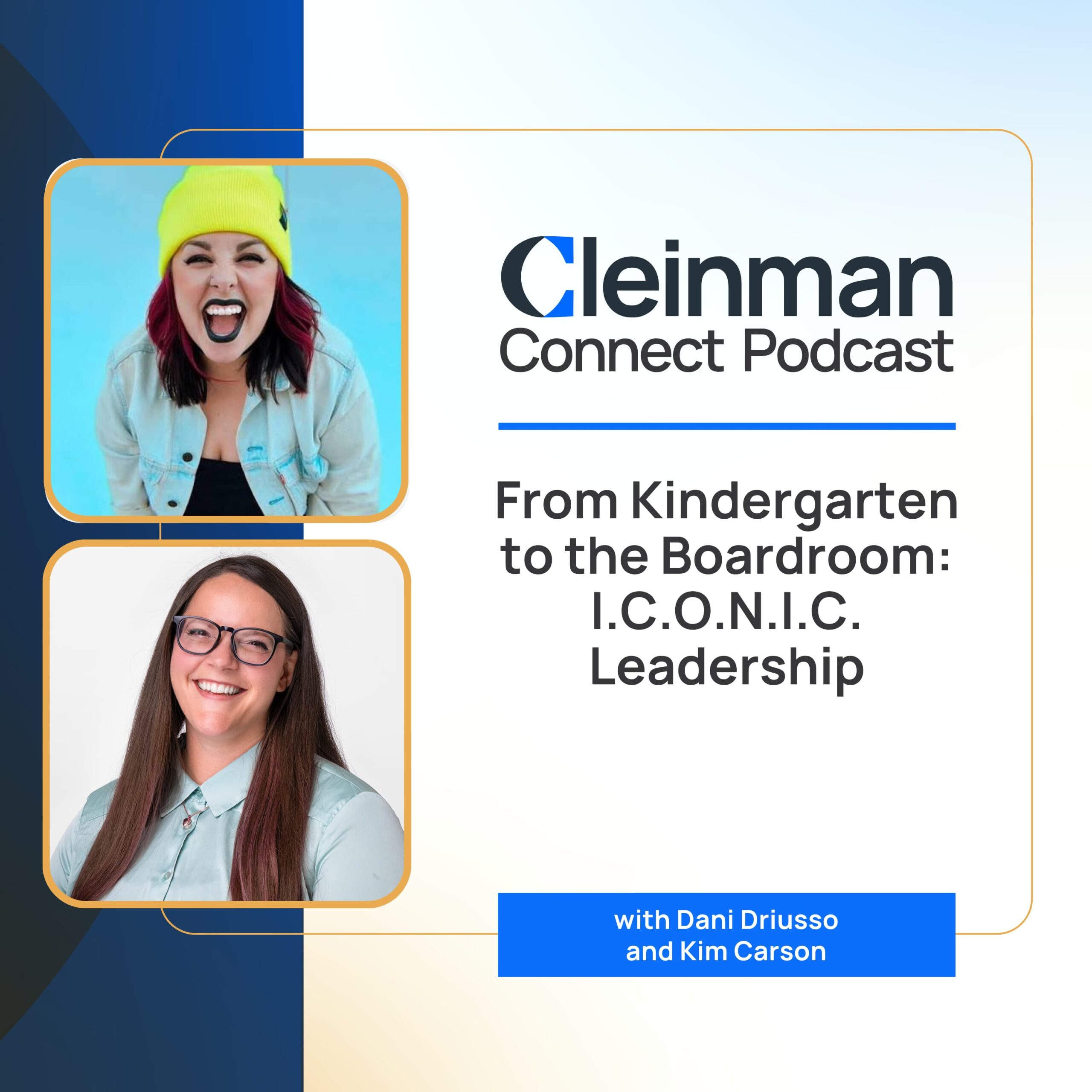

Dani Driusso is a speaker, consultant, author, and educator specializing in sustainable confidence, ethical leadership, communication, and community building. Through her work with organizations, she helps leaders and teams strengthen collaboration, build trust, and create more supportive workplace cultures. Dani has connected with more than 400 leaders and educators through her initiatives, speaks nationwide on sustainable confidence and compassionate leadership, and is the author of Get Off Your A$$ & Into Your Life.
Here’s a glimpse of what you’ll learn:
- [0:58] Dani Driusso’s I.C.O.N.I.C. Leadership Framework and the principles behind timeless, values-driven leadership
- [3:15] How Dani uses behavior as communication to uncover what teams may not be saying aloud
- [7:22] How showing up as your best self while asking for support can set the tone for a team
- [9:53] Why Dani emphasizes ownership, nuance, capacity, and consent as essential elements of effective leadership
- [15:38] How Dani reimagines the eye exam experience through comfort, convenience, and thoughtful personal touches
In this episode…
Strong leadership is often built through everyday interactions, not big speeches or sweeping decisions. The way leaders communicate, respond to mistakes, and support their teams can directly shape workplace culture. So what does people-centered, effective leadership actually look like?
Dani Driusso, an educator and consultant specializing in confidence, leadership, and community building, offers a practical answer through her I.C.O.N.I.C. Leadership Framework. Built around integrity, communication, ownership, nuance, and capacity and consent, the framework encourages leaders to align their actions with their values, pay attention to what behavior communicates, and take responsibility when trust needs to be repaired. Dani also highlights the importance of understanding different lived experiences and checking an employee’s capacity before adding more to their workload. These habits can help leaders improve team communication, prevent burnout, strengthen trust, and create a healthier workplace culture.
In this episode of the Cleinman Connect Podcast, Kim Carson talks with Dani Driusso, speaker, consultant, author, and educator, about building stronger workplace cultures through effective leadership. Dani explores values-driven leadership, behavior as communication, and understanding team capacity. She also shares how thoughtful details can improve the patient experience.
Resources mentioned in this episode:
- Kevin Wilhelm on LinkedIn
- Kim Carson on LinkedIn
- Marketing4ECPs
- Cleinman
- Dani Driusso: Website | LinkedIn
- “From Kindergarten to the Boardroom Part 1: Lessons in Confidence & Culture” with Dani Driusso on the Cleinman Connect Podcast
- Get Off Your A$$ & Into Your Life: Overcome your fears, take action, and stop apologizing for living your dream life by Dani Driusso
Quotable Moments:
- “Integrity for me is integrating your value system into everything you do.”
- “When people feel valued, they will show up, and they will be engaged, and they will participate.”
- “If you want the people around you to take ownership for their actions, you got to lead that first.”
- “People are willing to help if you ask for help.”
- “It’s all based on just being a human who understands that there’s other humans that you’re working with.”
Action Steps:
- Integrate your values into how you lead: Aligning your behavior with what you genuinely care about helps others understand what you stand for and builds trust.
- Pay attention to behavior as communication: Noticing changes in energy, engagement, or performance can reveal important issues that people may not say out loud.
- Take ownership of your actions and mistakes: Modeling accountability encourages your team to take responsibility for their own behavior and makes repair possible when trust is damaged.
- Consider nuance, intention, and impact: Recognizing that people have different lived experiences helps leaders understand that good intentions may still create a different impact.
- Check someone’s capacity before delegating more work: Creating a two-way conversation about what people can realistically handle can prevent overwhelm, burnout, and unnecessary conflict.
Sponsor for this episode…
This episode is brought to you by Marketing4ECPs.
Working with them is like hiring a full-time marketing professional who knows the industry and understands your goals. Except, instead of one experienced marketer, you get a whole team in your corner.
Whether you’re an optometrist, ophthalmologist, or optician, they can help you grow your business with a plan that’s completely customized for you. Learn more here.
Powered by Rise25 Podcast Production Company
Episode Transcript
Intro: 00:07
Welcome to the Cleinman Connect Podcast where we discuss marketing, ownership, growth strategies and everything else surrounding the business of optometry. Cleinman is Optometry’s trusted business partner for over 35 years.
Welcome back to the Cleinman Connect Podcast. This is part two of my interview with Dani Driusso. And we really get into I.C.O.N.I.C. leadership and her framework around that in this episode. It is a part two. So if you missed part one, you definitely can go back and listen to that at Cleinman.com or wherever you like to listen to podcasts. Please enjoy.
I want to kind of move to your I.C.O.N.I.C. Leadership Framework. Yeah. What are some of the pieces in that framework that you teach about?
Dani Driusso: 00:58
So the I.C.O.N.I.C. Leadership Framework I like to call it is a framework that I created based around timeless leadership. So I thought about everyone who was iconic and why you when you think of icons like what sticks. And to be a time and oftentimes it’s tied to something that’s timeless, that can branch across generations. So when I looked at what does it mean to be timeless, I thought, well, it’s I.C.O.N.I.C. So it’s an acronym actually.
So the first, the I stands for Integrity, but I do not think of it how some other leadership coaches would think of integrity. Like I’m not saying if you set your alarm for 5 a.m. and you get up at 5:02, you’re a bad person. Like I’m not saying like, you got to do what you say and say what you do. Like, yes, be a good person about the things that you commit to. But integrity for me is integrating your value system into everything you do.
So if you integrate your value system, like if you know, and step one, if you don’t know what your values are, go figure those out.
Kim Carson: 01:59
Go figure them out.
Dani Driusso: 02:00
Yeah, go figure them out. Look at a values chart and say, what do I actually care about? Because when you lead by those, people notice and people rise up to meet you, especially if you have brand pillars, same thing. Like what do you actually care about? What do you value?
Because that is going to what’s going to be driving your behavior anyways. So integrity, integrating your value system into everything you do. The first C is Communication. And I always say like all behaviors, communication, I actually learned that from a classroom that I worked at years and years ago. Like I’ve been doing it for ten years.
I worked with tons of differing needs, physical, mental, anything you can think of. And I was working in a classroom that had very high needs, a lot of nonverbal children. And I was really nervous working in the classroom because I’m doing theater at the time, I think I was about 24 maybe, and one of the teachers aides said to me, all you have to think about is all behaviors, communication. And that just like, boom, like blew my mind at the time because I started to look at the classroom in a different way I wasn’t looking for like sound cues or what people were saying. I was looking at how people were behaving, and I thought about that.
Like when even you’re speaking on stage. Like all behaviors, communication, like how you hold yourself, how you enter the room, how you look at people, like, are you looking at people in the eyes? Are you spending time when you catch someone in the elevator? Something like that, and they say good morning to you. Like all behaviors, communication, are you in, in, in yourself?
Are you putting your headphones in and like zoning out? That tells the world a lot about who you are as a person. So for yourself, think about what is your behavior saying about you and what are you reflecting to the spaces that you enter into and to the people who you are connecting with onto day to day basis? But it also goes the other way where when you’re looking at a team and you start looking at behavior and not what people are saying, it gives you a lot more information about them. So are you noticing that there’s a certain energy shift in the room when someone comes in, that is something that you can notice for the better or for the worse.
Do you notice how there is someone who is slipping behind on deadlines? That’s a behavior that you can notice. That might be like something that you might want to check in on. You might also notice that two people are making eye contact in weird ways during a meeting. What?
Like a lot of the different things that you look at and the dynamics of how people behave around each other, tells you a lot about what is going on in your space. And a lot of leaders turn a blind eye and they’re just like, I’m going to make these people pull this chariot instead of getting there with them. Because you never know, maybe someone’s falling behind on deadlines because they just went through a really emotional time, or they’re struggling financially, or they aren’t sleeping because something else is going on. And you, like the more that you lean into those behaviors, the more information and meaning that you’ll be able to mine from those.
Kim Carson: 05:01
I think to apply it back to the leader as well, like to your example of like you have headphones and you’re zoning out, someone says hello to you, you don’t say it back, put that into place in your practice. If you’re walking in and someone is saying hello to you and you’re ignoring them, or you never acknowledge when a protester drops a patient off in your room. What is that non communication behavior, but communication behavior telling them about how you view them, about how you think about the work they’re putting in. Like, what are those little signals that you could be sending out? And you know, I don’t want anyone to get like insecure and, you know, think about every single minute interaction you’ve ever had, but like, truly, if there is a, like walk into your practice tomorrow or, or after listening to this episode and notice how your own energy is a form of communication when you walk into your practice in your room.
Dani Driusso: 06:02
Absolutely. And how welcoming you have your patience feel because the way that you behave within just with your staff is going to reflect on the way that your clients feel when they come in and they might not notice, but they’ll be like, oh, something about here feels off. Like I actually recently had a specialist that I stopped seeing because every time I went to the office, I was recognizing how they would show up late. I even got gossip from one of the other clients was an older couple and they were like, this person always shows up late and they never do this, and they always do this. And they’re and they noticed how that doctor spoke to their clients and spoke to their staff and how they just moved about the space.
And they could tell that the specialist did not respect the people in the office. And that was interesting to me because I felt it. And then when I got into the room, I felt the same thing. But towards me as a client. And I was like, okay, cool.
So I don’t want to be here anymore because that is not for me in my own values. It’s not a place that I want to be, is somewhere that I feel like a burden. And so it’s really interesting.
Kim Carson: 07:14
I’m not about to show up to a place I’m not wanted.
Dani Driusso: 07:16
So exactly.
Kim Carson: 07:18
If you could just tell me that and oh, you actually are with your behavior.
Dani Driusso: 07:22
So yes, absolutely. Like it’s something as simple as like, oh, like, great seeing you again or, or even a good morning to those people who work for you. But that’s a huge thing of just getting yourself. Sometimes I tell people it’s, how can you get yourself hyped or excited for the day to be your best self? When you go into a leadership position, like how can you help yourself in the morning, whether it’s listening to music or doing whatever you need to do, meditate or work out or whatever, but always thinking about how can I be my best self?
So when I show up, I am my best self. And that doesn’t mean that you don’t have off days. That doesn’t mean that you’re not human. But if you are feeling off. Also, I’m getting to the other ones, but I will say the rest of the acronyms.
I promise, I promise. But even if you’re not feeling amazing, even saying, hey guys, I am not feeling my best today and I’m going to try my best to show up for you guys. Here’s what I need as support. That’s another great leadership thing. Because if you walk in and you say, hey, this is what I’m struggling with, you don’t have to get into details.
You can be like, hey, I’m having a really off day. What I need from you is if you guys can make sure you remind me more often about this, or if you guys can make sure that I’m not missing this. I would really appreciate it and be really grateful for you. Once again, I always say this in the classroom too. If I show up and I’m teaching teenagers and I’m like, I’m going to be really, really honest, like last year my back went out and I was like, hey guys, my back is really not doing great, so I can’t keep up with you guys.
Like I normally do what I need from you to have a little bit of grace for me, but also, if I need your attention that you can be locked in, can you do that for me? And they’re like, so willing to help. People are willing to help if you ask for help. And so they’re like, of course. And then the next week I came and they said, how’s your back?
What can we do? I said, oh, it’s getting better. And they cheered and they were like, yeah, amazing. And then the following week I was doing like jumping jacks with them. And they’re like, Dani, you’re back.
That’s amazing. And it’s the same thing, but applied to like a workspace, like get people in a space where they value you as a human and they will root for you. And when people feel valued, they will show up and they will be engaged and they will participate. And when they feel valued as more than just a number or, or someone in the office or a client, they’ll want to be there. And it’ll reflect in their behavior.
Kim Carson: 09:46
Yeah.
Dani Driusso: 09:46
Yeah. Okay. I’ll go through the other ones.
Kim Carson: 09:49
I know I’m like, let’s just stop. But I see this was like leadership. Thank you.
Dani Driusso: 09:53
Thank you so much. So the other ones, so we went through integrity, clear communication, which is also important, which is that how can I simplify this? Not dumb it down, quote unquote. Like I don’t like when people refer to it as that. It’s simplifying.
Like, how can I make sure we’re on the same page? Right. So with that is all behaviors communication. The oh and I.C.O.N.I.C. leadership is ownership. We already talked about this repair is always available.
Like owning your mistakes, owning your behavior, and also owning the fact that you have control over your own behavior. So you are responsible for you. And I see that too with a lot of emotional capacity. Some people really in a leadership position don’t understand how they can emotionally regulate themselves. So they oftentimes pass it on to the team like, oh, because they did this, then I have the right to act like this.
And you’re not doing any of that when you’re being an effective leader who wants to focus on cultivating a community space. Because if you want the people around you to take ownership for their actions, you got to lead that first. Like your behavior will say more. All behavior is communication than your words ever will. So you need to act in that way as well.
And the N is for nuance. So different, different experiences, understanding that you don’t have the same lived experience as anyone else and that people hold different privileges. So you could be in a leadership position with a lot more privilege than the people who might be around you. And so just recognizing that as well and doing the work to understand that intention, intention and impact. Huge.
So greatest intention can have the most impact. So just understanding that there are two different things. And when we take ownership, we also recognize the impact can be different than the intention, but we can go in with the best intentions and that’s awesome. But just recognizing that might not be received that way. And then the last one is capacity and consent, which is that clear communication aspect.
When I talk about consent, it’s really, are you involved in a two way conversation? Are you involved in a space where it’s like, hey, do you have the space to do this? Do you have the ability to go do this other thing? Like when you’re delegating stuff, not just being like, I need you to do this, this, this, this, this, this, this, and I need it snappy, right? Like understanding that everyone has a different capacity.
And when I explain capacity, because some people that’s a new term for them. I explain it the same way as I do for a 60 year olds, as I do with a six year old. I say, imagine I have this cup and it’s almost to the rim. Okay. And then I take scalding hot coffee and I pour it in that cup.
What happens? And oftentimes when I talk to six year olds, they’re like, it makes a mess. And I was like, yes, it does make a mess, sweetie. And it burns your hands. And I’m like, it does burn my hands and what else?
And they’re like, and it’s all over the floor. And I’m like, it is all over the floor. So what do I have to do next? And they say, you have to clean up your mess. And I say exactly.
Because if you do not focus on your emotional capacity or your physical capacity of how much you can do, you have a mess to clean up before you can actually move forward because you’re going to have an emotional explosion, you are going to have burnout, you are going to have something beyond your capacity and you’re not going to be able to recover in the same way that you would. If you notice your cup is half full and you’re like, you know what? I’m going to leave it here for now, or I’m going to like pour some of that out before I go add more to my cup. So that within that, that’s your capacity. And then a consensual conversation is understanding that other people have different capacities and checking in with them before you just throw a bunch of stuff on them.
Kim Carson: 13:29
Because before you pour the scalding hot water into their cup.
Dani Driusso: 13:32
Yeah, exactly. You don’t know where the cup is at. So you gotta ask where the cup is at, or you’re gonna make a mess and burn their hands. And that’s where repair is so important. I know is that’s so cute.
That’s why I love teaching. Like I teach leadership to like six year olds, 15 year olds, 60 year olds. And it’s all based on just being a human who understands that there’s other humans that you’re working with.
Kim Carson: 13:56
Yeah. I mean, we can understand that six, six, 6 to 600. We can understand like 100. Yeah. Well, honestly, thank you so much.
I’ve had a joyous time. Thank you for taking me through I.C.O.N.I.C. leadership. And I just have one last question for you. Yeah. Before I ask it, I’ll point people to our sponsor.
Again, that’s marketing4ecps.com. And my final question for you, Dani, is as someone like me who is not an optometrist or work in an optometry practice, something that we do have is eyes and we wear glasses. And I do wear glasses. She does wear glasses, especially at night and especially when driving. Yeah.
And she never ever, ever goes without them. Yeah. I would love to know from you, if you were going to pay $10,000 for an eye exam, what would you expect that eye exam to contain?
Dani Driusso: 15:08
I love this. So $10,000 is the budget.
Kim Carson: 15:12
It is the budget. So you’re like, you’re scrolling and you’re like, you know what? I want to treat myself. And you see, oh my God, get this $10,000 eye exam on the list of like, what’s included? What do you expect to be listed?
What are some of the things?
Dani Driusso: 15:24
Okay, so what I expect to be listed is that can I go as wild with this as I want and also as realistic?
Kim Carson: 15:32
I mean, if it’s going to stay within $10,000, I want you to say whatever you’re going to say.
Dani Driusso: 15:38
Oh, I love this. Okay, so I get really freaked out about eye exams, number one, because one of my biggest fears is not having vision. And number two, and because my vision as I get older is decaying, it’s very scary for me. And number two, I constantly lose my glasses. So this is what I would want to have it.
So I walk in, okay, I booked the appointment online. I walk in and honestly.
Kim Carson: 16:04
That’s the first thing. I booked the appointment online. I didn’t have to call.
Dani Driusso: 16:07
I didn’t have to talk to no one on the phone. I booked it online. I probably found them on social media. I saw that they had this offering. It looked like someone was very, very excited in a chair and I was like, that’s where I want to go.
And I walk in after my booked online appointment and everyone so friendly. They’re like, hi, good morning. And I’m like, hi, thank you for having me. And they’re like, thank you for being here. And then they check me in and they’re like, go have a seat.
And so I go sit down and there’s music playing. And then the person who walks in, I was like, Dani, come on in. I’m like, oh, thanks. And they’re like, I’m so happy you’re here. And I’m like, I’m so happy to be here.
And I go, and I sit down and I get taken to a second room, and this room has a heated blanket and it has a little bottle of water or a pop or coffee or tea or whatever of choice. And I get to sit back in the little cozy thing. There’s relaxing music. It’s like a spa. And then the optometrist comes in and checks my eyes and regularly tells me that I’m doing a really good job.
And then when I leave, I get to pick a toy from the treasure chest. And then I also get a gift bag that comes with those little strings that keep your glasses on. And also, I think that’s it. I think so, but like a little gift bag.
Kim Carson: 17:31
That I honestly.
Dani Driusso: 17:32
Okay, thank you. $500.
Kim Carson: 17:34
No, I know that’s honestly how that’s why I’ve been giggling the whole time. I’m like, you’re just describing what like I would expect any appointment to kind of be.
Dani Driusso: 17:43
That’s so.
Kim Carson: 17:44
I know it’s.
Dani Driusso: 17:45
Like. And. Oh, and in the little pack that they give me, they give me glasses, wipes and a cloth because I always smudge my glasses. And because I have astigmatism, it’s really hard to see at night when I have sponge glasses.
Kim Carson: 18:03
Okay, so honestly, if you are an optometrist that offers an average experience and you can throw in a heated blanket, a toy, treasure chest, and.
Dani Driusso: 18:13
Comments.
Kim Carson: 18:14
And compliments. Yes. Don’t forget the compliments. You might have a $10,000 customer. So.
Dani Driusso: 18:23
Absolutely.
Kim Carson: 18:25
So thank you. Thank you so much for coming on the show today, Dani. It was absolutely a treat.
Dani Driusso: 18:31
Thank you for having me. And thank you to everyone listening. I hope you had a great time.
Kim Carson: 18:36
Yay. So that’s our show. If you want to hear more of the Cleinman Connect Podcast, you certainly can. At Cleinman.com and wherever you like to listen. Thank you for joining us today.
Thank you for listening. At Cleinman, we take pride in helping our partners unlock their full potential. Subscribe to get the newest episodes or visit us anytime at Cleinman.com.