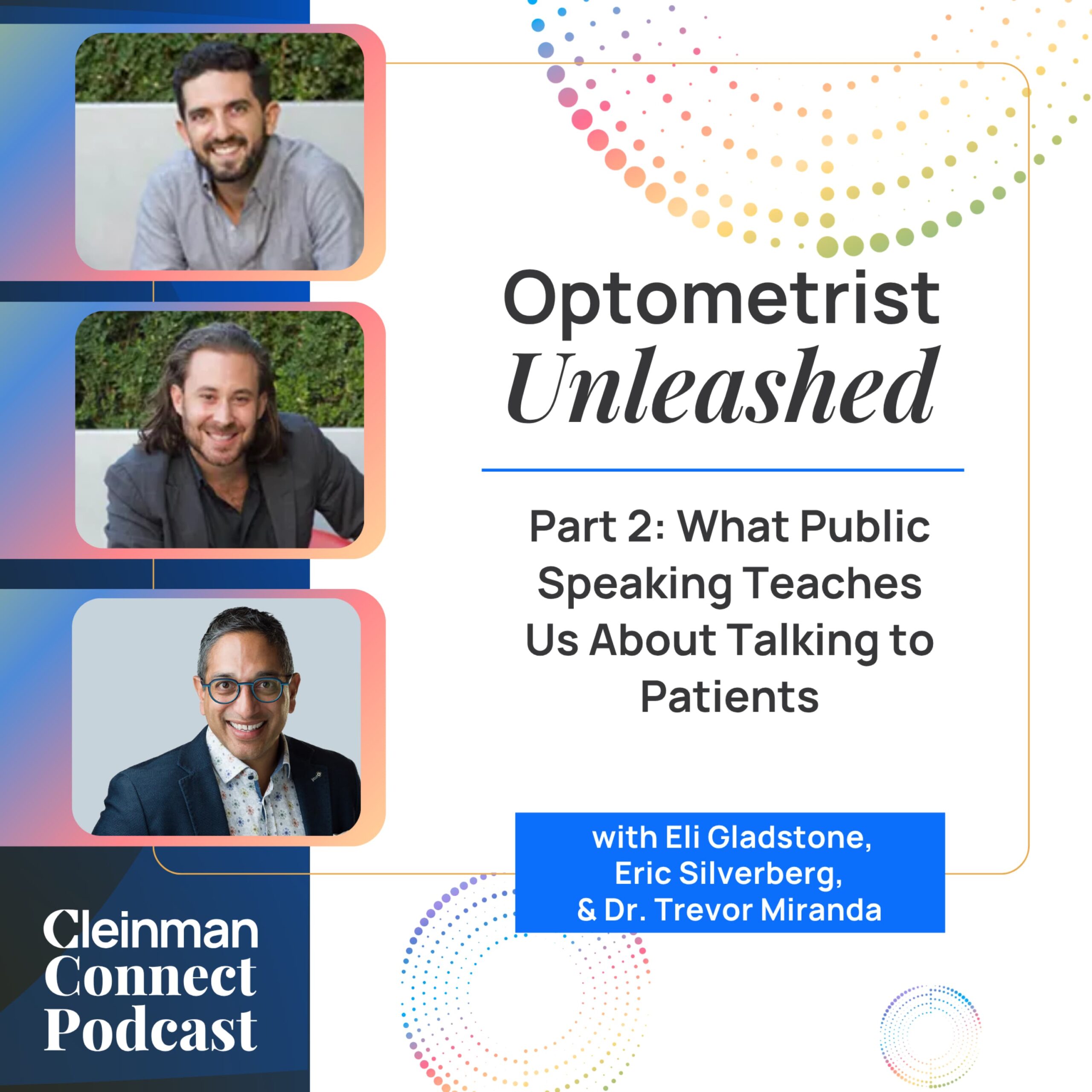

Eli Gladstone and Eric Silverberg are the Co-founders of Speaker Labs, a public speaking training company that helps professionals and enterprise teams communicate with greater clarity, confidence, and impact. Since launching the company in 2016, they have trained professionals and teams at leading companies, including Shopify, Google, TD Bank, and RBC. Both began their careers as faculty members at the Ivey Business School before gaining experience in tech startups. Drawing on backgrounds in teaching and business, Eric and Eli lead workshops focused on presentation skills, storytelling, delivery, mindset, and executive presence, helping professionals overcome speaking anxiety, engage audiences, and communicate effectively in high-stakes situations.
Here’s a glimpse of what you’ll learn:
- [1:02] Eli Gladstone and Eric Silverberg explain why one-on-one patient conversations feel more natural than high-stakes public speaking
- [3:04] How Eli connects social media, self-talk, and overcoming the fear of judgment when communicating with others
- [5:44] Eric explains why mindset, preparation, and communication skills help speakers build confidence with any audience
- [9:18] Eli and Eric discuss the importance of honest feedback and creating a safe environment for communication growth
- [14:53] What Eli shares about taking ownership of the patient experience through intentional communication
- [17:49] Eric and Eli explain how continuous improvement and leaning into personal strengths create stronger communicators
In this episode…
Effective communication plays a critical role in both public speaking and patient care. The ability to connect with an audience, simplify complex ideas, and build trust can shape how people receive and act on information. What can lessons from the stage teach healthcare professionals about creating better conversations with patients?
Public speaking experts Eli Gladstone and Eric Silverberg explain how public speaking principles can improve everyday patient interactions. Their insights highlight the importance of mindset, preparation, storytelling, and taking responsibility for the listener’s experience. Eli emphasizes that strong communication starts with understanding the audience, while Eric shares how honest feedback and intentional practice help people become more confident and effective communicators. These strategies show how skills developed for large audiences can translate into more meaningful one-on-one conversations with patients.
In this episode of Optometrist Unleashed, a Cleinman Connect Podcast, Dr. Trevor Miranda chats with Eli Gladstone and Eric Silverberg, Co-founders of Speaker Labs, about what public speaking teaches optometrists about talking to patients. Eli and Eric discuss overcoming communication fears, using self-talk to build confidence, and creating better audience experiences. They also explore feedback, storytelling, and continuous improvement as tools for stronger connections.
Resources mentioned in this episode:
- Kevin Wilhelm on LinkedIn
- Dr. Trevor Miranda on LinkedIn
- Marketing4ECPs
- Cleinman
- Eli Gladstone on LinkedIn
- Eric Silverberg on LinkedIn
- Speaker Labs: Website | Instagram
- “[Optometrist Unleashed] What Public Speaking Teaches Us About Talking to Patients – Part 1” on the Cleinman Connect Podcast
Quotable Moments:
- “You can look at the stakes through the lens of your fear or through the lens of your courage.”
- “You can’t be there for other people if you’re too in your own head.”
- “On some level, you’re here to get better, and you can only get better if you’re told the truth.”
- “That mindset stuff is the ultimate unlock, particularly in communication, because there’s a baseline of ability that everybody has.”
- “Certainly, it’s a skill that you can work on; there’s no doubt about that.”
Action Steps:
- Simplify complex information for patients: Breaking recommendations into clear, bite-sized explanations helps prevent confusion and makes it easier for patients to act.
- Tailor your communication to the individual: Adjusting the level of detail, tone, and delivery to the person in front of you creates a more useful and engaging patient experience.
- Use constructive self-talk before high-stakes conversations: Reframing anxiety as confidence and preparation can help you communicate more effectively when the pressure feels higher.
- Seek honest feedback on your communication habits: Specific feedback can reveal tendencies you may not notice yourself and give you practical areas to improve.
- Lean into your existing communication strengths: Identifying what already makes you effective and developing those qualities further can help you become a stronger, more distinctive communicator.
Sponsor for this episode…
This episode is brought to you by Marketing4ECPs.
Working with them is like hiring a full-time marketing professional who knows the industry and understands your goals. Except, instead of one experienced marketer, you get a whole team in your corner.
Whether you’re an optometrist, ophthalmologist, or optician, they can help you grow your business with a plan that’s completely customized for you. Learn more here.
Powered by Rise25 Podcast Production Company
Episode Transcript
Intro: 00:00
Welcome to Optometrist Unleashed, a Cleinman Connect Podcast with Dr. Trevor Miranda. A monthly doctor led discussion about everything surrounding the business of optometry.
Welcome back to part two of What Public Speaking teaches us about talking to patients with Eli and Eric, the minds behind Speaker Labs and of course, Dr. Trevor Miranda. If you haven’t heard part one, you should go run. Listen to it right now, wherever you like to get podcasts or at cleinman.com. If you’ve already heard it, though, please enjoy part two of this series already in progress.
Dr. Trevor Miranda: 00:42
I wanted to to talk to you guys about, you know, why optometrists seem to be comfortable in their exam lanes sometimes. And then you ask them, and I know you’ve trained some optometrists at quite a few. Now why do they get uncomfortable when they’re in front of a bigger audience? Is that just because they’re used to what they’re doing one on one.
Eric Silverberg: 01:02
I think that it has a little bit to do with that. It has a little bit to do with that. I think that we’re all not just optometrists, but just about everyone on earth is a little bit more practiced at speaking one on one than they are speaking one to many. Those opportunities to speak from a stage or even from a seat in a boardroom, they don’t come quite as frequently as speaking one on one. And I know optometrists are speaking one on one with patients all day.
But trust me when I say that we teach people across just about every industry you can imagine, and across every single industry, most people do most of their speaking one on one. And that’s part of why it’s easier. They have more reps doing it that way. But the other reason is the protector is not quite as strong in those scenarios. In the scenario where you’re speaking one on one, you’ve got one person’s view of you to lose.
And when you’re speaking one to many, you have However, many people are sitting in that room. You have all those people’s experience of your reputation to lose. And so it’s not just the reps. It’s also that the stakes are just higher. And again, we spoke earlier, but we could remind you that you can look at the stakes through two different lenses.
You can look at the stakes through the lens of your fear or through the lens of your courage. But the truth is, just objectively, the stakes do happen to be higher. And so I think because there’s less practice and because people are more afraid, those two reasons combined are probably more why people struggle speaking one to many or public speaking. It’s not just that they don’t have as many reps.
Dr. Trevor Miranda: 02:41
Yeah. Do you think social media, because you can edit your content and what you’re putting out there has really lessened the ability for folks to face the higher stakes of an engaged audience because they’re so used to, you know, speaking to the camera and making it pretty. Pretty it up so that it’s consumed in a better way.
Eli Gladstone: 03:04
So I actually think someone who’s gotten really good at speaking on social media to the faceless audience behind the digital wall, I think they could potentially be better at speaking to a live audience face to face engaged, but they could also be worse. And I would say the single biggest differentiator is when, when somebody actually let me say it this way, there are many people who want to build up a following online, build up a following on social media. They want to post more, but they don’t because they’re worried about what people might think. As a result of that. They stay in this, they stay behind the digital wall and they stay comfortable and they stay safe.
Nobody can judge you if you don’t even try. And for some people who start posting a lot on social media, they put themselves out there. They have to embrace that. People are going to think what they’re going to think. And that almost allows you to reduce the volume on your protector a little bit.
And then when you’re in front of a live audience, you might actually be able to use that and acknowledge that little voice that pops up that says, oh, what if I screw up? What if I forget what I’m going to say? What if I look like an idiot? What if they’re bored? What if I say the wrong thing?
You can recognize it for what it is. That’s that little part that’s so worried what everybody’s going to think. And you can just show up anyways for other people. They post on social media and they get very caught up in, well, that post didn’t do as well as the last one. I got fewer views, less likes.
Maybe people don’t like it. And what it actually does is it amplifies the volume of their protector and their worry about what people are thinking because they get so much repeated feedback on is this good? Is this not good? Is it good? Is it not good that it actually causes them to shrink even more when they’re in front of a live audience?
So I don’t think that it’s necessarily social media is helpful or hurtful. I think it can be either, depending on how you’re using your social media reps to color how you’re speaking to yourself.
Dr. Trevor Miranda: 04:53
And I think that, you know, in the intro, I touched upon how it was really life changing for me. This perspective of self-talk, if you will, talking yourself, your courageous, your protector, however we want to call it, but just telling yourself you’re going to be great and do well. It’s going to be fun. Let’s go get it. In everything that we do, I think is so, so valuable to me.
That’s the lesson I learned from Speaker Labs is, hey, listen, you can do it and just be brave and, and you know, you’ll deal with whatever happens, happens. Yes. You’re going to have a thesis. Yes. You’re going to have slides that are not too busy that are going to catch people’s attention.
And yes, you’re not going to be monotone, but at the end of the day, you’re going to be confident in your own ability to be up there. And k sera sera.
Eli Gladstone: 05:43
Yeah.
Eric Silverberg: 05:44
I want to be clear that it’s it. So you’re 100% right, Trevor. 100%. And that’s I’m thrilled that that was your takeaway from the program. But I want to clarify that it’s not all that touchy feely.
It’s not just be brave, right? Right. It’s a little bit more nuanced and a little bit more practical than that. Which person do you think is more likely to succeed? The person that tells themselves before they walk on stage, this is going to be horrible.
Everyone’s going to hate this. Or the person that walks on stage and thinks to themselves, I’m going to crush this, and if I don’t, I’ll be okay anyways. Which person is more likely to succeed? Now, of course, neither are guaranteed. Guaranteed to succeed, that’s for sure.
Both could fail, but who’s more likely to succeed? I think it’s the latter. My money is on the latter every single time. So it’s not just be brave, believe in yourself, touchy feely sort of bull. It’s a lot more practical and nuanced and useful than that.
And so I want to be really clear that it’s not just we don’t pat people on the back, give them a big hug and say, believe in yourself. We, we, we like getting to, you know, the real practical nature of the self-talk and how it doesn’t guarantee anything when you have the right self-talk. But man, it ups. It ups the odds in a big way.
Eli Gladstone: 07:02
Yeah. And something I want to add to which I think is really important is it applies. This applies specifically in domains where people already have a base of ability. So if, if you were sort of talking about the, the thesis and the slides and the, the expression and not being monotone and all of these things, these are skill sets and you can learn these skill sets and improve as a communicator. But that mindset stuff is the ultimate unlock, particularly in communication, because there’s a baseline of ability that everybody has.
It’s like communication is the ubiquitous thing across our species. It’s what differentiates us from all other animals in the animal kingdom is our linguistic ability, our ability to communicate. But if we’re, let’s say, standing at the foot of, of a 500 foot rock climb and it’s like, hey, listen, believe in yourself. You can climb up that with no rope, go free solo, you’ll be good to go. And I’ve never done real rock climbing in my life.
No amount of believing in myself is going to help me. And so it really only applies in a domain where there is a baseline level of ability that is so much greater than people give themselves credit for. And yes, we can enhance those abilities. We can improve your skill set. We can teach you strategies, frameworks, so many things that level you up dramatically, very quickly, that mental game that we all play, that has to be played in domains where the baseline level of ability is more than sufficient.
Dr. Trevor Miranda: 08:22
Yeah, 100%. The other thing that struck me in these courses was your honesty, you know, and the self-reflection that takes place after the exchange of feedback. So, you know, we had one of my colleagues would hold his breath and he didn’t realize that until you guys pointed it out. And then it was obvious to everybody, you know, he’s holding his breath and he’s an amazing public speaker. And, you know, I’m a little bit too pasty.
And so, you know, just having that feedback, that honest feedback is just it’s kind of missing a lot of way in a lot of ways. We just don’t always get that really, really honest feedback. And it’s like, whoa, whoa, do it again, you know? And if you don’t, if you, if you continue to do the same sort of tendency that we don’t want to see, we’re going to do it again in front of everybody. So I love that challenge of the real honesty and the feedback.
It made it, it made it entertaining. But we learned a lot too. So I thought that was cool.
Eric Silverberg: 09:18
Thanks for saying that. That’s what we’ve had to work on hardest over the past ten years that we’ve been running the workshops, like the ones that you participated in, finding that perfect balance between safe and fun and approachable and entertaining, but real and challenging and no bullshit. That’s a really difficult balance to find. So it’s music to our ears to hear you say that. We found it in the workshops that we ran with you, because it can be very difficult to hear constructive feedback while we still want you to love our program and love us and feel like this is a safe space.
So it’s a challenging thing. But I think I agree with you, Trevor, that anyone that invests time in up leveling a certain skill, they crave that feedback, even if it’s tough to hear sometimes they need it. On some level, you’re here to get better and you can only get better if you’re told the truth. Right?
Dr. Trevor Miranda: 10:09
And I think you could take that, you know, across. I’ve got a team of about 7012 docs and, you know, five locations. Our team needs feedback now, honest feedback from a place where we want you to succeed. So it’s a safe place, but it’s honest and sometimes that’s tough to deliver and sometimes that’s tough to take if it’s not the right environment, the right culture that we’ve built. So, you know, kudos to you guys for threading that needle there.
That’s really great. Do you guys have any thoughts or questions that going through your head? Tell me what’s what’s happening with you guys?
Eli Gladstone: 10:42
I’m curious how you’ve applied the stuff that we’ve explored in our programs in your day to day. Because I know the lens we look at communication through is public speaking. It’s one to many. It’s those super high stakes moments that either you have faced and you want to improve or, you know, on some level you’re going to face, like everybody who’s who’s ambitious knows at some point in my career, I’m going to have to speak to crowds and get a message across and inspire or motivate or persuade or whatever. And that’s the lens we look at communication through.
But as you mentioned earlier, a lot of communication happens outside of those contexts. So I’m curious, you think about what we talked about in our program from both the skill set perspective and the mindset perspective. How have you applied that in your day to day, smaller scale, more intimate? How have you done it?
Dr. Trevor Miranda: 11:29
Yeah, I think storytelling, you know, when you tell a patient a story about another patient and the experience and, and wins that we’ve had with someone else, I think that can be very powerful for that patient to buy in to what your treatment plan and recommendations are. So making sure I tell the story also, just in general, making sure that I take the time to pause and listen and also just not be monotone. And to Pasi in general. And of course, like I said before, just lower the whole global stakes in my mind for everything that I’m doing, whether it’s golf or whether it’s, it’s really literally everything isn’t that scary. If you, if you are going to sort of root for your projector.
So I’m on team projector, as you guys know, one time at one of your courses to get people’s attention, I throw a glass of cold water on a face of one of the participants. So that was a that got everybody’s attention.
Eric Silverberg: 12:31
I guess that’s perfect proof that we created a safe space. Right?
Dr. Trevor Miranda: 12:35
Exactly, exactly. And you know what? I think just making sure that you shed all the protector mindset, but you also prepare, you have a thesis, you make sure your slides are not too busy. So when I’m, when I’m out there in, in speaking, I’m making sure it’s not too busy when I’m with a patient. I want to also make sure it’s not too busy.
So let’s just bite sized, digestible things. And then I send videos and other things later. So I’ll give you an example. A patient says, what’s glaucoma? Wow.
It’s a big topic. They closed angle. They open angle glaucoma. There’s there’s different types of glaucoma and how we treat glaucoma. It could be a half an hour discussion.
So I’m going to send you a video about glaucoma, Mrs. Jones. And I want you to know you can reach out to me and we can if for any follow up questions, that’s it. I’m not going to go into the big deal about what glaucoma is, because that’s a rabbit hole right there because she doesn’t have glaucoma. We’re going to talk about some other things that are more pertinent to, you know, her eyes right now and the future health of her eyes. So those are the things to focus me on.
What matters and not too much confusion. So too many things more than I think it was for, you know, for symbols on a slide more than that is, is just chaos. And I think for patients too, how many of us are giving multiple treatment plans and multiple options? So the permutations become like 20 and the patients confused and they don’t do anything. They’re paralyzed, in fact.
So I think when it comes to choosing glasses, in fact, a lot of patients have told us they’re really scared when they choose glasses. It’s one of their biggest fears. It’s easier to choose a house in some regards. And so that’s a fear piece. What would people think?
Did I choose the wrong color, the wrong glasses? They need a place where we make it a little bit more simple. So sometimes having them sit in the eyewear gallery first, okay, sit down, get relaxed and say, hey, we’re going to dress you now. We’re going to bring you some choices and get some feedback. So it’s like the amuse bouche before the meal.
You don’t get all the meal at once. You get, you know, stages of the meal. And I think if you were just to let somebody loose in the eyewear gallery and try on 100 glasses. They end up with none.
Eli Gladstone: 14:53
Yeah. What I love about that is I think it’s you’re taking ownership over the experience that a person has as a communicator. I think a lot of times people can take more responsibility. It’s my job to figure out whatever question you ask. It’s my job to figure out is a robust, elongated answer relevant here?
Is it required or is it as simple as saying, you know, I understand you want to learn about this. Here’s something you can look at. But right now this isn’t your focus. So I love that you’re sort of taking responsibility for people’s experience, and people’s experience of communication should ultimately come down to the communicator.
Dr. Trevor Miranda: 15:30
Yeah. And we could get feedback. You know, if you’re an engineer type and you want all the details, we’ll give you that. If you’re a, you know, an outgoing type and you just want to have laughs and we’ll give you that. So we try to cater to, to the audience, if you will, of one in our case, but I think you’ve also said that to us in, in training the wider honest.
What’s that audience looking for and how can we be there for them? So it’s about their experience as much as anything, whether you’re talking to a whole crowd or or one on one.
Eric Silverberg: 16:02
Trevor, you were clearly sorry. Go ahead.
Eli Gladstone: 16:04
I just want to say which, by the way, comes back to a mindset thing. You can’t be there for other people if you’re too in your own head.
Eric Silverberg: 16:11
Trevor, we’ve hung out a few times. As you mentioned, you’ve taken our course twice, but something that I don’t think I’ve ever explicitly asked you is you were clearly already a good public speaker long before you met us. You were already clearly a confident communicator long before you met us. Why did you attend our program? What made you want to do this?
As someone who was clearly already good and already getting by on the skills you already had?
Dr. Trevor Miranda: 16:37
Well, thanks. I mean, I do think there was a lot of room for me to improve.
Eric Silverberg: 16:42
Well, there’s no finish line for anyone.
Dr. Trevor Miranda: 16:44
There’s no finish line.
Eric Silverberg: 16:45
Included, Eli included. You included. Right.
Dr. Trevor Miranda: 16:47
Yeah. So you can always get better. A you can always get better. I really think you. You really hit home with the pieces in my mind and actually what I needed to do.
So it. It solidified some of my tendencies one way or another. Like it helped me focus on the things I wanted to focus on and what I believe in, and shed some of the other aspects of perhaps going too fast, for instance, or speaking quickly when I was a bit nervous or anxious and being able to say, no, listen, we can just slow it down and I’m going to get through the content and it’s going to be fine. So I had this almost anxiety heading into it. Sometimes.
I, you know, I have learned to be more excited and anticipatory rather than anxious, but it wasn’t always that way. And you have to learn to be a great speaker. You just doesn’t you’re not born that way. I assume you guys feel that you can teach people to be great speakers, and you’re not just you just don’t come out of it being a great speaker at the beginning.
Eric Silverberg: 17:49
For sure. Certainly it’s a skill that you can work on, there’s no doubt about that. Was it just that you’re sort of learning obsessed and growth obsessed, and that’s why you decided to attend, even though I’m sure that your skills across other domains are probably worse than your skills were in this domain, right? It’s not like you came into our program one out of ten communicator. You were much higher than that.
So is it just that you’re always looking to improve, or were you noticing in your day to day a deficiency in your communication that you really felt a huge need and urge to fix?
Dr. Trevor Miranda: 18:25
No, I think probably the former. I’m driven by learning and improving. It’s interesting, I think, where you show tendencies of excellence, sometimes that’s the area that you could grow the most already. You know, Tiger Woods is a good example. He was excellent at the beginning as a young young boy and driving the golf ball and what he would work on was not sand saves.
He would work on driving the golf ball because he would already showing. Excellent. So I think if you want to be world class at something, I’m not sure I want to be world class, but let’s say you want to be really, really good is really go and work on the things you’re already showing some good tendencies towards. So I would say, hey, you know, you’ve developed a course at Speakers Lab that allows whatever level you’re at to grow and get better. So kudos to you guys.
I think I’m excited about the third round, whatever, whatever’s happening then. But I still think, yeah, there’s still lots to learn. And every time I’ve gone to your course, I’ve definitely taken home legitimate pieces that I can apply to my daily life and my speaking life as well.
Eric Silverberg: 19:39
I love that and I love what you said there about excellence. That’s such an interesting perspective. I know Eli and I, Eli and I are sometimes of one mind. And I know that’s something that we’re going to debrief on is leaning into that excellence. If you’re excellent at driving, work on your driving, that’s such a great soundbite.
I love that perspective.
Dr. Trevor Miranda: 19:56
Yeah, I think and you know, it’s you need to identify what you’re excellent at. I think you guys could be good at that. That would be an interesting exercise is listen, this is what I like the best from you, your charm or your energy or your intellect or your story, whatever it is. And that’s the piece that I want you to lean into. It’s going to be very individualized as to what is the strength, what’s that glue?
What’s that? What’s that attraction that you have with that speaker, if I can put it that way, and then lean into that a bit more.
Eric Silverberg: 20:30
Whenever you get tired of eyes, you’re hired. We’ll hand you a microphone. Okay. You can be one of our coaches. You know.
Dr. Trevor Miranda: 20:35
What? I would love to join you guys one day. You don’t even have to pay me. I would just come out and hang out with you guys. That would.
Eric Silverberg: 20:40
Be.
Dr. Trevor Miranda: 20:41
Super, super fun. You know?
Eric Silverberg: 20:42
We’d love that too.
Dr. Trevor Miranda: 20:43
Yeah, let’s do it. We’re going to do it one day. You know what, guys, I want to thank you, Eric and Eli for your insight and your time today and where people can learn more about Speaker Labs and the both of you is at speakerlabs.ca or Speaker Labs on Instagram. You gotta follow these guys. Thanks so much for joining us.
I want to thank our sponsor again, it’s Marketing4ECPs. Check them out at Marketing4ECPs.com. That’s our show. If you want to hear more of the Cleinman Connect Podcast and the special Optometrist Unleashed episodes, you can at Cleinman.com and wherever you like to listen. Thanks for joining us today. Thanks, fellas. I really appreciate it.
Eric Silverberg: 21:26
Thanks, Trevor. This was awesome. You rock. Thank you.
Eli Gladstone: 21:29
Appreciate it.
Outro: 21:31
Thank you for listening. At Cleinman, we take pride in helping our optometrists unleash their full potential. Subscribe to get the newest episodes or visit us anytime at Cleinman.com.