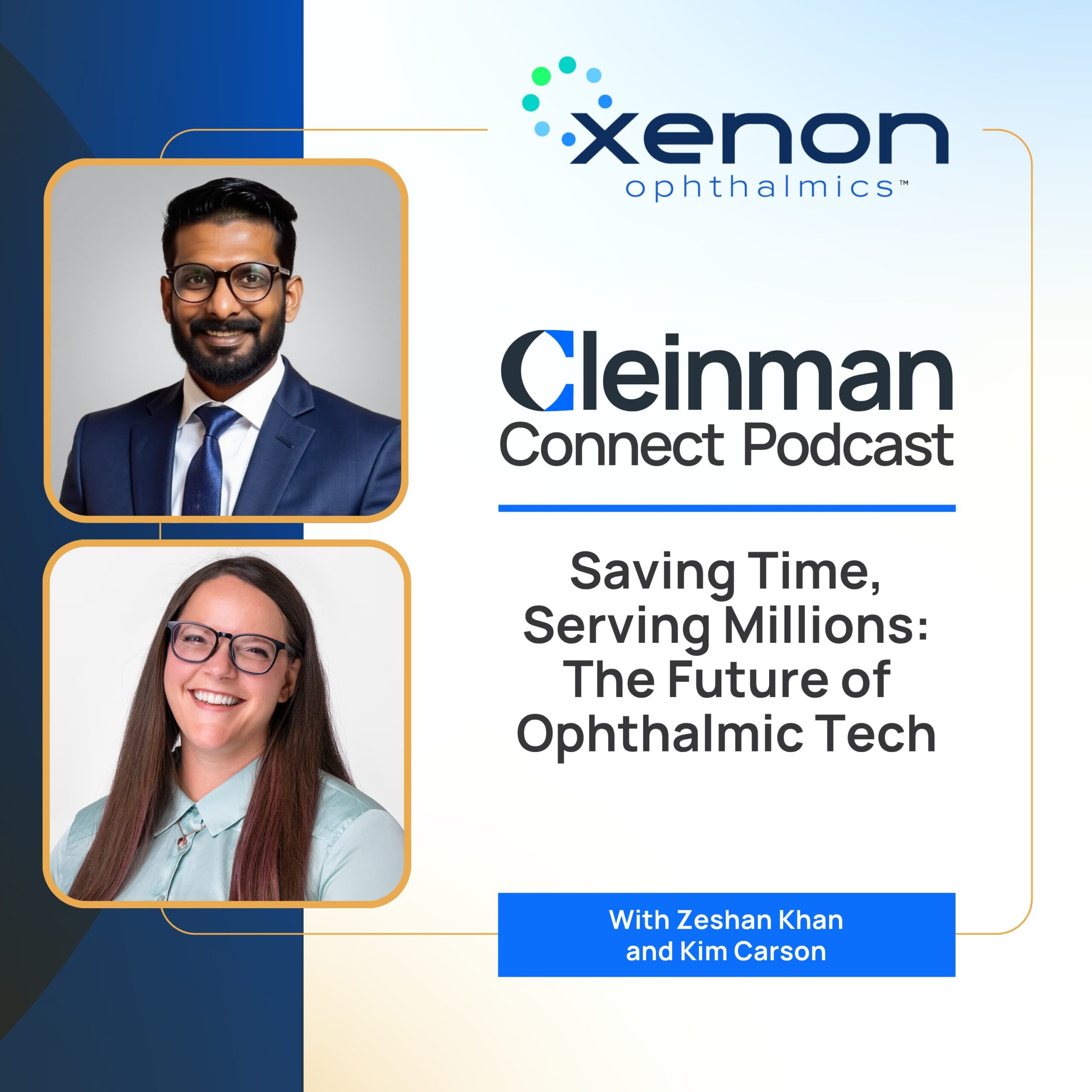
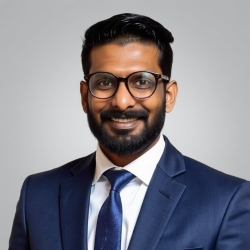
Zeshan Khan is the Founder, President, and CEO of Xenon Ophthalmics, a medical device company developing wearable technology for more accessible eye exams. With expertise in engineering, product development, and regulatory affairs, he leads innovations including the xoLens and xoExam System, which uses patented Liquid Lens technology to combine diagnostic tests in one headset. Inspired by his father’s difficulty completing traditional eye exams, Zeshan works to help providers save time and extend doctor-led care to underserved communities.
Here’s a glimpse of what you’ll learn:
- [2:33] Zeshan Khan’s personal journey and the inspiration behind founding Xenon Ophthalmics
- [6:49] Why portable eye care technology can make serving underserved communities more affordable and accessible
- [11:04] How innovative technology is making eye exams more efficient and accessible
- [15:39] What early testing in South Africa revealed about reducing exam times and reaching more patients
- [22:07] The impact of time savings on practice efficiency and patient care
- [24:55] What a strong sense of purpose means for attracting talent and driving innovation
- [27:21] Zeshan’s advice for balancing business growth with meaningful social impact
In this episode…
Traditional eye exams can be time-consuming, requiring multiple devices and limiting how many patients a practice can serve. In underserved communities, access to this equipment presents an even greater challenge. How can new technology help eye care professionals work more efficiently while bringing quality vision care to more people?
According to Zeshan Khan, an ophthalmic technology innovator with a background in engineering and medical devices, more efficient eye care starts with portable, doctor-led tools. By bringing multiple diagnostic tests into one wearable headset, practices can shorten exams and free up time for more patients. Zeshan points to early testing in South Africa, where a refraction test dropped from three minutes to 30 seconds. With simple training, reliable offline operation, and strong community partners, this approach could help practices improve workflows and extend quality care to underserved areas.
In this episode of the Cleinman Connect Podcast, Kim Carson talks with Zeshan Khan, Founder, President, and CEO of Xenon Ophthalmics, about how innovative technology can save time and expand access to eye care. Zeshan explores streamlined eye exams, doctor-led technology, and reaching underserved communities. He also shares lessons from field testing and advice for building nonprofit partnerships that support meaningful outreach.
Resources mentioned in this episode:
- Kevin Wilhelm on LinkedIn
- Kim Carson on LinkedIn
- Marketing4ECPs
- Cleinman: Website | Network Events
- Zeshan Khan on LinkedIn
- Xenon Ophthalmics
- EyeCare4Kids
- Steve Susanibar on LinkedIn
- “Digital, Traditional, and Best Practices for Marketing in Optometry” with Kate Virzi on the Cleinman Connect Podcast
- “How Digital Awareness Ads Can Influence Your Patients of Tomorrow” with Tyler Kemp on the Cleinman Connect Podcast
Quotable Moments:
- “This problem cannot be solved by one simple company.”
- “Having the operational capacity for the nonprofit is one of the main things.”
- “All of that process that you go through is now built inside of this headset.”
- “That will add value to you daily, and that daily can increase the number of patients for you.”
- “We made that process such a simple way that anybody can learn on that end.”
Action Steps:
- Identify inefficiencies in traditional eye exams: Evaluating how much time patients spend moving between equipment can uncover opportunities to streamline workflows, reduce delays, and improve the patient experience.
- Embrace innovative, doctor-led technology: Integrating portable diagnostic devices can simplify examinations, save valuable time, and expand patient capacity while keeping clinical decisions in the hands of eye care professionals.
- Make eye care accessible beyond traditional settings: Investing in portable, battery-powered technology with offline capabilities can help bring essential vision services to underserved communities with limited infrastructure.
- Build partnerships with organizations that share your mission: Collaborating with established nonprofits that have community trust, qualified professionals, and operational resources can make outreach initiatives more sustainable and impactful.
- Measure time savings to maximize patient impact: Tracking examination times and practice efficiency can reveal opportunities to serve more patients, improve operational performance, and dedicate additional resources to community outreach.
Sponsor for this episode…
This episode is brought to you by Xenon Ophthalmics. Founded in 2019, XO was born from a simple yet powerful belief that everyone deserves access to clear vision no matter where they live. They work to solve the limited access to eye care services by 2.2 billion people globally. High costs of traditional eye exams and inefficient operations, like annual scheduling and frame fitting can waste valuable time, and they work to address these three large issues with their suite of products: the xoExam, xoFit, xoLab.
You can learn more about how they can help your practice and how they’re helping the world at xophthalmics.com.
Powered by Rise25 Podcast Production Company
Episode Transcript
Intro: 00:07
Welcome to the Cleinman Connect Podcast, where we discuss marketing, ownership, growth strategies and everything else surrounding the business of optometry. Cleinman is Optometry’s trusted business partner for over 35 years.
Kim Carson: 00:28
Hello, I’m Kim Carson hosting Zeshan Khan, Founder and CEO of Xenon Ophthalmics. On this episode of the Cleinman Connect Podcast, past guest of the show include Kate Virzi and Tyler Kemp of Marketing4ECPs. You can listen to those episodes now at Cleinman.com or wherever you’d like to get podcasts.
This episode is brought to you by Xenon Ophthalmics. Founded in 2019, XO was born from a simple yet powerful belief that everyone deserves access to clear vision no matter where they live. They work to solve the limited access to eye care services by 2.2 billion people globally. High costs of traditional eye exams and inefficient operations, like annual scheduling and frame fitting can waste valuable time, and they work to address these three large issues with their suite of products. The xoExam, xoFit, xoLab. You can learn more about how they can help your practice and how they’re helping the world at xophthalmics.com.
I am joined by Zeshan Khan, the Founder and CEO of Xenon Ophthalmics. Under Mr. Khan’s leadership, Xenon has developed the xoLens and the xoExam System utilizing patented liquid lens technology. These groundbreaking solutions are the first medical grade wearable headsets capable of remotely writing prescriptions and replacing multiple traditional tabletop devices in eye care practices. His extensive professional experience encompasses, and I wasn’t ready for this list. Startups, medical devices, product development, software engineering. Hardware engineering. Strategic planning, project management, process improvement, medical affairs, FDA regulatory affairs, eye tracking technology and more areas than that, if you can believe it. His passion lies in creating transformative technologies that significantly impact people’s lives, particularly in the field of vision care. Thank you for joining me today.
Zeshan Khan: 02:18
Oh, nice to meet you. Thank you for having me.
Kim Carson: 02:20
Yes of course. Thank you for being on this episode. And honestly, with your extensive resume, I’m interested to. What drew you to found Xenon in 2019?
Zeshan Khan: 02:33
Officially, we founded Xenon in 2019. Unofficially, we founded Xenon before that. There’s always plans. This is a personal passion project for me. I found a Xenon every time I took my dad to an eye care, I’d see how the patient handling was and how patient moving from one equipment to another, equipment, so on and so forth. And more importantly, my dad was in a wheelchair, so half the time, if not all, he would never be able to perform the comprehensive exam. So a lot of times they have to do basic manual exam and send him home.
So during the college I, I’ve seen that multiple times, but that during that time over the year, I guess you can say it was a really stressful. And I decided, you know what, we’ve gone advancement in every industry in a medical sector and I k is the only one still using 100 100 years old technology. So I end up figuring out how do we make this compact? How do we do this? So unofficially part is we created our prototype using existing table top off the shelf VR equipment and realize quickly that it’s going to become a screening device.
It’s not going to be a comprehensive diagnostic level of information that provide a system. So we pretty much scratched that project in 2017. We started writing our own patent, the technology and everything else. And in 2019, when we first brought in our investor, we registered the company. So now you know why.
Unofficially and officially between them. And that’s the reason that.
Kim Carson: 04:10
Something else that, you know, I think that we could have a full episode on the technology, the ability of a lot of the XO products, like what they can actually do. But something extremely interesting about Xenon, the company is that you have very large charity initiatives. When in this startup’s lifecycle, did you realize that that was, you know, kind of a core pillar to what this company would be?
Zeshan Khan: 04:42
I want to reframe the premise. Yeah. So we did not launch separate charity innovation the way we wanted to do. We formed this entire partnership with Ikea as an organization that has been doing work since 2001, and they’ve been serving almost 400,000 children over the years. So their mission, their relationship, that trust that we had and ability to reach that kind of community, we bringing examination and capacity to perform those kind of examining that kind of level of area.
For us, access to care is not something that we decided to support after we successfully. It is the reason why we started building that product. Our traditional eye exam lane contains so much machines and is very expensive. Fixing those and fixing fixing in those. One of these locations require patient to move from so many different equipment.
And meanwhile, apparently, as you mentioned, 2.2 billion people are having an eye problem. So that simply cannot be just eye care professionals to serve everyone through the traditional model. So bringing them on in the way we built it, it helped us out a lot to go faster to provide exam to a lot faster People. I guess you can say a lot of access to those underserved areas. We can provide that.
So these multiple different reasons is the reason why we partner up with them early on while the product is still in a position while we’re about to launch in, hopefully everything goes well. We’ll be bringing that product this year to the industry.
Kim Carson: 06:15
Yeah. Okay. Do you find that there are any like and sorry if this is too blunt of a question, like do you do any like fundraising to be able to provide these units to underserved communities is, is this, you know, we’re talking about like a kind of chicken and an egg situation where XO wasn’t necessarily developed without the idea that it would provide care to underserved communities. So do you need to fundraise or do anything like that to get these units out?
Zeshan Khan: 06:49
Not necessarily. We did that kind of commitment early on. not as a startup. We don’t have the capital that we wanted to divide, as everybody is doing today. Non-Profit point of view.
We have divided capital. So providing Ikea units is critically what internal capitalism capital already exists and we can deploy these units. So in our case that’s simple, straightforward economic for us, like what clinics are already equipped with and what we are going to be adding into the clinics in a faster, smaller compact system. It’s a lot cheaper to deploy through this. Most importantly, it can be done remotely and world country.
You can deploy this in any village all over the world where your doctor is sitting in New York City, for example. That kind that that care that we provide is the most important part as far as do we need to raise fundraising as a company, we’re always raising fundraising. That’s a that’s the nature of the startup. So for this specific mission, we do not. Or depending on the fundraising, this is already been established, already been focused.
What needs to be done to deploy these units. So but we always raising funds. So if you do have investor was welcome to bring those to us.
Kim Carson: 08:05
They’re welcome to hit up your website.
Zeshan Khan: 08:07
There we go.
Kim Carson: 08:09
So you did mention your partner that you have for like the distribution of your equipment for other business owners, maybe looking to start an initiative, whether that is pre their company’s existence or if they already have one and they would like to, you know, hit one of those, those pillars or they, they have this passion for helping others. What would you say would be like a framework to finding the right partner for that? Like you mentioned that yours has trust and started in 2001. So they obviously have storied history of, you know, being a great partner already and you approach them. But was there a certain framework that they needed to hit for you to kind of make that leap with them?
Zeshan Khan: 08:57
Yes. Our requirement was very simple. It was not like you have to be 100 years old nonprofit. Our requirement was simply somebody who is serving in this area, probably population, somebody who’s already had built in relationship to with the community, somebody already qualified eye care professional who knows what exam to serve. So those are the few things we wanted to make sure we had.
You know, having the operational capacity for the nonprofit is one of the main things. If you can deploy this, a thousand of these unit, if they can’t have a capacity to do the examination, they are sitting on a shelf and doing nothing. So these are the few things we wanted to make sure they are matched before we start doing this. And most importantly, one of the things we wanted to make sure what happens if the equipment is not being maintained, reliable, who is referred to patient. How the patients are coming to the doctor.
So all of these how the practice are run. We have to make sure that those are these communities. Is it for kids or other nonprofit who wants to work with us, have those capacity. So considering all of that, we thought these are the best partner that we can work with. So that’s how we frame work, how to find the right nonprofit.
And if, whether it’s a domestic or international, if the nonprofit world is expanding into IC specialty, we would love to have a more partner on this. This problem cannot be solved by one simple company. You have to partner up in order to achieve $2.2 billion. I mean 2.2 billion population over the world to achieve that. So working together is like number one way to start that first process, I guess you can say.
Kim Carson: 10:43
Yeah. Of course. And you mentioned earlier, you know, who is maintaining the equipment. Do they have the capacity to. To actually use it?
You know, will it sit on a shelf? I am wondering how does XO manage training on the technology? Being, you know that some of them are remote locations that they’re being sent to.
Zeshan Khan: 11:04
Yeah. Well, there’s two questions within that. One is how they maintaining the product. And two is how we’re going to train the technicians. So I’ll order in the same.
The maintaining process is very simple. Our internal software is built and determine how we can calibrate. We can rerun the entire system modularized that we can change and update the system remotely. Of course you need to have an internet for that. So our AI, internal AI that is behind the scene, that works, always keeping monitoring the system, how it’s working, how is it doing this?
And that report is given to daily technicians. Hey, this headset is X, Y, Z is issue. So those are how we maintaining and updating the system. Number two, how are we doing the training part. Right.
So actual exam is a platform. It’s not an app you download online and then do so being platform the product you see one behind me. The headset itself has a training built inside for technician built inside for patient, how to utilize the headset or how to conduct x, y, z exam for technician. And if still have an issue, we have on our web portal, which is part of that software where they can log into and to get comprehensive detail, confidential detail of how the system works from A to Z. And if you still have an issue after all this, how to run the training.
There’s an AI built on the website. You can ask 1000 questions and it will answer you how the training need to be done. So we have learned, and that training is one of the most complicated problem when you in onboarding a new product. So we made that process such a simple way that anybody can learn on that end. And doctor doesn’t have to spend hours, if not days, to train their staff member on that.
Kim Carson: 12:58
These like, this is an audio podcast, so I’m careful to not describe too many things or, or be like that thing behind you. But. But you have the xoExam. You have a, a picture of it behind you. So anyone listening, that is what is behind him. That’s what I’ll refer to. What is included in this exam.
Like if someone were to put this on, what would they see? What would happen next?
Zeshan Khan: 13:24
So each exam. So we have almost roughly 15 exam in this the first generation which is going to be launched which will have six focus exams which entails a visual field autorefractor digital phoropter wavefront aberrometry, color vision and so on and so forth. Right. So each test is expertise. So as I want to disclose too.
So nobody’s saying I’m not a doctor. So any of these tests validation what they do. I don’t know what the data looks like. That’s for the doctor to determine. And even Xenon is not even determining what the output is.
We provide information to doctor just like a tabletop equipment does. And as comprehensive as tabletop, we don’t diagnose them. So depends on the practice depending on what doctor is performing, which exams. So if you’re doing let’s say Autorefractor exam, right. And that will do how to get your updated prescription.
A basic one order factor. If doctor conduct that they can do objectively or subjectively within the system. So if doctor decide hey, you know what, I just want to read the result of XYZ patient. I read the results, make sure results are validated, make sure they are perfectly good to expertise level as his or her, and then he or she will write it off. And that’s objectively if they want to do subjectively, which means that the.
They can control the entire system manually. So which means when you’re asking, hey, can you follow lens one lens one better or lens two better? Can you follow this light? Can you do this all? As you are wearing glasses, you understand the process.
All of that process that you go through is now built inside of this headset. So that provide doctor full comprehensive examination process. Same time it gave them full controllability that they are in charge. This is doctor led. So they will it’s up to practices how they want to conduct examination.
We’re not telling them follow this than this. We’re telling them this is equipment. It can do x, Y, z and that’s it.
Kim Carson: 15:27
Okay. And I think recently you were traveling and you, you went to some of the places that have some of these headsets. Do you want to tell me a bit about that experience?
Zeshan Khan: 15:39
We haven’t deployed the product in the market. We did some prototypes. We did take it to other places and showing them, get some validation feedback from a doctor and see how the environment looks like, you know, so I was in South Africa, I believe I was in a mid July and the we wanted to see how it works on area where there is, let alone power, there’s no water. So this is a mission of Xenon is deploying this in the place where you can’t really have a full comprehensive diagnostic equipment level product in those area. And the one we exist in tabletop, nobody can travel with those because the customs kind of block you for months, you know, so having that product, it’s the size of what you can do.
So we put it there out there. We wanted to see how the feedback was, how the, the market in that area, the community, the communities, how they going to react to this. And we tested out a few things. You know, we didn’t do a whole comprehensive, but we did a few things where we took an exam of refraction instead of taking it three minutes. Now you only took 30s.
So those are the things we tested out. And then we decided to see how long does it take to do x, y, z? So we validated it and the feedback from the user was excellent. We comfort accessibility and these. Working with EyeCare4Kids in South Africa, they use things pretty much lined up in our mission, but we wanted to achieve.
So we were able to see how it works. And docked. On the other hand, was the reaction we get from the technician who works there doing volunteer work. They’re like, so if I have five of these, you’re telling me I can do 200 patients a day? I’m like, no, if you have five of these, you can do 1000 patients a day because depending on the test, you can accelerate that.
So the feedback was absolutely more than what I anticipated and beyond what I can measure, I guess you can say it was excellent.
Kim Carson: 17:38
Yeah. Oh, that’s an amazing experience.
Zeshan Khan: 17:40
It was. And you should definitely go there. That safari up there is my God, it’s amazing.
Kim Carson: 17:46
I mean, some of the most beautiful places in the world, right?
Zeshan Khan: 17:49
I was about two feet away becoming a snack. Just say, oh, yeah.
Kim Carson: 17:53
Sorry. By what animal?
Zeshan Khan: 17:55
By lions. There was a whole story. It was beautiful.
Kim Carson: 17:59
Oh my gosh. Yeah. Very scary. I want to kind of dive into some of the, the logistics that you’re mentioning, you know, they need you’re saying there’s a need for Wi-Fi, there’s a need for power. Is that something that Xenon is also looking at helping to contribute to these areas that are getting the, the exams?
Or is that something that like a nonprofit that you’re partnered with is working towards?
Zeshan Khan: 18:31
So we already resolve those issues, by the way.
Kim Carson: 18:34
Okay. Okay.
Zeshan Khan: 18:36
When we, like I said, I, when we looked into this in 2000, early 2000 before pre I guess pre Xenon Ophthalmics. We looked at it. How is this going to work in underserved area. What happens. We looked at it.
I’m an engineer myself and my partner Steve is also engineer. So we like to break things before we make it. So understanding where the power is going to come from. How does the Wi-Fi going to connect? How do you can operate the system without Wi-Fi?
You know, and this is another problem that let alone underserved area. But in USA, in modernized cities where if Wi-Fi is down, the system is down. If power outage down, the entire practice is done. So doctor, have to reschedule all those patients, right? Since Xenon System, we designed this system in a way that even though you have no power, no Wi-Fi, you can still run eight hour completely nonstop.
And that’s because it’s a portable battery operated. We have you can buy multiple battery. You can run it for a whole week without a problem. It’s a wireless. And then also have a power outlet like we have a power if you want to connect it to power?
That’s is there too. Now, talking about Wi-Fi. Our system comes with a dedicated tablet, a tablet that controls the entire headset, which we pretty much to think of it this way. You are sitting in one room, doctor is sitting in his office. He or she will have a tablet.
You just put the headset on and so the doctor will control all of that. The tablet and the headset communicate like a like a handshake process where you don’t require a Wi-Fi. They connect through Bluetooth and you can run all the way. Whenever the system is connected to a Wi-Fi, it will automatically sync online. So there’s a multiple model, so you can call it that comes with it, which each model is advantage for doctor, how they run their practice.
It’s not just oh doctor, pick this. And that’s the only model you get. Now there’s a multiple way we looked at it. What if this happened. This kind of failed.
Doctors are not going to do this. So we’re losing this. Like I said it’s doctor led patient focus. That’s how we put it together.
Kim Carson: 20:41
Yeah. Okay. Perfect. I had no doubts that you already had logistics figured out. I just in my mind, I was like, but what if what if something does happen?
Zeshan Khan: 20:52
Full transparency. I didn’t figure that out. My partner did. I just learned about it.
Kim Carson: 20:57
You know what I there’s lots of plenty of smart people in this world. I am happy to let them be smart and I am happy to learn from them. So I’m glad that you are too. I, I want to know. So I’m very glad that you know, your trip there was fantastic and that you did not get eaten by a lion.
I want to know, are there some metrics that you and Xenon are watching to kind of measure the true impact of what you’re doing, and are there any metrics that you would kind of suggest to anyone trying to start initiatives and their practices as well to hold themselves accountable when they’re when they’re doing things like this.
Zeshan Khan: 21:44
This is one of those things like there’s no quantify metrics right now in terms of that, because the system doesn’t exist. Well, there’s never seen any a solution that doesn’t exist like that, you know what I mean? So it’s, it’s like putting a cart before the horse. The horse before the cart. Sorry, I’m a horrible expression.
So you’re gonna learn that from me?
Kim Carson: 22:04
I think it’s cart. Yeah. Cart before the horse is is the wrong way.
Zeshan Khan: 22:07
Yeah. It took me a second to realize that, but the metric point of view we have looked at justify the metric based on what’s out there in the market and how each of these equipments are working and how we’re going to justify how many patients we can see. So if you’re looking at number of patient metric, how many patients we can see per practice, that is we can’t really increase the number of patients. That’s up to the doctor. What we can’t do is we can save you 3 to 5 minute per exam.
That will add value to you daily, and that daily can increase the number of patients for you. That metric we have determined, and our estimate is simple daily. If I practice 125 to 30 patients a day, right, and we can save two more hours for practice, that means that they can see additional 3 to 4 patients depending on the exam, depending on what is the procedure, whether it’s a short exam, long exam, comprehensive exam. Again we don’t determine that doctor do. So if you can give a doctor back two hours a daily that is five days practice ten hours.
And you do the math metric on that. So that’s an ROI. Doctor can get right away. That’s the number of patients. They can see more.
So we have determined metric on based on that value and how do we quantify that. That’s the question everybody’s going to ask me. And it’s simple. We looked at what traditional tabletop equipment cost in terms of time, how long it takes. And then we took our equipment and did the exact same thing.
So like I was saying earlier, three minute exam to do a refraction we did in Africa. Now we do it in 32nd. So we just saved two minutes and what two minutes and 32nd for a patient. Now that right there is a metric that we can validate and we can quantify. So I don’t have exact broad number.
What’s a metric on scalability looks like yet. But our idea is to get patient at least 2 hour to 2 hours back and let them increase the patient value. Let them go out, do the outreach more. And one of our product that does that is actual Iris, that pretty much help doctor to book an appointment via schedule appointment to all of that.
Kim Carson: 24:17
Okay. Thought of everything.
Zeshan Khan: 24:20
It only took us ten years.
Kim Carson: 24:21
That’s fine. Yeah. Great things take time. Yep. So, you know, talented and obviously very intelligent individuals work at Xenon and increasingly so we’re seeing that, you know, people who have tremendous skills like that, they don’t want to settle.
And they want to work for companies that have a clear sense of purpose. Do you think that having a clear global mission has influenced Xenon’s ability to recruit innovative minds, these engineering minds that you clearly have on your team?
Zeshan Khan: 24:55
To be honest, that that may. That was the easiest job of recruiting people. And that because what we are doing and, and we, we recruited people from this industry. They’ve been trying to get their hands on it. I’ve I’ll tell you a funny story. In the beginning when I created this, I always asked, doctor, what if you can do an exam in third world country?
Like, I’d love to do a mission trip, but how do I take a day off? I mean, a whole week off? And then on top of that, how do I take all my equipment? Because I’m going to go there. There’s no equipment.
What’s the point of me going there? Right? So that was one of the biggest challenge I’ve noticed. And when we built this, when we gave give them this idea, okay, this is what Xenon is trying to achieve. And this is our goal and a mission is the recruitment become relatively easy.
They understand, okay, now they can do a mission trip while they’re sitting home with the family, and yet they see almost 30, 40 patients in an hour in Africa, for example. So that’s from a doctor’s side. That’s from my advisory side, our people that we brought in, we have generally interested what Xenon is trying to accomplish. And most importantly, we have distinct ourselves really well, that we are not a VR, as you notice in industry or we are, I care a lot of VR companies are in there. So because of that, doctors understand that we are not just giving them a screening tool, we give them a comprehensive device which they control.
That means they are the leader of this industry, just like Xenon motto is doctor led. So because of that recruitment from doctor recruitment from engineers, it become relatively easy. If you ask me. I think that was my easiest job I am doing in Xenon. So yes, it’s very easy.
Kim Carson: 26:37
Amazing. Well, I have you know, I have just a couple more questions for you in our wrap up. I would like to point people to your website again. It’s xophthalmics.com. If they want to see all of the many suite of products that you have.
So I would love to know for the own, the owners of practices listening who maybe want to build a social good initiative in their operational blueprint from day one, or they want to add one. Now, what would be the single biggest lesson that you’ve learned in the pre 2019 years, the, the imagination years of Xenon that you’ve learned about blending profit with global purpose?
Zeshan Khan: 27:21
Well, it is just so you know, it’s, it’s very good to have separate profit and model. They don’t work together the way most people envision. The first thing is cutting a back order and having everyone in the organization knows about it. That’s the transparency we do in Xenon. What how the system with the capital and startup work is now practice owners.
The question is not whether what is the cost exploding? It is whether how does the practice do better than anyone else in within 20 miles? And how do you find like who is not nearby, right. If they want to do an initiative like this, they can simply figure out the cost analysis itself, how much it is and expand on it. Now, the other thing about, you know, in terms of blending them together, they always you have to determine what the, what exactly your mission is in terms of that.
And then you, based on what you’re already doing as a doctor, you’re trying to get out there, you want to help our kids. That means you have to sacrifice a day or two or weekend from your family. If you have kids to go out there and do the initiative. And then as you grow, you can bring people like, like I’ve been doing in Xenon. There’s a lot of people in the world.
I truly believe that I want to do good and generally so blend them good people with a decent resources together, you can do a very good thing in the world.
Kim Carson: 28:49
Okay. And perhaps a sillier question to end on, but if you were to pay $10,000 for an eye exam, steep price, I know, what would you expect to be included in that exam?
Zeshan Khan: 29:06
That depends. What exactly am I getting? AM I going to pay $10,000 for a visual acuity exam that says no? AM I going to pay $10,000 for glaucoma surgery? Depends where I’m getting it.
What detail is behind it. So yeah, it depends on what it is. They are Doctor Who deserve $10,000 because their level of education they have received. And the perfectionist. I mean, I don’t want anybody who’s not trained doctor poking my eyes.
So $10,000 is a steep price, but depends on what exam I’m performing.
Kim Carson: 29:41
You know what I think that that and it depends answer. And maybe it would have to involve a surgery and you would not pay $10,000 for an eye exam. I mean, I mean $10,000. I mean, what if, you know, what if a helicopter was going to pick me up from my house and take me to my exam? I would pay more than $200 for that exam.
Zeshan Khan: 30:03
We talk about transportation. This is different. You said exam. So if there’s a helicopter I have that’s part of the exam. You’re right.
I might pay for that.
Kim Carson: 30:12
Maybe we’re a little more interested. Yeah. Okay. Well thank you so much for joining me today. And that is our show.
If you’d like to hear more of the podcast, you can at Cleinman.com and wherever you like to listen. And thank you so much for joining. Is there anywhere you would like to direct people to go and find out more about Xenon?
Zeshan Khan: 30:35
The simple answer is Google it. It’s type Google Xenon Ophthalmics. You’ll know everything about us, what we’re doing, how we’re doing it. And it’s a it’s all over the world nowadays. But I appreciate your time.
Thank you for inviting me. And it was a. It was a fun, lovely talking to you and I look forward to seeing you next month.
Kim Carson: 30:54
Yes. I’m very excited to see you at the Cleinman Performance Network Event. Thank you so much for your time.
Zeshan Khan: 31:01
Thank you.
Kim Carson: 31:01
Thank you.
Outro: 31:06
Thank you for listening. At Cleinman, we take pride in helping our partners unlock their full potential. Subscribe to get the newest episodes or visit us anytime at Cleinman.com.