
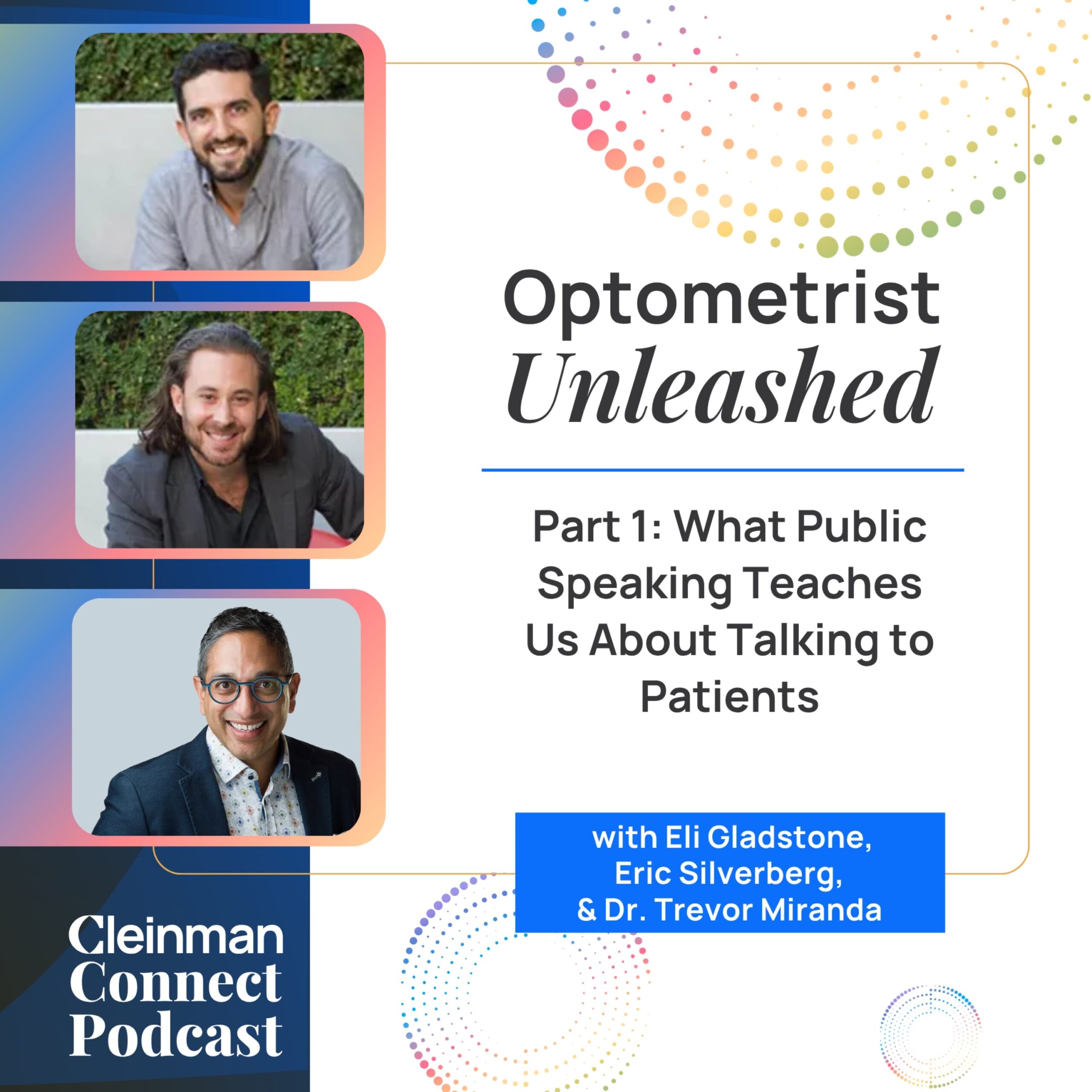


Eli Gladstone and Eric Silverberg are the Co-founders of Speaker Labs, a public speaking training company that helps professionals and enterprise teams communicate with greater clarity, confidence, and impact. Since launching the company in 2016, they have trained professionals and teams at leading companies, including Shopify, Google, TD Bank, and RBC. Both began their careers as faculty members at the Ivey Business School before gaining experience in tech startups. Drawing on backgrounds in teaching and business, Eric and Eli lead workshops focused on presentation skills, storytelling, delivery, mindset, and executive presence, helping professionals overcome speaking anxiety, engage audiences, and communicate effectively in high-stakes situations.
Here’s a glimpse of what you’ll learn:
- [2:33] Eric Silverberg and Eli Gladstone’s mission to help strong ideas win through better communication
- [4:10] How Eli’s “protector” and “projector” mindsets shape confidence, risk-taking, and performance under pressure
- [8:14] Why vocal, physical, and pacing variety can keep audiences engaged and avoid monotony
- [10:55] Eric’s approach to grabbing attention, building confidence, and using storytelling and creativity to bring ideas to life
- [14:29] What clarity and emotional resonance can teach optometrists about more memorable patient communication
- [17:40] Reading audience reactions, resisting unnecessary pivots, and treating public speaking as one-to-one communication at scale
- [22:42] Applying one-to-one public speaking principles to virtual meetings and creating real connection
In this episode…
Optometrists often explain complex information to patients who may be anxious, distracted, or overwhelmed. Public speaking techniques can help make those conversations clearer, more engaging, and easier to remember. What can public speaking teach doctors about connecting with patients?
Public speaking experts Eric Silverberg and Eli Gladstone explain that effective patient communication starts with clarity, emotional connection, and intentional delivery. Rather than overwhelming patients with too many options or details, they recommend identifying the most important message and communicating it in a way that gives the words meaning. Eric and Eli also emphasize varying tone, pacing, and body language, while treating communication as a one-to-one exchange even in larger settings. These principles can help optometrists make recommendations more memorable, build stronger patient connections, and communicate with greater confidence.
In this episode of Optometrist Unleashed, a Cleinman Connect Podcast, Dr. Trevor Miranda sits down with Eric Silverberg and Eli Gladstone, Co-founders of Speaker Labs, to discuss what public speaking can teach optometrists about talking to patients. Eric and Eli explore clarity, emotional delivery, and one-to-one connection. They also share ways to manage speaking anxiety, avoid monotony, and make messages more memorable.
Resources mentioned in this episode:
- Kevin Wilhelm on LinkedIn
- Dr. Trevor Miranda on LinkedIn
- Marketing4ECPs
- Cleinman
- Eli Gladstone on LinkedIn
- Eric Silverberg on LinkedIn
- Speaker Labs
Quotable Moments:
- “It’s not just about how you speak to the crowd; it is about how you speak to yourself.”
- “Your projector looks at those stakes in a whole different way because, yeah, you might fail.”
- “Clarity and emotion are probably the two biggest things that I think span all kinds of communication contexts.”
- “How you look at the stakes is really the differentiator between the world’s best speakers and everyone else.”
- “Storytelling is just part of what we teach in our program because people really struggle to master storytelling, mostly because of the stories they tell themselves.”
Action Steps:
- Focus on clarity in every conversation: By narrowing your message to the most important point, you increase the likelihood that patients understand, remember, and act on your recommendations.
- Connect your message with emotion: Adding emotional meaning to your communication helps people remember what you say and creates a stronger connection with your audience.
- Shift from a “protector” mindset to a “projector” mindset: Recognizing limiting thoughts and embracing growth-oriented thinking can help you communicate with more confidence and presence.
- Use creativity to bring ideas to life: Incorporating stories, analogies, metaphors, and examples can make your message more engaging, memorable, and meaningful.
- Speak one-to-one, even in larger groups: Treating communication as a series of individual conversations helps you build stronger connections and better understand your audience.
Sponsor for this episode…
This episode is brought to you by Marketing4ECPs.
Working with them is like hiring a full-time marketing professional who knows the industry and understands your goals. Except, instead of one experienced marketer, you get a whole team in your corner.
Whether you’re an optometrist, ophthalmologist, or optician, they can help you grow your business with a plan that’s completely customized for you. Learn more here.
Powered by Rise25 Podcast Production Company
Episode Transcript
Intro: 00:00
Welcome to Optometrist Unleashed, a Cleinman Connect Podcast with Dr. Trevor Miranda. A monthly doctor led discussion about everything surrounding the business of optometry.
Dr. Trevor Miranda: 00:16
Hi, everyone. Welcome back to another episode of Optometrist Unleashed, a Cleinman Connect Podcast. I’m your host, Dr. Trevor Miranda, coming to you from beautiful Vancouver Island. And today we’re talking speaking how daily communication can be the most feared challenge. Why that is and how the great guys behind Speaker Labs, Eric and Eli, are working to change that.
This episode is brought to you by Marketing4ECPs. Working with them is like hiring a full time marketing professional who knows the industry and understands your goals. Except instead of one experienced marketer, you get a whole team in your corner. Whether you’re an optometrist or ophthalmologist or optician. They can help you grow your business with a plan that’s completely customized for you. Learn more at marketing4ecps.com.
Well guys, I’m so excited. Today I’m joined by Eric and Eli, who started Speaker Labs in 2016, so they could focus all of their time and effort around two of the two of the things that they value most communication and teaching. They both began their careers as faculty members at the Ivey School of Business. My son’s there right now, where they were fortunate enough, and their students were fortunate enough to have packed classrooms every day where they lectured.
It was during this time they fell in love as best friends, of course, but also with teaching, helping each other and helping others turned out to be a life passion realized. After teaching, they took a few years to explore the world of tech startups, as all good millennials do, and notice how communication is pervasive not only in the classroom but in all areas of business. It was clear that expressing ideas confidently and clearly was a common challenge, and they gravitated towards helping others over that all too common hurdle. They took a leap, a leap that turned their passions into a company. And Speaker Labs was born.
Hey, welcome, Eric and Eli. So glad to have you guys.
Eric Silverberg: 02:22
Thanks for having us, Trevor. We love chatting with you. This should be fun.
Eli Gladstone: 02:26
Yeah. Good to be here.
Dr. Trevor Miranda: 02:27
Yes. I want to ask you, you know, what is Speaker Labs? What’s your mission? What are you guys trying to accomplish?
Eric Silverberg: 02:33
We’re trying to make people amazing communicators in a really tight nutshell. But really it’s we found Eli and I that it’s not always the best ideas that get adopted and that get buy in, in business. And that’s a problem. It should be the best ideas that always win. But it turns out it’s often the best communicated ideas that win.
And so it’s our mission to help people become better communicators and to level the communication field so that the good ideas start to win out when everyone’s communicating well. And I mean, you know, Eli and I have both been through our own sort of journeys as communicators. Ours are a little bit different. We can go into that if you want, but I’m someone personally who used to really suffer public speaking. I was terrified of it.
I sucked at it. I would lose a ton of sleep the night before a big presentation. And so one of the goals behind my passion, which is helping people become amazing public speakers, is to rid people of that suffering that I’m so intimate with, because I used to be a sufferer myself. Public speaking can be really scary.
Dr. Trevor Miranda: 03:37
Yeah, absolutely. And I know I’ve taken your course actually twice. I’ve taken 2.0 Speaker Labs. And quite frankly, this is not hyperbole. It’s it’s been life changing in a lot of ways.
And I’m we’re going to dig into that. Why? But I wanted to ask you, Eli, you know, to explain this protector projector mindset, because a fear of a lot of people is going blind. But really close up there is speaking in front of a room full of strangers or an audience where they’re on stage and people are looking at them.
Eli Gladstone: 04:10
Yeah, I think people always look at public speaking as being an activity between a person and an audience. But that overlooks just how much of communication happens between you and yourself and your own mind. And Eric and I realized that pretty early on for ourselves, and it became quite a core tenant of what we try to help people understand is that it’s not just about how you speak to the crowd, it is about how you speak to yourself, especially when you’re in front of the crowd. And the crowd tends to be something that amplifies a lot of these inner barriers that we all face. And the the realization we had is that it tends to trigger a certain pattern of thought in people.
When you’re in front of a crowd, whether it’s a super large crowd, 5000 people, 10,000 people, a reasonably large crowd, 500, 100, or even a really intimate group of 5 to 10 people. When people start communicating under pressure, these patterns of thoughts start to emerge and they tend to constrain you. And we realize that a lot of that constraint is a protective mechanism. And so we call it your protector, because ultimately, there’s this huge part of you that’s trying to just keep you safe, and it views the crowd as a threat. And we need to stay safe when we’re in front of that threat.
But then we also recognize that there’s this other part, these other patterns of thought that emerge in people which are really growth oriented, which push you forward and embrace discomfort and embrace uncertainty and embrace the potential for judgment and failure. And we call that the projector part of your mindset because you’re projecting everything forward and you’re pushing forward. And so we start to try to get people to recognize both parts of themselves and start to have a little bit more agency into which part is governing their decisions, their experience, and their actions when they’re in front of a crowd.
Dr. Trevor Miranda: 05:53
Yeah. Something I learned from you guys is to take stock of what the stakes are. And what you mean by that is, you know what’s at risk here. Should you bomb? And kind of I’ve really translated that to my golf game, so I.
I have an anxiety in my backswing guys. It’s a bit tough to watch. Especially on the first tee. And I think what, what I’ve done is really reduced the stakes and say, hey, what’s the worst thing I bomb it. My friends laugh and I shoot a breakfast ball.
So it’s really calm myself down in a lot of areas in the past that I tended to feel this anxiety and grip the club harder and more times than not talk myself into failure. So do you guys want to add to that, Eric, a little bit about that sort of the stakes, aren’t they quite exaggerated? A lot of ways by people.
Eric Silverberg: 06:47
Yeah, 100%. And I think that what Eli just spoke about is a good foundation for that conversation too, because the stakes in public speaking are real. But you can look at those stakes through the lens of your protector. Or you can look at those stakes through the lens of your projector, and your protector is going to tell you things like, if I fail, my career is over. If I fail, everyone in this audience is going to hate me.
It might even tell you things leading up to that big presentation like, I don’t have what it takes. I’m gonna suck. There’s no way I can do this. I’m not good enough. I’m not smart enough.
There’s no way I’m going to be able to meet the moment. But your projector looks at those stakes in a whole different way because, yeah, you might fail. And yeah, it would be better to succeed. But the truth is, you’re going to be fine either way. And when you start to see it with that lens, your likelihood of succeeding becomes a lot greater because you’re going to be freer to think, you’re going to be freer to express, you’re going to become the more confident version of yourself that has more executive presence.
When you’re in front of whoever it is you’re in front of. So yes, the stakes are real in public speaking. Everyone wants to crush it. How you look at the stakes is really the differentiator between the world’s best speakers and everyone else.
Dr. Trevor Miranda: 07:58
Yeah, absolutely. You know, I went to a conference in Milan on Dry Eye and I was thinking, gosh, I wish you guys had taught those speakers how to keep me awake and entertained. And I think we what I learned at your course was don’t be monotone. Eli, can you explain what you mean by that?
Eli Gladstone: 08:14
Yeah, I think I mean, it’s really simple stuff. The funny thing about public speaking is that it’s not rocket science. It’s not calculus. It’s really basic. And to be a really great communicator, you got to start doing basic things that more and more advanced levels.
And one of the basic tips to be an effective communicator is to not be flat. You can’t let your audience just bore and fade out. You got to maintain attention. You got to captivate. You got to hold them.
And in order to do that, you have to avoid that all too common monotone. And something that is a little bit funny is people think monotone is really just robot voice, but anything can be monotone. You can be monotone with your volume, you can be monotone with your pacing. You could be monotone with your gestures. Even somebody who.
If you picture a person on a stage who’s pacing back and forth from the right side of the stage to the left side of the stage, it can almost lull people. And this idea of monotony, it applies to everything that we do with our vehicle of communication called our body and voice. Every element of body and voice can be monotonous. And what we try to do is we try to help people recognize just how much of a fatal flaw it is when you fall into that monotony, and how the opposite of it, the variety, creates so much more engagement and so much more emotion, and so much more meaning to the words that you’re sharing. And then the hard part is not understanding it.
It’s doing it. And that’s where people run into that protector, those inner barriers that keep them small and keep them in that zone of safety, which tends to correlate with monotony versus actually pushing them to move forward and actually use the skills that are available to them in the moments that matter. So we try to help people understand the monotony. We try to help them understand the opposite. And then most importantly is we try to get them to do it, to actually start putting their money where their mouth is.
Dr. Trevor Miranda: 10:01
Yeah, 100%. I know, Eric, when you get, you’ve got a way of welcoming everybody to your sessions and what do you, what do you do there? Eric you, you just get up and be loud, right?
Eric Silverberg: 10:14
Yeah, I yell, I yell, I put my arms out really wide. And I smile really big and I yell, good morning or good afternoon. If we’re running an afternoon session or good evening or running an evening session. But yeah, that’s what I do. Why do you have questions about that?
Dr. Trevor Miranda: 10:29
No, I just think you grab people because you, you vary things and I, I think boring, you know, that’s the fear of every public speaker as well is they don’t want to be boring. I think one of the things you taught us too, is we’ve a story in there so that the story becomes part of the thesis that you’ve made. But it brings people in. They want to hear what’s happening. Can you tell me a little bit about storytelling in public speaking?
Eric Silverberg: 10:55
Yeah for sure. I’ll take a step back and and I’ll answer maybe both questions, because I do think there was a bit of a question underlying that, how I start our presentations. And I want to be clear that I start my presentations with a huge yell for a dual purpose. I’m doing it for the audience in that I want them to be engaged and I want them to capture. I want to capture their attention, and I want them to feel my excitement.
But I’m also doing it for myself. Starting a presentation with something really extreme is a great way to shock yourself into projector mode, to shock yourself into confidence. And it doesn’t need to be a yell. In fact, Eli does the exact opposite when he starts speaking. He starts with a really long silence, but a silence much longer than you can possibly imagine.
And that silence is actually just as extreme as my yell, but doing something really emphatic and really extreme with your delivery, with your body and voice to start your presentation. It tends to have this dual benefit. It engages your audience and it shocks your system into a more confident mode because you’re proving that you have the power of control. But yes, storytelling is another thing that folks should do when they’re public speaking. And I want to be clear about storytelling.
Storytelling is like the biggest buzzword in business today. You need to scroll LinkedIn for about 12 seconds to realize that storytelling is just a big topic and a big thing, and every business needs a story, and you need to change the story you tell yourself, and you need to tell other people more stories. But really, what we find when it comes to public speaking is that story is just one mode of creativity, and creativity is the route. Creativity is the pattern that you really need to recognize as valuable in public speaking, because you can tell people an idea or you can bring ideas to life with creativity, and creativity can look like analogies or metaphors or examples or thought experiments or stories. And I wouldn’t necessarily say that any of those things are better than any others.
I think an analogy can be as good of a story, but under it all, you need to bring your ideas to life. If you want your audience to feel those ideas, to remember those ideas, and to be more engaged along the way. All of our favorite public speakers, they’re the ones that use some of that creativity throughout their talk. So yes, storytelling is amazing, but the truth is any creativity is really good. Storytelling is just part of what we teach in our program because people really struggle to master storytelling, mostly because of the stories they tell themselves.
Yes, storytelling is awesome. Creativity is an underlying perspective is even more awesome.
Dr. Trevor Miranda: 13:43
Yeah, totally. You can do it in different ways. Yeah. As you said, you know, I want to pivot to what optometrists do. A lot of optometrists are listening to this podcast and representatives from industry as well.
And it’s like we’re on stage, you know, one on one we’re delivering. 15 to 25 minute keynotes daily to distracted or anxious patients or parents. You know, I wanted to talk. What, what do you guys think the best way to go about being impactful with each patient is? It’s different than public speaking, where we don’t necessarily get a feedback mechanism.
But what do you guys think, Eli? I’ll throw that to you. What do you think optometrists can do to kind of be a more impactful. So patients remember this experience and what we told them in fact.
Eli Gladstone: 14:29
Yeah, it’s a good question. There’s a lot of focus on the differences between, let’s say, a one on one conversation and a high stakes one to many presentation. And there are obviously differences, but there are a lot more similarities as well. It’s sort of like swimming. If you know how to swim in a pool, you can swim in an ocean.
And sure, there are differences. You might not be able to touch the ground in the ocean. You might have some bigger waves. Maybe it’s salt water instead of chlorinated water. So there are some differences, but there are a lot of patterns that emerge across the size of, of the body of water you’re in.
And the same applies in communication. So when I think about what I would tell someone as they’re speaking in smaller, more intimate contexts, it’s the exact same stuff that I would tell someone who might be preparing for a high stakes, one to many scenario with some slight nuance. The two biggest things that I would say for somebody in a smaller context are one, clarity is critical. It’s so common for people to share so many different things. The receiver of the communication loses the plot, loses the thread, and can’t even maintain all of that information in their working memory, let alone their long term memory.
So it goes in one ear out the other type of thing. When you have a really clear message, when you are so zoned in on the thing that you want the other person to get, you increase the probability of them actually getting value. So I would say instead of five treatment options, with a long winded explanation of each, and then three additional decisions that the patient might have to make. What’s one thing you want them to do? That’s probably going to increase the likelihood that they do something and you can treat them over time.
But you got to recognize that clarity really is the single most critical piece to having people get value from a communication. And the second thing I’ll say is there’s the age old quote from Maya Angelou, which is people don’t remember what you say. They remember how you made them feel. So I’ve got like a slight tweak on that, which is people do remember what you say. They just remember what you say differently based on how you made them feel.
And so in a one on one context, maybe you’ve got a really clear message or a really clear recommendation that you’re trying to share with a person. That’s awesome. But if you say it in a way removes all of the emotional meaning of those words, then it loses its resonance and it loses its impact. So whether you’re 1 to 1, 1 to 5, 1 to 10, 1 to 10,000. I don’t care about the scale.
If you aren’t clear on what you want someone else to get, they’re not going to get anything. And if you deliver it in a kind of way that loses all of the emotional meaning, they might get something, but it might not be what you intend for them to get. So clarity and emotion are probably the two biggest things that I think span all kinds of communication contexts.
Dr. Trevor Miranda: 17:14
Yeah. Thanks for that insight, Eli. Eric, I wanted to ask you, have you ever been speaking in public or witnessed a public speaker that pivoted based on the feedback of the audience? So, you know, you’re losing them and you need to snap them back or, or something was happening and you had to weave a story in to get them back or change tone or quick pick up the pace based on what you’re feeling from the audience. Any thoughts on that?
Eric Silverberg: 17:40
I think it’s a dangerous game to play, if I’m being honest with you, is feeling something from your audience and completely changing course based on that feeling. Trevor, let’s try a little experiment, okay? Think of a number between 1 and 1000 and give me a thumbs up when you’ve got it. Okay. Okay.
It was 967, wasn’t it? Of course it wasn’t, because I can’t read your mind. And I think people decide that when they’re in front of a crowd, that they have developed this mind reading superpower. But of course you have not. You’re trying to read the faces and the reactions of your audience, but it’s impossible to know what they’re really thinking.
Are they yawning? Maybe that’s you. And maybe they didn’t get any sleep last night. Are they checking their phone? Maybe it’s you.
Or maybe they got a really important message about their kid who just got injured at school. Trying to read your audience is actually part of what makes public speaking so hard. Because in a one on one dialogue, I can just ask you how you’re feeling and I can ask you if you’re distracted. And we can have a dialogue that allows me to adjust and iterate based on what I hear from you. But trying to just read an audience is a really dangerous game.
It’s impossible to know what they’re thinking. The very first client that Eli and I ever had was a marketing tech company in Toronto called Uberflip, and it went really well. So much so that they started to bring us in year after year to train other to train other cohorts of people at their company. And I remember it was like our seventh year into training this company. And we had this one cohort, and it felt like they absolutely just despised the program and that they despised us.
They weren’t asking questions. It was a virtual program. They weren’t turning their cameras on. They looked bored. They looked unengaged, just shooting us like death stares.
And I remember I called Eli at lunch and I was like, what’s going on? Did we lose our magic? Why do they hate us so much? And we slogged through the rest of the day beating ourselves up. And then we sent that group of feedback survey.
And to date, that was the highest feedback scores we ever received to that point. And it taught us retaught us a really valuable lesson that trying to read your audience is a fool’s errand, so you’re much better off just giving it everything you’ve got and sticking to your plan, and then hopefully asking for some real feedback in a way that’s actually effective once it’s all said and done. That said, we have seen amazing public speakers that go in without a plan that just run, you know, fireside chats or they don’t have a slide deck, and instead they have a whiteboard and they’re asking for audience involvement. And, you know, what do you think today? Would you rather me talk about storytelling?
Or would you rather be talking about body and voice? And they’re ready to pivot because they’ve got such a great knowledge to the topic they’re speaking about, and they know how to think in a way that’s always going to be clear and creative to the points that Eli and I were talking about earlier. So we’ve seen people that are amazing at that because they have these amazing mental blueprints, but we don’t recommend that people change course just because they got a death stare. That death stare could mean so many different things.
Dr. Trevor Miranda: 20:48
Yeah. That’s interesting. I mean, I guess that’s your protector speaking too. If you surmise that the audience is not paying attention, you know, for me, I like to make eye contact with a safe friend of mine. And that’s my safe place where they’re paying attention.
I’m like, hey, I’m gonna look at you a lot. And I tell them in advance, just smile and nod and make me feel better. So that’s, I don’t know what you guys think about that.
Eli Gladstone: 21:11
Yeah, I think that’s awesome. And I think it’s useful for you as a speaker. I think what’s even more useful, if I were to, if I were to push you a little bit and try to offer you something that might be even more powerful for you is recognize that even though we call public speaking a one to many activity, it’s actually 1 to 1 times, however many people are in the room. And what I like to do, and I would encourage you to do is don’t just single out the person who you know, who you’re comfortable with to get that little affirmation from them in subtle facial reactions, speak directly to one person at a time and really speak to them. And even though you’re the one talking and they’re the one listening, you’re in communication with one individual at a time.
And what I find happens in that scenario is you actually glean a lot more value from each individual person’s reaction to you at any moment in time than you do trying to read the crowd as though it’s a single entity. So I highly encourage everybody to speak directly to individuals. And even if you have an audience of 5000 people, you can still pick out individuals in the crowd. And even if you have spotlights in your face, you’re in that kind of keynote situation because some people find themselves there and you cannot see the crowd. It’s almost like, imagine that there’s a human sitting right over there and you’re talking directly to them, and you can’t see their face, but you’re piercing their soul through their eyes and then pick a different area and focus there.
It’s really valuable to speak 1 to 1 times many rather than one to many.
Dr. Trevor Miranda: 22:42
Yeah. You kind of answered what I was going to talk, you know, during Covid, we all discovered Zoom, which we’re on now and how we can connect still, if you have the right mindset, right. And you are speaking 1 to 1. So that’s really, really great insight.
Outro: 22:58
And that is unfortunately where we will have to leave you for this week. Please tune back in next week where we get the rest of the podcast with Eric and Eli of Speaker Labs with Dr. Trevor Miranda on these special episodes of Optometrists Unleashed, a Cleinman Connect Podcast. And next week, we will get into what public speaking teaches us about talking to patients and actually applying it to being in the exam room. In the meantime, if you would like to hear more of the Cleinman Connect Podcast, you certainly can at Cleinman.com or wherever you’d like to listen.
Outro: 23:34
Thank you for listening. At Cleinman, we take pride in helping our optometrists unleash their full potential. Subscribe to get the newest episodes or visit us anytime at Cleinman.com.