
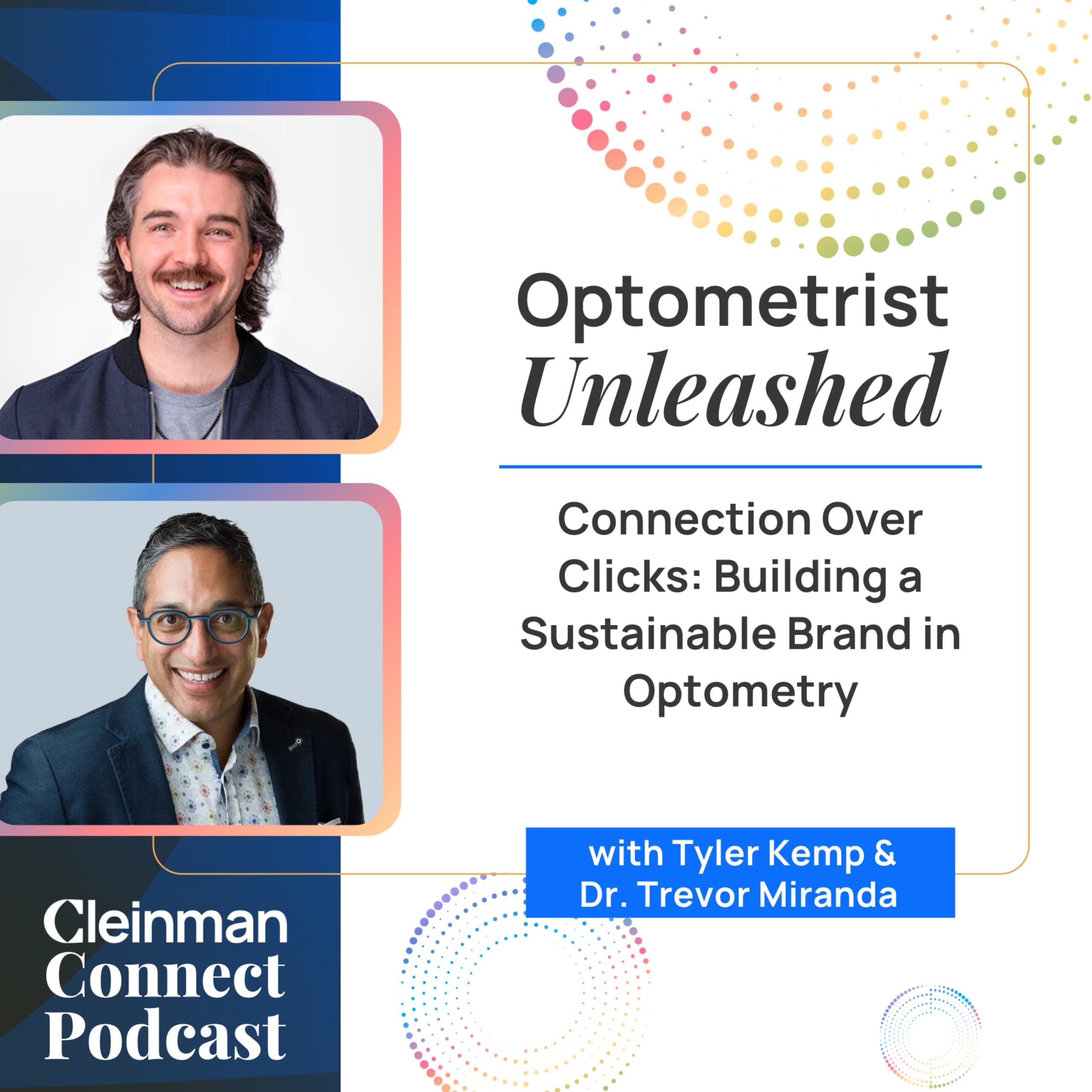

Tyler Kemp is the Client Success Lead at Marketing4ECPs, an agency helping independent eye care practices grow through digital marketing and branding. With more than a decade of marketing experience, he helps optometrists uncover what makes their practices unique and build lasting patient relationships. Tyler has presented at Vision Expo, sharing practical insights on personal branding and marketing performance. He also hosts 4theRecord, a video podcast exploring eye care marketing, industry trends, and creative approaches to growth.
Here’s a glimpse of what you’ll learn:
- [01:30] Tyler Kemp’s advice for new optometrists looking to stand out through authentic personal branding
- [04:54] How consistency and clearly defined core values help build a recognizable brand over time
- [11:58] Why venting about patients online can damage trust and undermine your practice’s reputation
- [14:58] Tyler’s advice on using a trusted sounding board to maintain consistent messaging across audiences
- [19:42] What to consider when choosing the right social media platforms for your personal brand
In this episode…
Patients often encounter an optometrist online before they ever sit in the exam chair. An active social media presence can draw attention, but it takes more to earn lasting trust. How can eye care professionals build a brand that feels genuine, both online and in person?
Optometry marketing strategist Tyler Kemp believes trust starts when patients get to know the person behind the title. Sharing interests, motivations, and personality gives people a reason to connect beyond promises of great service. Tyler urges doctors to align personal brands with practice values, so patients recognize the same person online and in the exam room. Before posting a trend or joke, consider whether it fits those values or could undermine patient trust. Focus on a few content themes, get feedback on questionable posts, and use one or two social platforms where your audience is active. Authenticity works when it’s consistent.
In this episode of Optometrist Unleashed, a Cleinman Connect Podcast, Dr. Trevor Miranda chats with Tyler Kemp, Client Success Lead at Marketing4ECPs, about building an authentic optometry brand. Tyler explores how new doctors can stand out, why practice values should guide online content, and how consistency earns patient trust. He also shares tips on vetting posts with a sounding board and choosing social platforms that fit your audience.
Resources mentioned in this episode:
- Kevin Wilhelm on LinkedIn
- Kim Carson on LinkedIn
- Marketing4ECPs
- Cleinman
- POD Marketing
- Tyler Kemp: LinkedIn | Instagram
- 4theRecord
Quotable Moments:
- “I truly believe in the phrase, ‘People choose who they trust, and they trust who they know.’”
- “It has to be those individual pieces that are so unique to your practice.”
- “These core values need to be extremely clear and repeated consistently.”
- “I’m sure it might get some clicks, but at what cost?”
- “You don’t need to be everywhere; be authentic in one or two places, and that’s going to be enough.”
Action Steps:
- Build an authentic personal brand: Sharing your personality, interests, and unique experiences helps patients connect with you beyond your professional credentials and builds lasting trust.
- Align personal branding with practice values: Ensuring your messaging reflects your clinic’s core values creates a consistent patient experience and strengthens your practice’s reputation.
- Prioritize authenticity over social media engagement: Focusing on meaningful content instead of chasing likes and clicks protects patient trust and attracts people who genuinely connect with your brand.
- Maintain consistency across online and in-person interactions: Demonstrating the same professionalism, personality, and values in every setting reinforces credibility and strengthens relationships with patients.
- Choose social media platforms that fit your audience: Concentrating on one or two relevant platforms allows you to share valuable content consistently without spreading your marketing efforts too thin.
Sponsor for this episode…
This episode is brought to you by Marketing4ECPs.
Working with them is like hiring a full-time marketing professional who knows the industry and understands your goals. Except, instead of one experienced marketer, you get a whole team in your corner.
Whether you’re an optometrist, ophthalmologist, or optician, they can help you grow your business with a plan that’s completely customized for you. Learn more here.
Powered by Rise25 Podcast Production Company
Episode Transcript
Intro: 00:00
Welcome to Optometrist Unleashed, a Cleinman Connect Podcast with Dr. Trevor Miranda, a monthly doctor-led discussion about everything surrounding the business of optometry.
Dr. Trevor Miranda: 00:15
Welcome to another episode of Optometrist Unleashed. I’m your host, Dr. Trevor Miranda. Today we’re going to talk marketing and any questions I have about marketing and marketing yourself, creating your own brand. We’re going to have our guest Ty from Ty Talks Marketing and POD Marketing with us.
Today’s episode is brought to you by our sponsor, Marketing4ECPs. That’s like having your very own team behind you, not just one person, a whole team to create a marketing plan and enhance your business, to grow your business.
We’re pleased to have Ty with us today right from marketing for peace. We’re actually at the home of marketing for Peace in Calgary doing this live. And if you’ve ever been here. Never been here. You’ve got to come. What a great building. What a great setup. Ty. Great to have you.
Tyler Kemp: 01:06
Thank you so much. It’s a pleasure to be here.
Dr. Trevor Miranda: 01:08
Yeah. Ty, I want to, you know, we have at our clinic three new doctors. Two of them are new grads. And what I want to know from you is how does a new grad. Market themselves to the community and to the practice when there’s all these experience.
Let’s call it clinicians that suck up a lot of the oxygen in the room.
Tyler Kemp: 01:30
When it comes to standing out as a doctor when it comes to standing out as a new grad and kind of making your entrance into that patient care side of things. It’s the same thing that I would recommend to any practice. Looking to stand out from the other 1015 optometrists that your patient has to drive past to get to you. It is not just about we offer great customer service. We are taking a little bit of extra time with all of our patients, and we have a great frame selection.
As soon as those three things get mentioned, it is so you’re the same as every other practice. It has to be those individual pieces that are so unique to your practice. It’s the same thing as an optometrist. I truly believe in the phrase people choose who they trust and they trust who they know. And the only way that you can actually get to know someone is to delve a little bit into what makes you you.
Now, that doesn’t mean filming everything that goes on at your house and doing a full Bravo documentary show on yourself. But it is letting people in a little bit to. What makes you a person. What is behind the title of doctor? What made you interested in this in the first place?
What are your specialties? Those pieces are so crucial to actually creating that personal brand. And what I see as successful people on social media, or even just creating their own websites, trying to build their own brand. There’s just that unique personal aspect to them and what I’ve believed since getting into this industry seven years ago. There is almost nothing more personal than an optometry appointment, because that is someone looking deep into your eyes and seeing the future of your health and what’s going on with you currently.
That is a really impactful piece for people, especially when the target audience is you’re trying to bring in parents with kids so that you can help support the kids from early in their life and set them up for a great future. That’s something that cannot be overlooked. That sense of trust and actually getting to know your optometrist and feeling like you know them a little bit more. That is so crucial. So when it comes to brand and building that, it is letting people in to what makes you a little bit different?
Not just what specialty you’re interested in, because the ordinary person on the street, they’re not coming in and saying, this guy’s a myopia master. That’s why I’m coming into him. It’s. This guy has a personality that I vibe with and that I want to bring my family to.
Dr. Trevor Miranda: 04:05
Yeah. So you got a couple agendas that may conflict at times where you’ve got the practice at large trying to advertise and get patients in to see all of their doctors. Then you have specific doctors that are trying to fill their own book in your clinic. So to your point, making them, getting them out there on social media, showing their personality off both, you know, in and outside of the clinic and trying to attract patients to that vibe, to have them book with them is really, really great. Right?
Is there other things that you find in the community when you’re out and about that? I always say, hey, listen, you’re the best advertisement out there. You’re walking advertisement and carrying your card with you, interacting with everybody and just being brave enough to let them know you’re a new optometrist in town is really, really important. Do you have any other suggestions on that?
Tyler Kemp: 04:54
Well, for one, it takes time. It is not done. In the first six months of walking in somewhere, you you brought up tie talks marketing. That’s my Instagram account that I started four years ago. This was the first conference last week at Ncte where I actually introduced myself to a ton of people, as you do networking at a conference.
And I had four people whose response was, yeah, I know, I follow your Instagram account or yeah, I know, I watch your podcast. And that was extremely validating. It’s always great to know that the kind of content you’re putting out to that specific audience is being noticed. But I have hundreds of posts that we’re recording at this point, probably about 12 full length episodes of the podcast. This isn’t new.
So this is sticking to a dedicated brand over time and continuing to post content or just represent that brand consistently over time, but giving information and giving an experience that people find value in. One thing that I don’t want to get away from. And you made a really good point that there is kind of a two pronged approach to this is that you are typically a part of a practice and the, the agenda and the brand of that practice. But you’re also an independent optometrist looking to build your own brand and fill your own schedule and build that. That is where the importance of the core values of your business comes into focus so much.
We’ve been talking a lot about core values from our subsequent company. Cleinman. And one of the pieces with core values is that everybody will say, every business owner I’ve ever talked to will say, yes, of course we have core values. And I said, that’s amazing. What are they?
And it’s funny because very few people will be able to list the 4 to 5 core values, that those are the center point of their business. Everything goes back to if we’re making a decision, if we’re giving a certain level of customer or patient service. Do they relate back to the core values? And if a business owner can’t name what their core values are, how do you expect the optometrist and the team members to really lean in to the same things? So that is so crucial that when you have new doctors coming in, if you want them to find their own voice and drive people into your practice because they want to come see them.
But you also want to make sure that those are very aligned with the goals and values of your business. It can’t be forgotten about that. These core values need to be extremely clear and repeated consistently. So we actually do that at our staff meetings, every staff meeting. It starts with naming our five core values.
And for us, it’s teamwork, integrity, positivity, initiative, and excellence. Everything we do is based on those five core values. And what’s very cool is we’ve actually leaned into nominating each other for representing our core values. So we give out what’s called love notes in our Slack channels. And every time that someone does something really cool, it goes a little bit extra for a client or does something internally that’s really help someone.
The nomination comes through as, hey, I wanted to nominate so and so for positivity, I wanted to nominate so and so for excellence. So everyone leans into the same thing. And when I kind of started building my own personal brand as a person at Marketing4ECPs, those core values are at the center of everything that I try to promote for myself too. So it is actually impactful for, for ECPs too, because if people come in having met me, it’s not a surprise when they get here what kind of values our agency has because we’re very aligned in that sense.
Dr. Trevor Miranda: 08:43
I think that’s great. We have an onboarded our new doctors as well, and part of that is putting them through our what our culture is. We made a culture book with you guys, our core values. What does it mean to be a trustworthy optometrist and a clinic, and what is authenticity and all those pieces? So I think that you, you hit it right there. Be consistent with your own personal brand and the big practice brand, right?
But don’t be afraid to be vulnerable and, and let people in the door. You don’t need this inauthentic persona. And I think that speaks to a lot of people too, is it’s okay to have, you know, share some of your worries and your inner thoughts. But I think also it’s important to be consistent with the professionalism and the excellence that we bring in the clinic. So, you know, be careful who’s watching is what I say and curate your content within the broader context of the practice and their values and their, their missions and all those type of things.
Tyler Kemp: 09:44
The same reason that you wouldn’t have every frame where brand available in your optical boutique. If you’re focused on everything, you’re focused on nothing. And so I’ve seen some of the some of the best opticals that I’ve walked into. You can tell the theme and the vibe and the feel, right when you walk in there, even if there’s only ten brands that are really highlighted, those ten brands really tell a story that way. And it would be very strange to toss a brand in that didn’t really relate at all to the rest of it, because you start to go, okay, what is this place?
It’s the same kind of concept when you’re creating content for yourself online, or even if you’re showing up at conferences and representing yourself as a new body. If you’re focused on everything, you’re focused on nothing. So having those kind of those pillars that you focus on, having those things that you always kind of tie back to, and you ask yourself, if I post this, will it benefit one of those main pillars? Will it benefit one of those core values that I’m trying to represent? And if it doesn’t, don’t post it because it’s very easy to get off that track just for the sake of.
Well, this might get me seen more. This might get me more clicks or more likes or views or shares. But if it’s inauthentic, then what? You’re going to bring someone in to see you based on their understanding of something, and then they get there and their experience is different. You want a great way to lose trust with patients.
Be different than who they believe they were coming to see, especially when their family and their loved ones are involved. It just never works out. It’s a volume play instead of a quality play. And that’s so crucial.
Dr. Trevor Miranda: 11:18
100% I like what you’re saying there. And I wanted to run this by you. You find some online optometrists or other doctors or other health care practitioners and they’re complaining about the patient. They’re throwing shade at the patient. And I just think that is so counter to the brand that the office is presenting.
So they’re just stream of consciousness, some frustrations, you know, hey, guess what? It’s frustrating at times to deal with the public, but I don’t think you need to vent here and you might get a few laughs, but I worry about what that means in the broader context of the brand of the office. There’s no consistency there. So I think you’re saying exactly that. Don’t do it.
Tyler Kemp: 11:58
So it’s actually funny. And I’ll be authentic because it’s just you and me talking. Don’t worry. There’s not a bunch of people listening. Yeah.
When we were at our Cleinman conference a few weeks ago, we all know what conferences are like. They’re extremely busy. You start early in the morning, you finish late at night, and it’s full of knowledge the whole day. And by the time you get back to your bed at night, you’re exhausted. Your mind is so full.
You’ve been talking to people. It is. It’s very fulfilling, but it’s very tiring. And I had seen a trend online of people showing the time, the downtime that they have at conferences. And I made a reel when we got back from one of the events at Cleinman before we went out for dinner.
And it was that time between conference and dinner, and it was me walking into the hotel room, lay down on the bed, and three seconds later, standing back up, grabbing my coat and walking back out the door. And from a comedy perspective, sure, it might have got a few laughs, but I paused before actually posting that because my first initial thought was, okay, I’m doing this for the laugh because I saw the trend, but how it could come across is that I wasn’t having fun at the conference, and that I wasn’t getting a lot of value out of it. And what paused for me was I’m like, this feels inauthentic. Like, I’m sure it might get some clicks, but at what cost? That people believed that I didn’t just enjoy the day of learning that I was at, and that I’m not excited to go out for dinner and, and get to talk with people like yourself.
It just, it, it immediately stopped me and I went, this isn’t my core value be it isn’t what I actually believe. I’m just doing it for clicks and it’s just inauthentic. So I scrapped it. I didn’t post it. Could it have gotten me some followers?
Sure. But at what cost? Someone thinks I’m different than the way that I actually intended to be. So I feel that very wholeheartedly. And I cringe when I see content being posted about patient complaints or oh, don’t you hate it when you get this type of patient in?
It’s kind of like, well, these patients are trusting you. They are trusting you with those things that they don’t know. They’re not familiar with things. So they might have those silly questions. But to them, that’s really important.
So I’m completely aligned with you on that sense. No, I love that.
Dr. Trevor Miranda: 14:11
And I love that, you know, that’s the word. It’s cringe. I’m the same way. I always think, oh, I’m a Gen X or maybe I’m too old for this social media stuff, but I just think, hey, be authentic and don’t throw shade and make fun of your patients that you’re trying to attract in. It’s counter to the marketing that you’re trying to do.
So let me ask you this. Let’s say you’re branding yourself a young lady that’s out there and you want to also have an audience of other oads, other optometrists that are you’re going to get laughs too, but you’re worried about being inconsistent. Would you suggest having some team or trusted people in marketing to bounce reels off of beforehand so they kill it if it’s counter to the core? Maybe AI, maybe the Council of Five can help us in that, I don’t know. What do you think?
Tyler Kemp: 14:58
Yeah, I think it’s important to have a sounding board for sure. I think it is. It is very challenging to have multiple audiences that you’re talking to. I’ve ran accounts like that before, and it is a very challenging brand exercise to say this is my audience, but this is also my audience. And if they don’t intersect super well, it can seem odd if you’re posting for one and not the other, because it’s not going to be accepted by 50% of your audience.
So finding that, finding that balance in between, it’s not impossible, but it’s definitely a challenge. And so yeah, having a team that you can bounce ideas off of, its consistency.
Dr. Trevor Miranda: 15:40
Right. I think that’s the key is be knowing who you are, what you want to be, and, and being reflective in everywhere that you do that online in the office. I’ll tell you a story. I was in Las Vegas on a boys trip one time. I was checking in and someone said, Doctor Miranda.
And it made me realized that you are Doctor Miranda, wherever you are, especially in Vegas. And you know, people are watching you. And so you need to be consistent with what you are and who you are everywhere you are. And I think that’s part of marketing the consistent approach. Understand who you are and be that person and be consistent so that there isn’t this conflict of people trying to figure out what they get from you.
It’s not a cracker Jack box with a prize that you don’t know what’s happening. It’s something you’re buying into a consistent approach, a trusting person that you can understand, that gets you. And so I think that to me, that personal branding is it’s it’s all the time. It’s ubiquitous. You are your personal brand.
You just have to know who you are. And you have to be that in real life and online.
Tyler Kemp: 16:46
My favorite example of that was Jarome Iginla, who used to play for the flames, and he was widely regarded in the media as such a nice guy and a great leader and a great captain. And I remember that I got to go in the back of the Saddledome. It’s our final year at the Saddledome. It was very exciting for Calgary Flames fans, and I got to see him as a kid, and he signed everyone’s autographs. And before he left, he actually paused and said, did everyone get all the photos and autographs they wanted?
Whereas a lot of players just kind of kept walking through. He didn’t. He stopped and did that. And it would have been very odd if he was one of the players who walked back through, because what you see in the media, what you see on the ice, if it didn’t reflect that impacts everything. Even if you’re having a bad day, it downgrades the authenticity that you have and that is so crucial to you.
Run into someone in the hotel room. If you were there in your Hawaiian shirt, kind of walking around stumbling with a drink in Vegas, that changes things pretty, pretty thoroughly. So there is that importance of if you are going to build a public persona, if you are going to be in a profession like optometry, where you are selling yourself, you are selling your knowledge, you are selling your sense of care. It’s important to know that whatever you’re doing, it needs to lean into that. And that’s why when I hear people say like, the best way not to get caught in a lie is just simply to tell the truth.
It’s that reality that if you build a persona online that isn’t you, and then people meet you and you have to think about, how do I act in this situation? Well, that’s the greatest way to become inauthentic like that 100%.
Dr. Trevor Miranda: 18:24
I actually think too, you know, in your office, a lot of doctors are working in their dark room in the back. They come out front. And nowadays, patients at large, there’s patients you saw last week, these patients maybe saw a couple years ago. Now they’ve seen another doctor in your office. They’re all looking at you to say hi and be acknowledged.
Don’t hide from it. You know, we have a five foot greet rule. If you come within five feet of somebody, you’re going to greet them and look at them. So I think again, it’s just because otherwise you don’t want to be let down like Jarome Iginla story. You said, hey, this is a famous person.
Well guess what? You’re the famous person in your practice and you need to like echo that brand everywhere despite the stresses. Guess what? Jerome wants to catch the bus or get back to his team in the dressing room. He’s taking that time out.
When you see your patients at large, just pretend you saw all of them. Even if they’re seeing other doctors in your clinic and have that interaction with them, don’t ignore them because they want to feel that brand that you’re putting out to the universe all the time. So, you know, just think of it like you’re in Vegas, but you’re in your own office. Everybody’s watching. Be authentic.
Be yourself all the time.
Tyler Kemp: 19:31
Love it. Completely agree.
Dr. Trevor Miranda: 19:32
Anything else? Any other tidbits you want to add in that we should think about with branding, especially when it comes to personal branding and how you’re going to be consistent, I.
Tyler Kemp: 19:42
Think that it can be very easy to get lost in all of the channels that you can be on. Yes, we know that social media is becoming and has become a major research tool for people. That doesn’t mean you need to be on every single social media channel. Actually, to go back to the potential conflicting or different audiences that you might have as an odd if you’re talking to your professional colleagues, that’s where LinkedIn can be a really, really powerful tool and you can get a little bit more focused on the technical side. You can talk about some of the specialties you’ve been getting into, some of the things that might not interest patients as much, because I don’t particularly know how many patients are looking for their optometrist on LinkedIn.
However, from a patient side of things. I still believe fully in Instagram. I think it is such an accessible platform to talk to people. The stories versus the post gives you different ways to be a little bit more polished, a little bit more authentic, and really just knowing where your particular audience is. And, you know, you might be on Facebook, you might mirror kind of what you’re doing on Instagram, depending on the age and demographic of the patients that you’re trying to talk to.
Facebook skews a little bit older, Instagram skews a little younger, but really just when you’re trying to promote your professional brand, it doesn’t need to be that complicated. If you are someone who is very research based, you really want to share articles and podcasts that you’ve listened to. LinkedIn might be the place where you just lean into because trying to make that kind of vibe and that brand fit on something that is a platform that doesn’t really fit that, like Instagram and Facebook, it might just seem a little more inauthentic. It might just come across kind of strange, but if you are trying to share some of your humor and your personality and earn that that way, that’s where the kind of little bit less polished and a little bit more authentic side of Instagram might be the best place for you. So it’s not just the brand that you want to put across, it’s also the best place to put that brand.
But you don’t need to be everywhere, be authentic in 1 or 2 places, and that’s going to be enough.
Dr. Trevor Miranda: 21:55
Yeah, I think that’s great advice.
Well, thanks. I want to thank you for joining us here at Optometrist Unleashed, and we look forward to the next episode. Thanks again to our sponsor, Marketing4ECPs. That’s marketing4ecps.com for all your marketing needs. Until next time.
We’ll see you soon.
Outro: 22:14
Thank you for listening. At Cleinman, we take pride in helping our optometrists unleash their full potential. Subscribe to get the newest episodes or visit us anytime at cleinman.com.